









Want personal coaching while still training with other people? Semi-private personal training gives you both.
The simple answer is: find the right training partners, set your goal, choose a good coach, and follow a program suited to your level. At YR Fitness, we often see this setup help people train together while progressing individually.
As an Exercise Physiology & Biomechanics Expert, I work closely with exercise technique, resistance, and training progression. I’ve seen that semi-private training works best when each person gets the right weight, exercise adjustments, and coaching for their own ability.
Below, I’ll show you seven simple steps to get started. Use them to find a setup that keeps your training personal, organized, and easy to follow.
1. Understand What Semi-Private Training Is
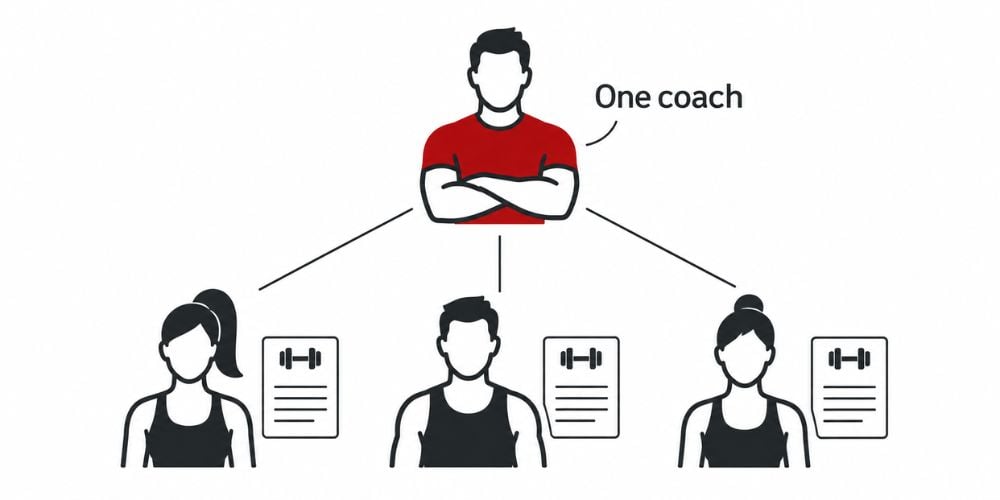
Semi-private training usually means one coach works with a small number of people at the same time.
It is different from a large group fitness class.
In a normal class, everyone may follow roughly the same workout. In semi-private training, you can still have your own:
- Exercises
- Training weight
- Sets and reps
- Progression
- Technique adjustments
For example, two people may both use a leg press, but one may use 40 kg while the other uses 80 kg.
Do you need the same fitness level?
No. You need a coach who knows how to adjust the workout for each person.
That individual adjustment is the important part.
2. Choose the Right Training Partners
You do not need to train with your strongest friend.
Choose people who make it easier to show up consistently.
Look for training partners with:
- Similar schedules
- Similar commitment levels
- Compatible personalities
- Reasonably similar training goals
Your strength levels can still be completely different.
I often tell people that consistency matters more than matching strength. A reliable training partner who shows up every week is more useful than someone who trains exactly like you but regularly cancels.
Already have two or three friends who want to train regularly?
You may already have the start of a good semi-private group.

3. Set Your Own Fitness Goal
Before your first proper session, decide what you want from training.
Your goal might be:
- Getting stronger
- Building muscle
- Improving general fitness
- Managing body weight
- Improving exercise technique
- Becoming more confident in the gym
Do not simply copy the goal of the person beside you.
One person may want to build muscle while another wants to feel stronger in daily life. You can use many of the same exercises while changing resistance, training volume, and difficulty.
The latest American College of Sports Medicine resistance-training guidance emphasizes matching the training plan to the person’s goal rather than making the program unnecessarily complicated.
Not sure where to begin?
Pick one clear goal for the next 8–12 weeks instead of trying to improve everything at once.
That gives you something simple to measure.
A good semi-private setup needs equipment that different people can adjust quickly without slowing down the session. At YR Fitness, we design our commercial strength and cardio equipment for repeated daily use and different user setups, so you can explore the equipment range if you want to see the types of machines commonly used in structured gym training.
4. Find a Coach Who Works With Small Groups
Not every good one-on-one trainer is automatically good at semi-private training.
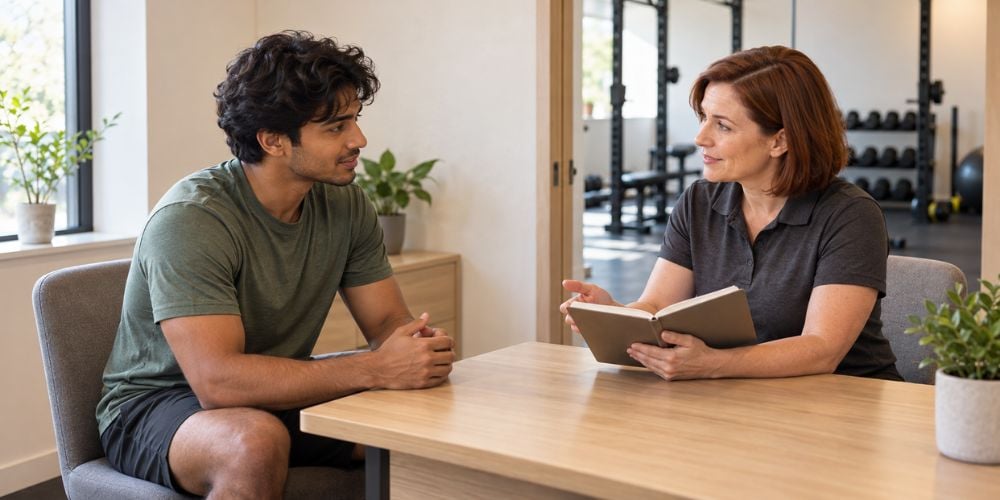
The coach needs to watch several people without making anyone feel ignored.
Look for someone who:
- Check your technique
- Adjusts exercises when needed
- Tracks your progress
- Explains what you are doing
- Keeps the session organized
- Gives each person enough attention
Ask how many people normally train in each session.
A smaller group generally makes individual coaching easier.
I would also ask one simple question:
“Will I have my own program, or does everyone follow exactly the same workout?”
That answer tells you a lot.
If everybody must copy exactly the same exercises, weights, and progressions, the session may be closer to a group class than truly semi-private coaching.
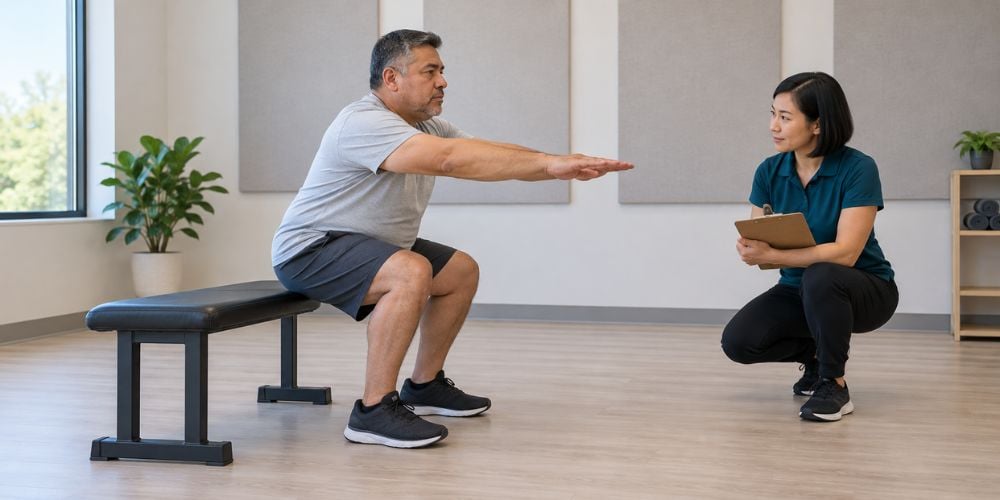
5. Complete an Initial Assessment
Your first session should not immediately become a heavy workout.
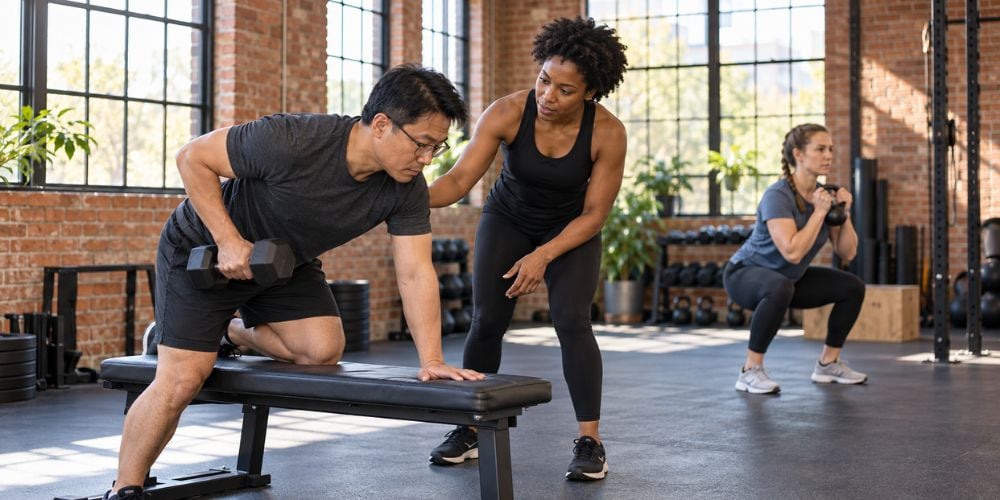
The coach should first learn about you.
This may include:
- Training experience
- Current fitness level
- Previous injuries
- Exercise limitations
- Main goals
- Exercises you already know
- Movements that feel uncomfortable
The assessment does not need to be complicated. It simply gives your trainer a starting point.
I often see beginners benefit from this because it stops them from selecting weights based only on what someone beside them is lifting.
Be honest during the assessment.
If something hurts, feels awkward, or makes you nervous, say so.
It also helps to look at your overall activity, not just the semi-private sessions. Current U.S. Physical Activity Guidelines provide evidence-based recommendations covering both aerobic and muscle-strengthening activity.
6. Learn the Main Exercises First
You do not need dozens of exercises when starting.
Learn a few basic movements properly.
Movement | Example Exercise |
Knee-dominant | Squat or leg press |
Push | Chest press |
Pull | Seated row |
Vertical pull | Lat pulldown |
Shoulder work | Shoulder press |
Isolation/accessory | Cable exercise |
Conditioning | Bike or treadmill |
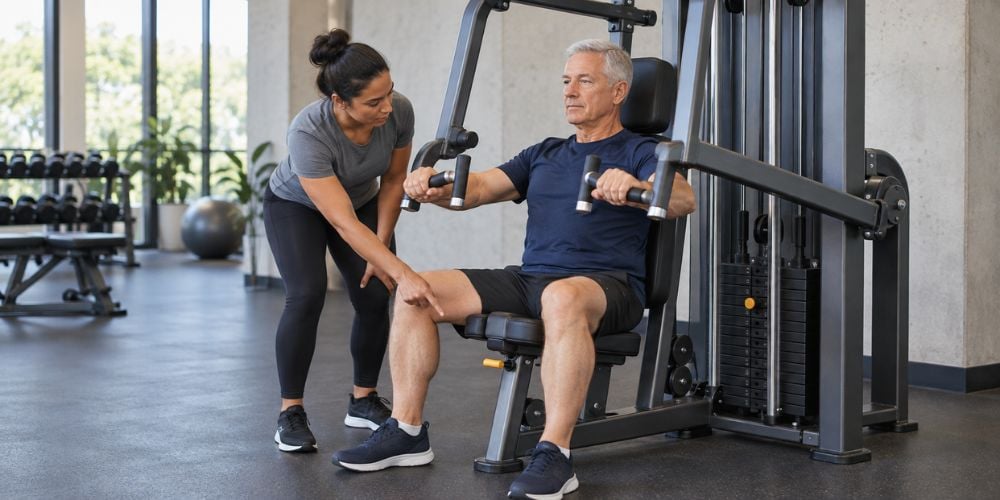
Focus first on setup and control.
Can you adjust the seat correctly? Can you control the weight through the full movement?
Those basics matter more than using complicated exercises.
What about cardio?
You can include that too.
The CDC‘s adult physical activity guidance recommends at least 150 minutes of moderate-intensity aerobic activity per week and muscle-strengthening activity on at least 2 days per week for adults aged 18–64.
Your semi-private sessions can therefore be one part of a wider weekly activity routine.
7. Follow Your Own Weight and Progression
This is one of the most important parts of semi-private training.
Do not copy someone else’s weight just because you are training beside them.
Your resistance should match your own ability.
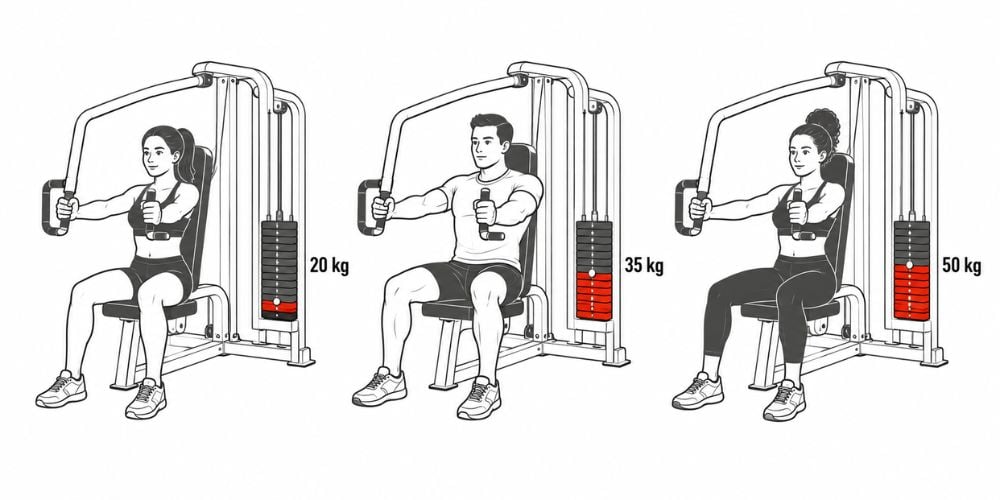
Person | Exercise | Weight |
Trainee A | Chest press | 20 kg |
Trainee B | Chest press | 35 kg |
Trainee C | Chest press | 50 kg |
All three people can perform the same exercise while using different resistance.
Here is why this matters.
If 20 kg is challenging for you with good technique, using 50 kg just because someone else can handle it does not make your workout better.
Increase your weight when the current load becomes manageable with good form. You can also progress by:
- Adding repetitions
- Improving movement control
- Increasing training volume
- Using a harder exercise variation
ACSM’s current resistance-training guidance also emphasizes gradual progression and consistency rather than relying on unnecessarily complicated techniques.
I prefer this approach because progress becomes easier to measure.
You are trying to improve your previous performance, not beat the person next to you.
Conclusion
Starting semi-private personal training is simple: choose reliable training partners, set your own goal, find a coach who gives individual guidance, complete an assessment, learn the basic exercises, and progress at your own pace.
You still get the motivation of training with other people without giving up personalized coaching. The key is remembering that sharing a trainer does not mean sharing the same program.
If you also want to see the strength, cable, and cardio machines commonly used for structured training, explore the YR Fitness commercial equipment range and compare the options that fit the way you like to train.
Related articles:



