





Do members often wait for benches, racks, cable machines, or treadmills during peak hours? Long waits can quickly hurt the workout experience.
The fix is simple: find the busiest equipment, add capacity where needed, improve the layout, and give members more exercise options. You do not need more of everything.
At YR Fitness, we design equipment for heavy daily use, which gives us practical insight into what helps gyms handle peak-hour traffic.
Below are the simple ways to reduce equipment waiting. Start with the areas causing the biggest queues.
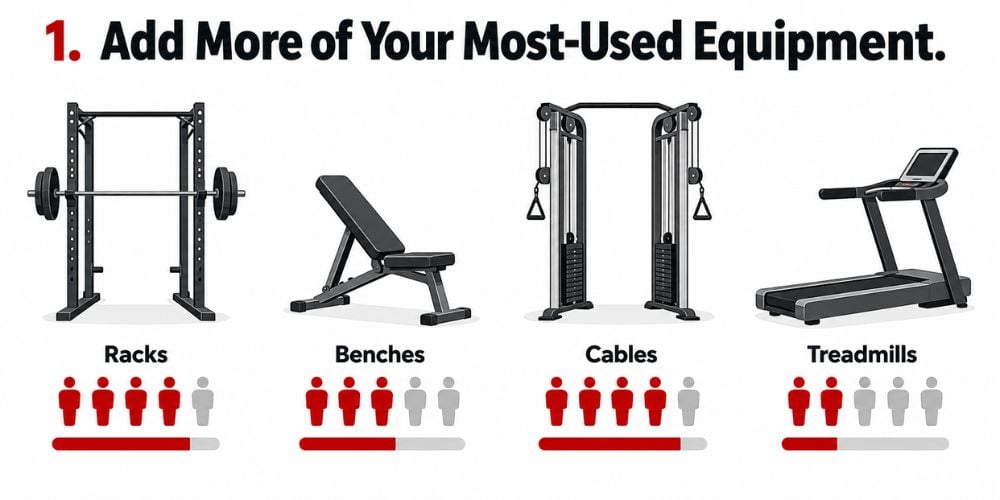
1. Add More of Your Most-Used Equipment
Start with a simple question: What are members always waiting for?
Walk through your gym during the busiest periods. Look for equipment that stays occupied and stations where members regularly form a queue.
Common pressure points may include:
- Squat racks
- Flat and adjustable benches
- Cable machines
- Leg press machines
- Lat pulldown machines
- Treadmills
- Smith machines
You do not need equal numbers for every machine.
If you have six rarely used machines but only two benches that members constantly wait for, the equipment mix may be the real problem.
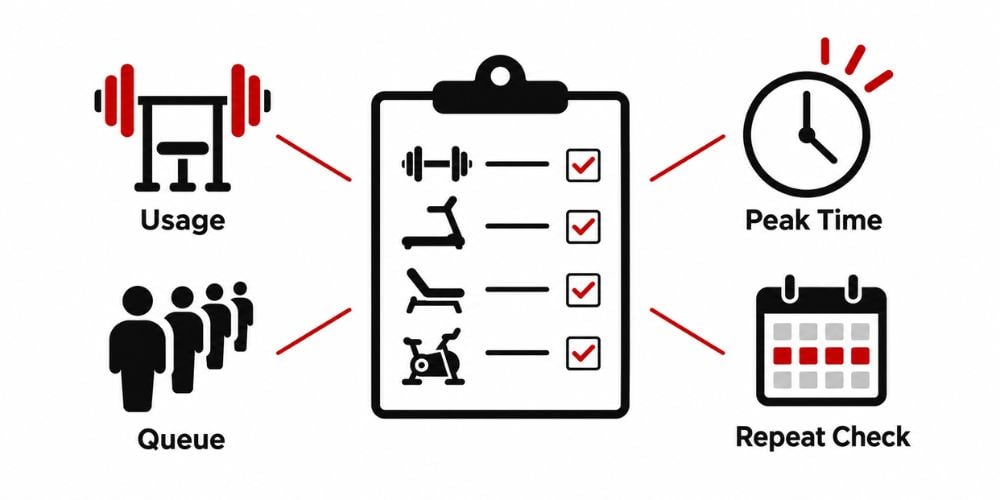
What should you track?
You do not need complicated software at first. A simple usage check for one or two weeks can tell you a lot.
What to Track | What It Tells You | What to Do |
Machines with regular queues | Where demand exceeds capacity | Consider adding another unit |
Equipment that stays occupied | Which stations carry the most traffic | Prioritize them in your next purchase |
Rarely used machines | Where floor space may be wasted | Relocate or reconsider that equipment |
Time of each queue | When congestion is worst | Plan staffing and peak-hour rules |
Repeat bottlenecks | Problems that are not temporary | Invest in more capacity |
Check several peak periods rather than watching the floor once.
Then put your next equipment budget into the bottlenecks first. Two additional adjustable benches, for example, may improve member flow more than another specialized machine used by only a small group.
The point is simple: buy based on actual use, not guesswork.
2. Use Multi-Function Equipment to Serve More Members
What if you do not have room for five more machines?
You may not need them.
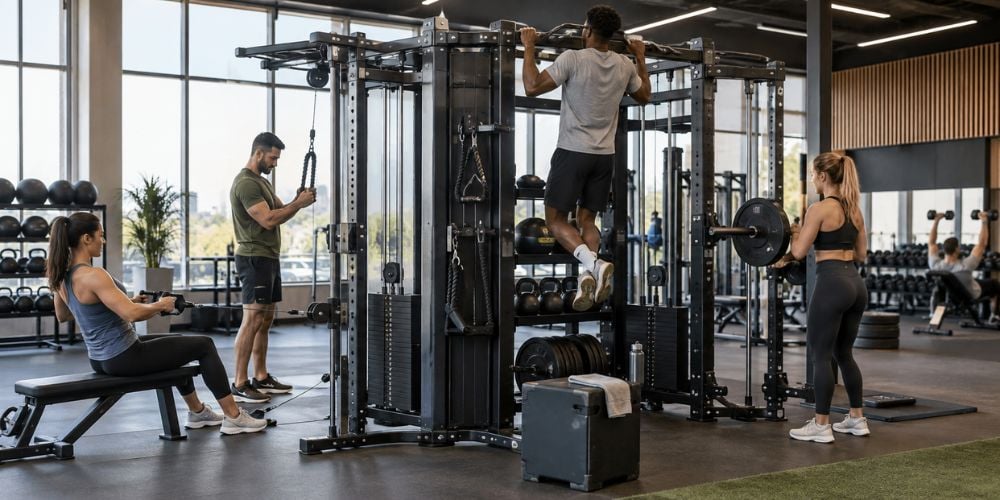
A versatile station can support several exercises while using less floor space. Functional trainers, adjustable cable systems, half racks with attachments, adjustable benches, and dual-function strength machines are useful examples.
Take a cable station.
Members can use one for chest exercises, rows, arm work, shoulder movements, leg exercises, and many other movements. If another station is occupied, they still have somewhere useful to train.
This idea also lines up with current resistance-training evidence. The American College of Sports Medicine’s 2026 resistance training update notes that, for the average healthy adult, specific equipment type such as machines versus free weights does not consistently determine training outcomes.
What does that mean to your gym?
You can focus more on giving members practical ways to perform movements instead of trying to provide a separate machine for every exercise.
In my design experience, I look at how many useful exercises a station can support, not simply how impressive it looks on the floor.
If your peak-hour data shows that one training area needs more capacity, look for equipment that solves that specific bottleneck. At YR Fitness, we build commercial strength and functional equipment around daily gym use, so you can compare options by exercise variety, available space, and the type of traffic your gym actually gets.
3. Rearrange the Gym Floor to Improve Member Flow
Sometimes you have enough equipment.
The layout is the problem.
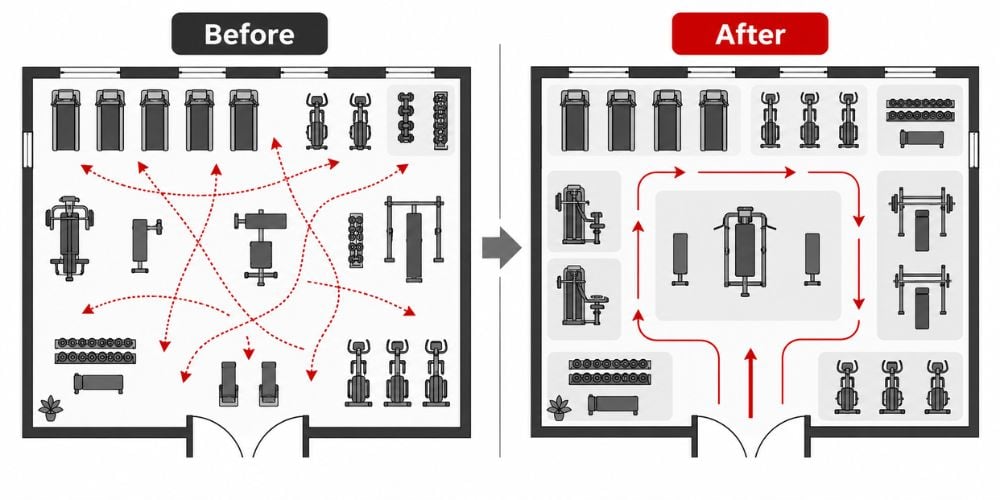
Walk through your gym during peak time and watch how members move. Where do people gather, cross paths, or struggle to reach the next station?
Ask yourself:
- Are several popular machines packed into one area?
- Is the free-weight section too narrow?
- Do members have to cross another training zone to reach equipment?
- Are benches difficult to move between racks?
Small layout problems become much easier to spot when the gym is full.
The ACSM Health/Fitness Facility Standards and Guidelines specifically covers areas such as facility design, construction, and facility equipment, which makes it a useful reference when reviewing a commercial gym layout.
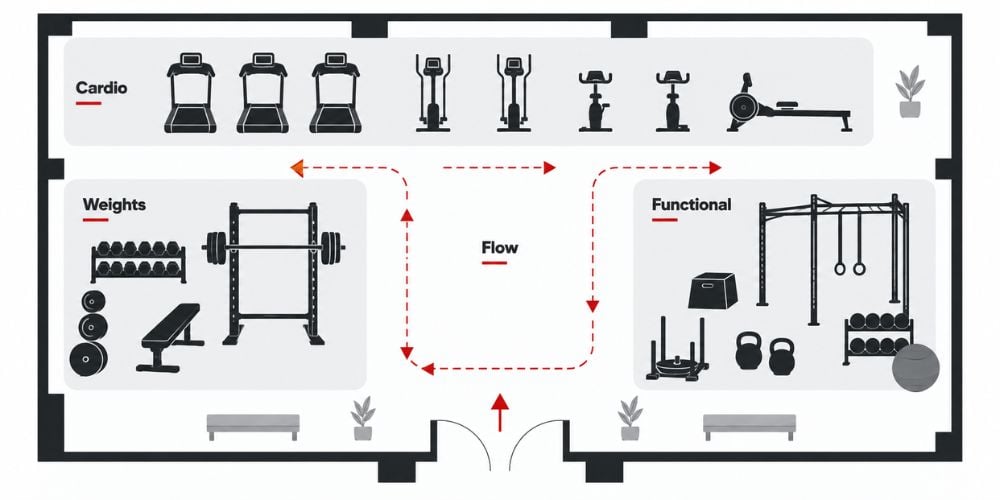
Keep your training zones clear
A simple structure might look like this:
Zone | Typical Equipment | Main Goal |
Free weights | Benches, dumbbells, racks | Give lifters room to move |
Plate-loaded | Presses, rows, leg machines | Keep related strength equipment together |
Selectorized | Pin-loaded machines | Make circuits easy to follow |
Functional | Cable stations, functional trainers | Support multiple exercise choices |
Cardio | Treadmills, bikes, ellipticals | Keep continuous traffic organized |
Stretching and recovery | Mats and open floor space | Keep floor work away from equipment traffic |
Give high-use stations enough surrounding space for members to enter, train, and move on.
You can also spread popular stations across a larger area instead of placing every high-demand machine in one corner.
A better layout will not create extra equipment. It can, however, make the equipment you already own easier to access.
4. Give Members More Ways to Perform Popular Exercises
Does a member really need to wait for one particular machine?
Often, no.
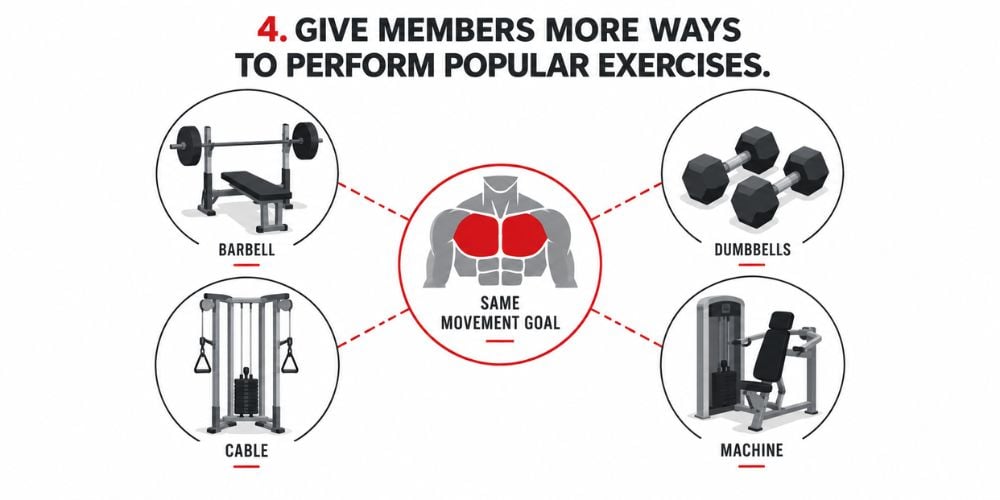
Give members several ways to train the same general muscle group.
Training Goal | Option 1 | Option 2 | Option 3 | Option 4 |
Chest | Barbell bench press | Dumbbell press | Chest press | Cable press |
Back | Lat pulldown | Pull-up | Seated row | Cable row |
Legs | Squat rack | Leg press | Split squat | Other leg machines |
Shoulders | Dumbbell press | Machine press | Cable work | Free weights |
This matters because adults are encouraged to perform muscle-strengthening activity involving all major muscle groups at least twice per week under the CDC’s current physical activity recommendations.
Your gym does not need one specific machine to serve every movement.
Instead, give members enough practical alternatives. If one station is busy, they can move to another exercise rather than stopping their workout.
This also helps your trainers. They can quickly suggest a substitute when a member’s first choice is occupied.
5. Set Simple Peak-Hour Equipment Rules
What if the equipment is available, but one person stays on it forever?
That is where simple gym etiquette helps.
Consider rules such as:
- Encourage members to let others work in between sets.
- Ask members not to sit on equipment for long periods while using their phones.
- Discourage leaving towels or bottles on equipment while training somewhere else.
- Consider reasonable cardio time limits during very busy periods.
- Use clear signs to explain peak-hour expectations.
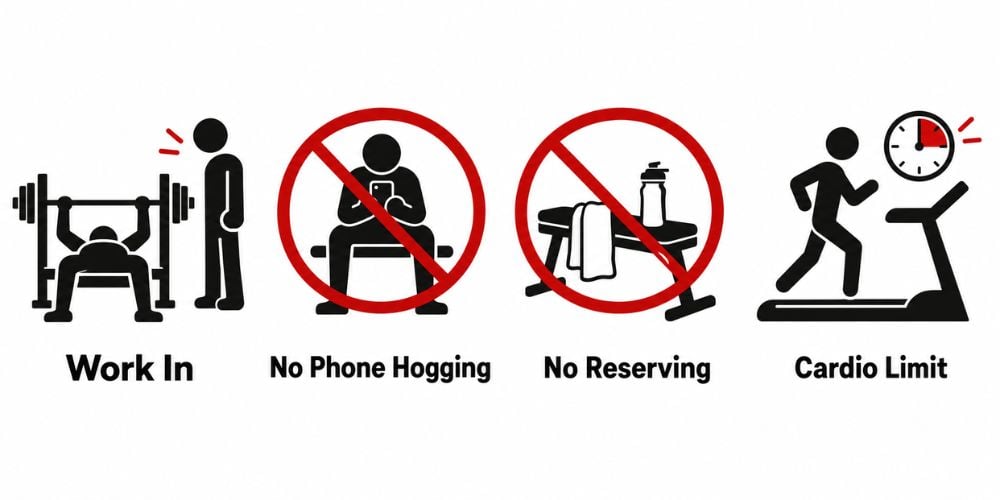
Keep the rules easy to understand.
Too many restrictions can make the gym uncomfortable. I often find that a short explanation from staff works better than a wall covered in rules.
Staff can also step in politely when queues start forming.
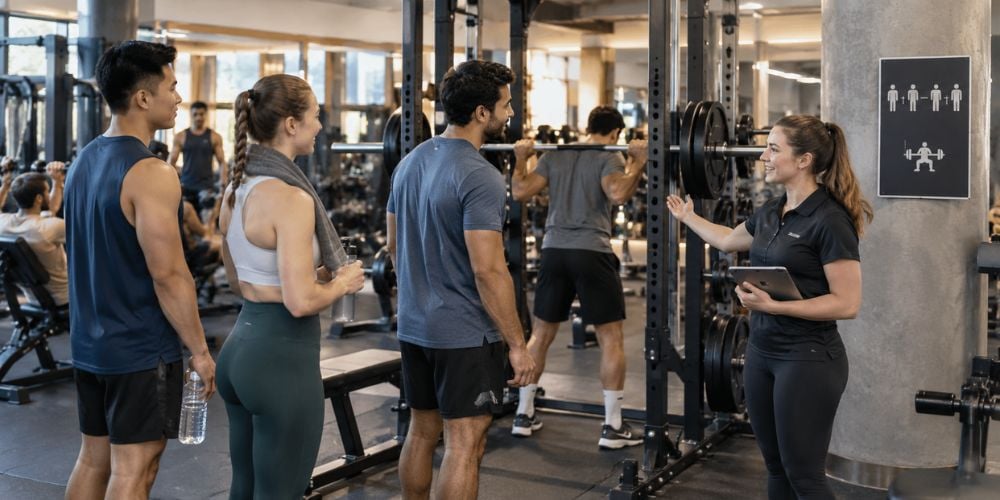
Conclusion
Start by fixing the equipment and areas that create the longest waits.
Better equipment choices, more exercise options, a smarter layout, and simple peak-hour rules can make a big difference.
If you are planning to add or replace equipment, explore YR Fitness commercial gym equipment and choose options based on your space and member demand.
Related articles: