




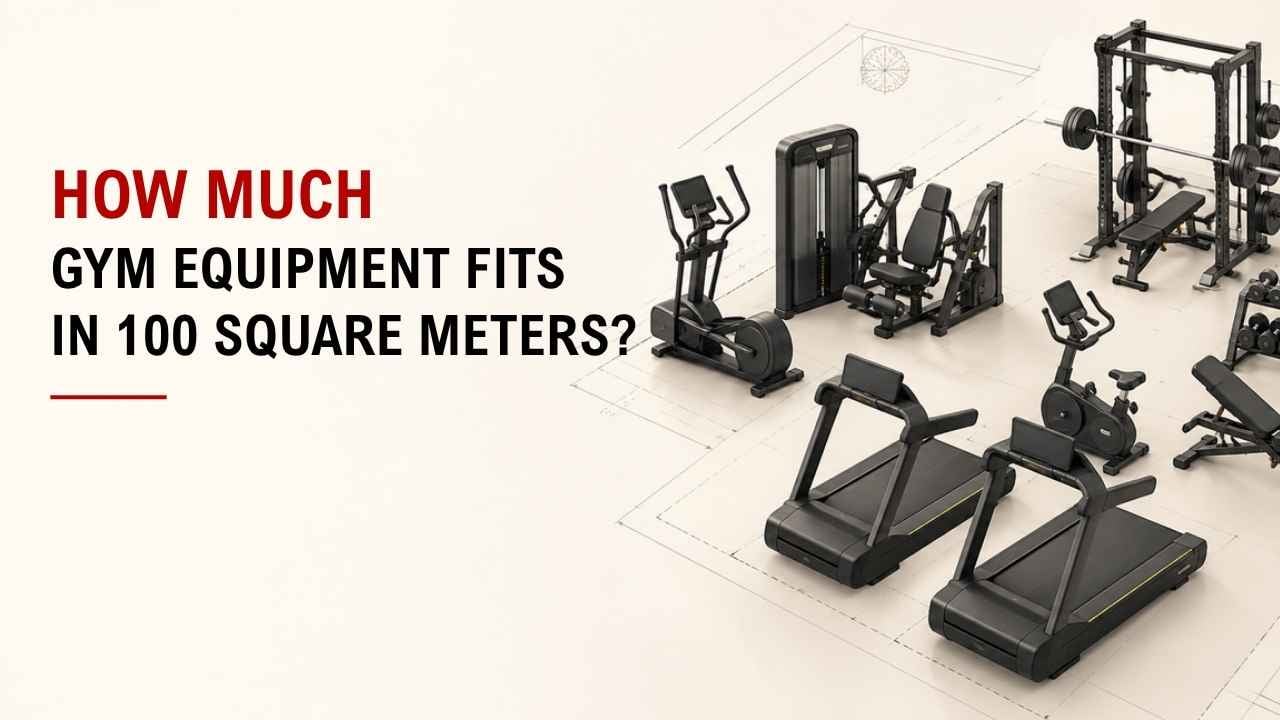

Is 100 square meters enough for cardio machines, strength equipment, and free weights? Yes, but choosing the right mix makes a big difference.
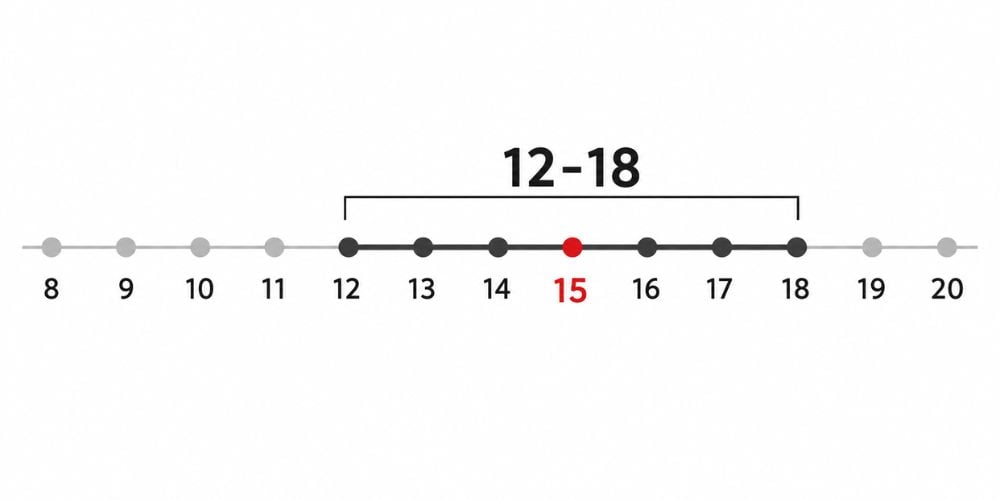
The quick answer is simple: a 100 m² gym can usually fit around 12–18 main pieces of equipment comfortably. For most setups, around 15 pieces gives you a good balance between equipment variety and usable floor space.
As an Ergonomics Engineer at YR Fitness, I work with equipment dimensions, user clearance, and training flow. I often see a gym feel much bigger once the machines are positioned properly.
Below, I’ll show you how much space to leave, what 15 pieces can look like, and which machines take up the most room. Keep scrolling, and you should quickly know what can fit in your own 100 m² space.
1. How Much Space Should Actually Be Used for Equipment?
Do not fill all 100 m² with machines.
A practical target is to use around 50–60 m² for equipment and training stations. The rest can support walking, exercise movement, storage, and open training.
Use | Approximate Space |
Equipment and training stations | 50–60 m² |
Walking and user clearance | 20–25 m² |
Open exercise space | 10–20 m² |
Storage or small accessories | 5–10 m² |
Some of these areas can overlap. For example, the clearance beside one machine may also form part of a walkway.
Can you squeeze in 20 machines?
Possibly, but more equipment does not automatically mean a better gym.
The Health & Fitness Association’s facility layout guidelines recommend providing ample open walkways and spacing fitness equipment according to manufacturer recommendations. That is a useful reminder not to judge a layout by machine count alone.
Accessibility also matters when you plan the open space. Under the U.S. ADA Standards for Accessible Design, accessible walking routes generally need at least 36 inches (915 mm) of clear width, and accessible exercise equipment needs appropriate clear floor space. Local requirements can differ, but it shows why walkways should not be treated as wasted space.
Personally, I would rather have 15 useful stations with comfortable spacing than 20 machines packed tightly together.
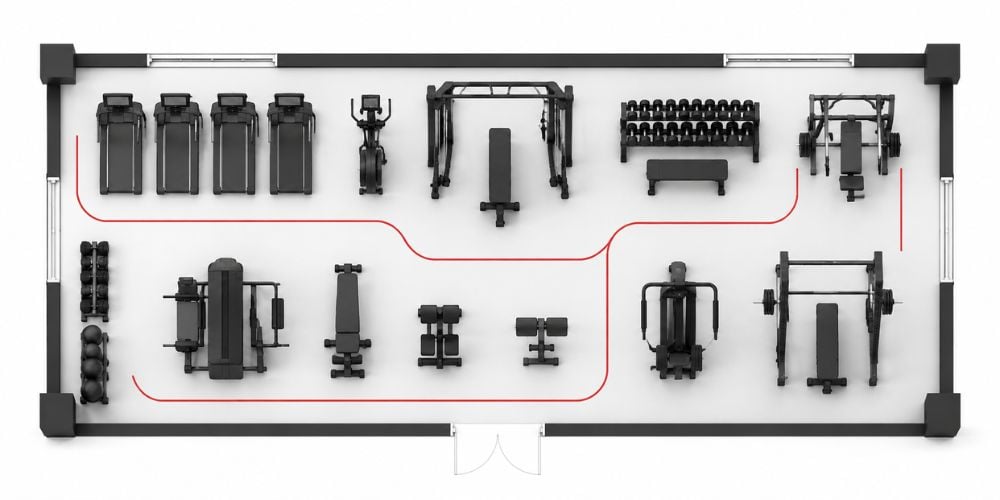
2. 15 Pieces of Equipment in a 100 m² Gym
So, what could 15 pieces actually look like?
Here is one balanced example.
Cardio Equipment
- Treadmill
- Treadmill
- Exercise bike
- Elliptical
Upper-Body Strength
- Chest press
- Lat pulldown
- Seated row
- Shoulder press
Lower-Body Strength
- Leg press
- Leg extension
- Leg curl
Multi-Purpose and Free Weights
- Functional trainer
- Squat rack
- Adjustable bench
- Dumbbell rack
That gives you 15 main equipment stations covering cardio, chest, back, shoulders, legs, cables, and free weights.
For most fitness lovers, that is already enough variety for a complete training routine.
Why include both cardio and strength equipment? The CDC’s adult physical activity guidance recommends a mix of aerobic activity and muscle-strengthening work each week, so having access to both types of equipment gives you more ways to structure balanced workouts.
You do not need a separate machine for every muscle. A rack, adjustable bench, dumbbells, and functional trainer already give you a lot of exercise options.
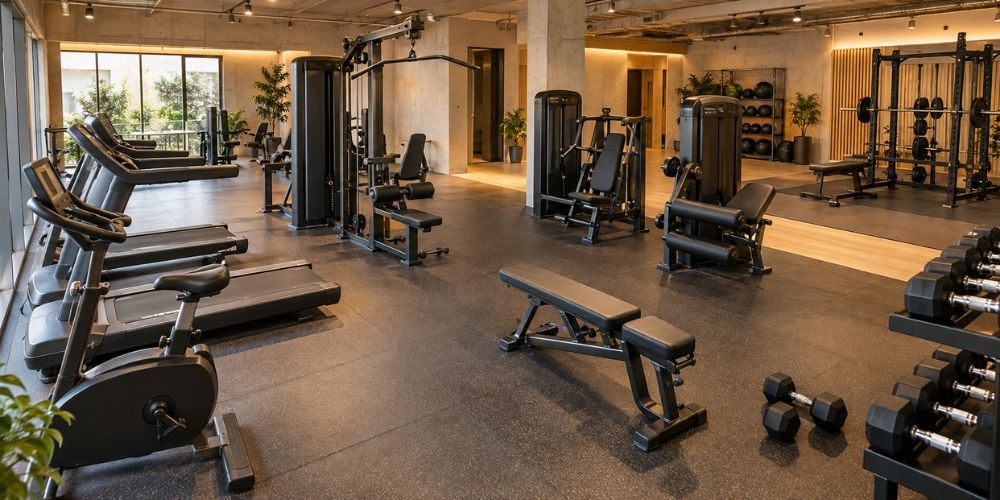
3. What Equipment Takes Up the Most Space?
Some machines eat up floor space much faster than others.
The biggest space users are usually:
- Treadmills – long machines that also need space for getting on and off.
- Leg presses – often longer than standard selectorized machines.
- Power racks – the frame may be compact, but the barbell needs clearance on both sides.
- Cable crossovers – wide frames can take up a large section of the room.
- Functional trainers – versatile, but still larger than many single-exercise machines.
A chest press or leg extension is usually easier to place because most of the movement happens inside the machine’s footprint.
Free weights are different.
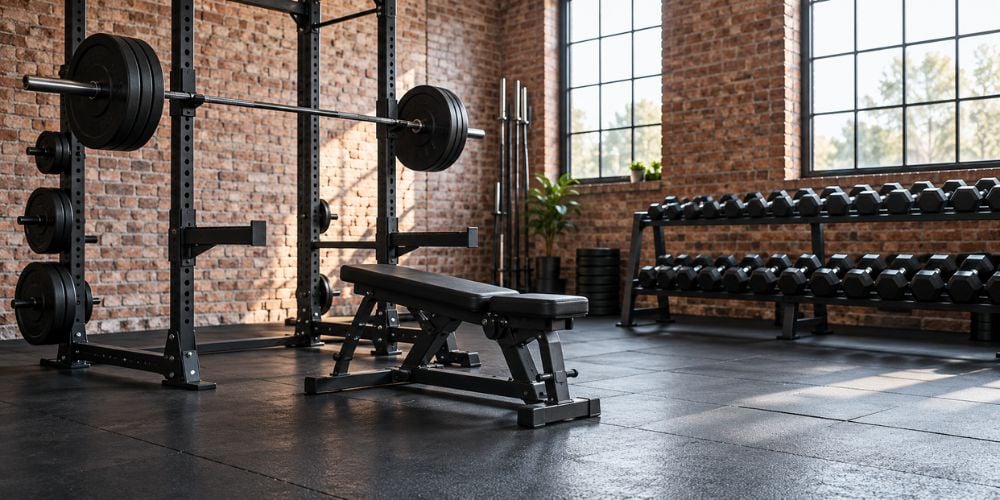
A dumbbell rack may look small on a floor plan, but you still need open space in front of it for lifting. A squat rack also needs room for the bar, plates, and the person exercising.
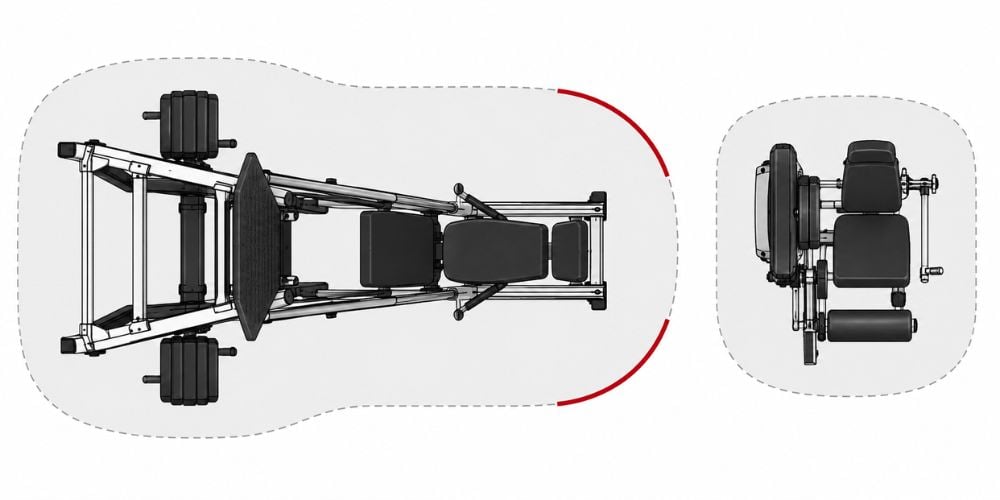
What should you measure?
Do not look at machine length and width alone. Check the space needed to enter, exercise, load weights, and move around the equipment.
That is why I always look at usable training space, not just the dimensions printed on the specification sheet.
4. 100 m² Gym Layout by Training Zone
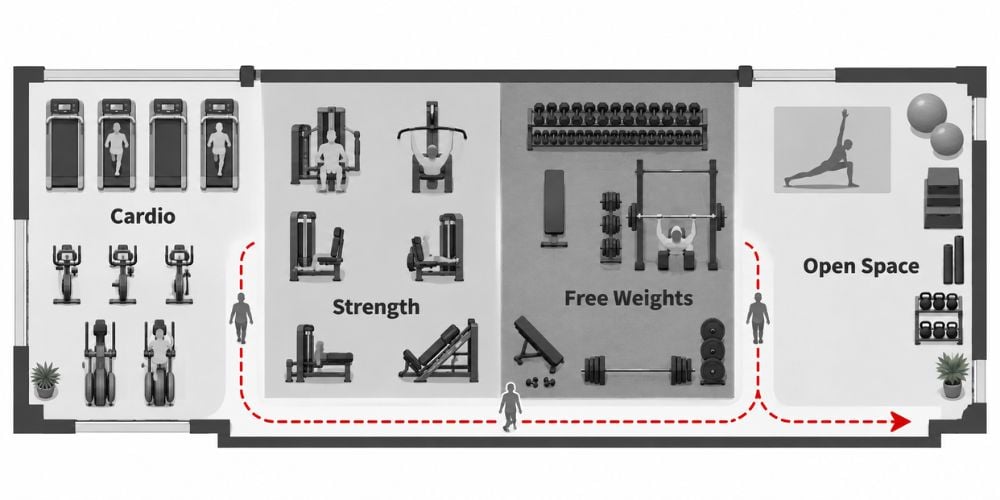
Dividing the room into zones makes planning much easier.
Here is one simple layout:
Training Zone | Space | Equipment Example |
Cardio | 20 m² | 2 treadmills, bike, elliptical |
Strength machines | 45 m² | 7 strength machines |
Free weights | 20 m² | Rack, bench, dumbbells |
Open space and main walkways | 15 m² | Movement, warm-ups, access |
Total | 100 m² | 15 main stations |
Cardio – 20 m²
Place the treadmills, bike, and elliptical together.
Cardio machines often work well along a wall because users mainly exercise in one direction. Keeping them together also makes the room easier to understand.
Strength Machines – 45 m²
Use this area for the chest press, lat pulldown, seated row, shoulder press, leg press, leg extension, and leg curl.
I like grouping similar machines together. You spend less time crossing the room between exercises, and the layout feels more organized.
Free Weights – 20 m²
Use this area for the squat rack, adjustable bench, and dumbbells.
Leave enough open space around the rack so the barbell does not interfere with nearby machines.
Open Space – 15 m²
Do not be afraid of empty floors.
You can use it for stretching, warm-ups, bodyweight exercises, or simply moving between stations. A gym packed from wall to wall may look impressive, but it often feels much less comfortable once you start exercising.
Not sure whether the machines you want will fit? At YR Fitness, we offer commercial strength, cardio, and functional equipment in different sizes and configurations. Compare the equipment options and dimensions first, then build your 100 m² layout around the machines you will actually use.
5. How to Fit More Equipment Without Making the Gym Crowded
Want more exercise options without needing a bigger room?
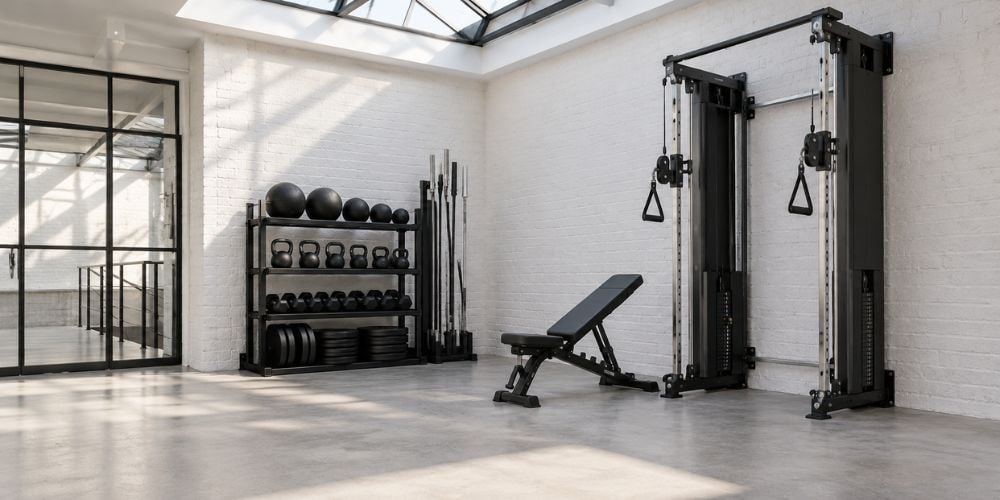
Start with equipment that can do more than one job.
- Use a functional trainer for many cable exercises.
- Choose adjustable benches instead of several fixed benches.
- Use one squat rack for squats, presses, and other barbell movements.
- Put storage racks against walls.
- Keep cardio equipment in one row.
- Avoid several machines that train almost the same movement.
- Use compact or dual-function machines where practical.
Placement matters too.
Large equipment often works well around the outside of the room. Keeping some of the center open can make the entire space feel easier to move through.
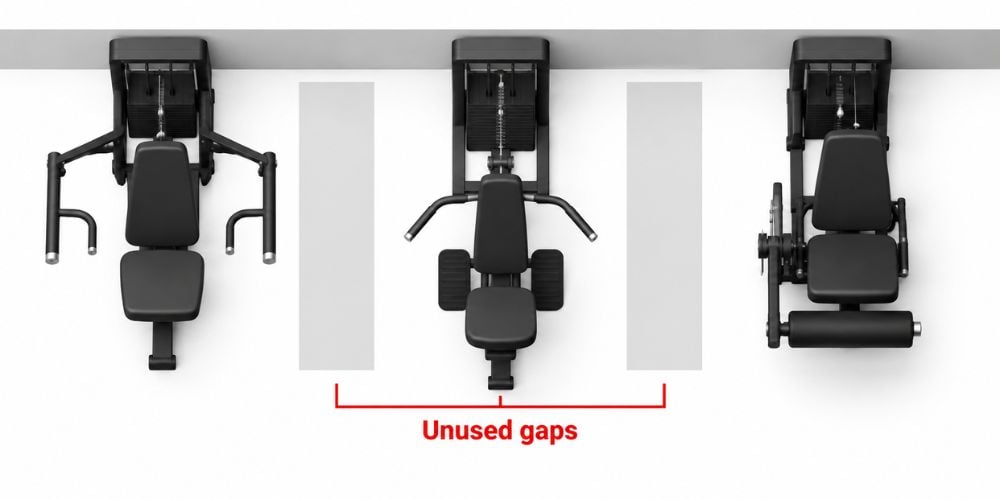
What about small gaps between machines?
They add up faster than you might expect.
One issue I often see is a random 30 cm or 50 cm gap that serves no real purpose. Repeat that across several machines, and you can lose enough floor area for another useful station.
At the same time, do not remove gaps that are actually needed for exercising or access.
6. Is 100 Square Meters Enough for a Complete Gym?
Yes.
For most fitness lovers, 100 m² is enough for a very complete gym.
You can realistically fit around:
- 10–14 pieces if you choose mostly large commercial machines.
- 12–18 pieces with a balanced cardio and strength setup.
- 15–20+ training stations if you use compact and multifunction equipment.
- 8–12 pieces if you prefer a more spacious layout.
Which number is best?
For a balanced setup, I would aim for roughly 15 main stations rather than trying to hit the highest possible number.
The equipment mix matters more than the total count.
Conclusion
A 100 m² gym can comfortably hold around 12–18 main pieces of equipment. Around 15 pieces is a practical target if you want a good mix of strength, cardio, and free-weight training.
Large treadmills, racks, and cable systems reduce the number of machines you can fit. Compact, multifunctional equipment can increase the number without making the room feel crowded.
If you want to compare machine types and equipment combinations before planning your floor, explore the commercial equipment from YR Fitness.
Related articles: