




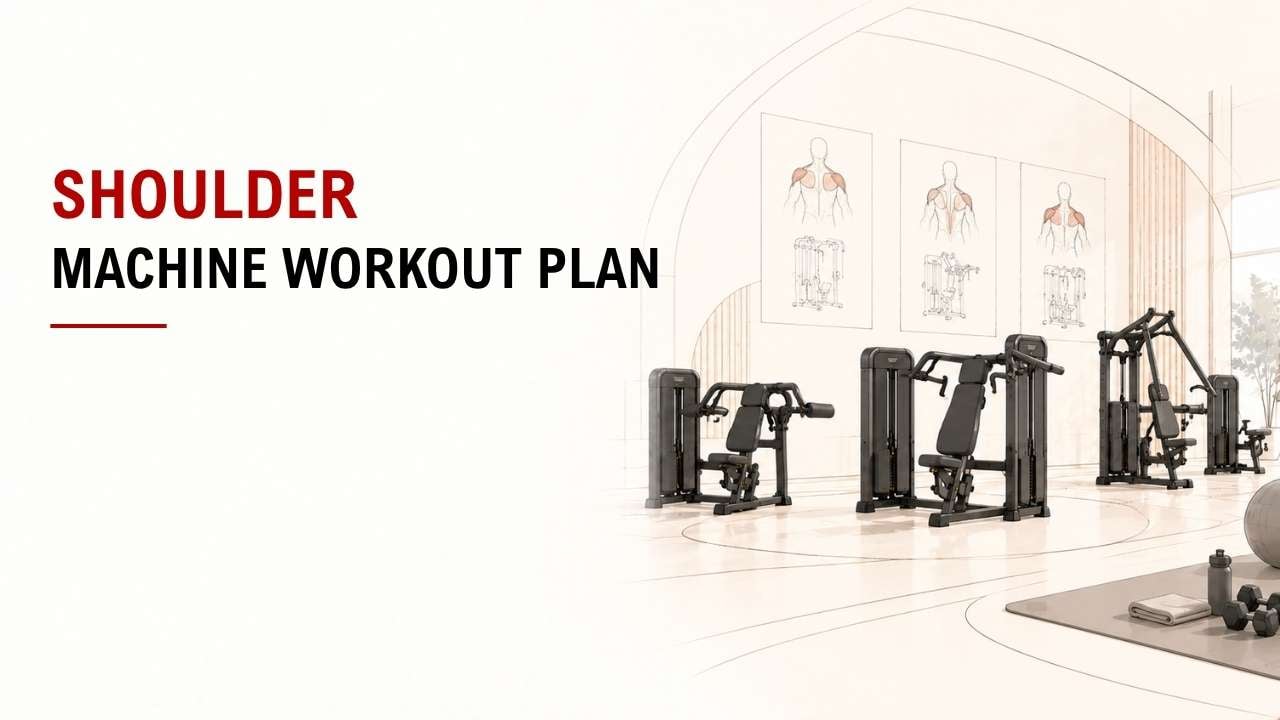

Want a simple shoulder machine workout that trains your whole shoulder? You only need five exercises to cover the front, side, and rear delts.
The plan is simple: shoulder press, lateral raise, reverse pec deck, front raise, and face pull. At YR Fitness, we work with strength equipment designed for smooth, controlled training.
As an Exercise Physiology & Biomechanics Expert, I focus on how shoulder position and exercise order affect each rep. I often see better results when people use proper form and manageable weight instead of simply going heavier.
Below, I’ll show you the sets, reps, rest times, and key form tips. Follow the plan in order and keep every rep controlled.
1. Machine Shoulder Press
Start with the machine shoulder press while your shoulders are fresh.
Adjust the seat so the handles begin around shoulder height. Keep your back against the pad and your feet firmly on the floor.
Press the handles upward until your arms are almost straight. Avoid aggressively locking your elbows.
Then lower the handles slowly back to the starting position.
Sets: 3–4
Reps: 8–12
Rest: 60–90 seconds
Main muscles: Front deltoids, middle deltoids, and triceps
I usually put this exercise first because it is the heaviest movement in the workout. You can normally handle more resistance here before fatigue builds.
Quick form check
Are your shoulders rising toward your ears?
If yes, reduce the weight slightly. Keep your shoulders down and focus on a smooth press.
2. Machine Lateral Raise
Next, move to the lateral raise machine.
This exercise puts more focus on your middle deltoids, which contribute to shoulder width.
Sit firmly against the pad. Place your arms comfortably against the machine pads.
Raise your arms outward until they reach about shoulder height.
Pause briefly, then lower them slowly.
Sets: 3
Reps: 10–15
Rest: 45–60 seconds
Main muscle: Middle deltoid
Do not swing the weight or shrug your shoulders.
Use less weight than you use on the shoulder press. Here, control matters more than load.
Prefer shoulder exercises that feel stable and easy to control? At YR Fitness, our strength equipment includes machine and cable-based options for movements like presses, raises, and rear-delt work, so you can see how different equipment designs support this type of workout.
3. Reverse Pec Deck
Now move to the back of your shoulders.
Sit facing the chest pad of the reverse pec deck. Adjust the handles so your arms start comfortably in front of you.
Keep a slight bend in your elbows.
Open your arms outward until they are roughly in line with your body. Squeeze briefly, then return slowly.
Sets: 3
Reps: 10–15
Rest: 45–60 seconds
Main muscles: Rear deltoids and upper-back muscles
Should you pull as far back as possible?
No.
Stop while you can still control your shoulder position. Pulling farther is not automatically better.
I often see people skip rear-delt work because those muscles are harder to see in the mirror. But balanced shoulder training should include more than pressing and front-delt exercises.
4. Cable Front Raise
Next, move to the cable station.
Set the pulley near the bottom.
Hold the handle in front of your body with a small bend in your elbow. Raise it until your arm reaches about shoulder height.
Then lower it slowly without letting the weight stack slam down.
You can train one arm at a time or use a cable attachment with both hands.
Sets: 2–3
Reps: 10–15
Rest: 45–60 seconds
Main muscle: Front deltoid
How heavy should you go?
Not very heavy.
Your front deltoids already work during the shoulder press, so the front raise is mainly extra isolation work.
If you have already done plenty of pressing, two controlled sets may be enough.
General ACSM resistance-exercise recommendations also emphasize good form, controlled lifting and lowering, and gradually progressing resistance rather than simply adding as much weight as possible.
5. Cable Face Pull
Finish with cable face pulls.
Set the cable around face height and attach a rope. Hold one end in each hand.
Pull the rope toward your face while guiding your elbows outward.
Your hands should finish near the sides of your face, not down near your chest.
Pause briefly, then return under control.
Sets: 2–3
Reps: 12–15
Rest: 45–60 seconds
Main muscles: Rear deltoids and upper-back muscles
Keep the weight moderate.
I prefer using face pulls as a controlled finishing exercise instead of turning them into a heavy pull. Smooth reps are easier to control once your shoulders are already tired.
How Often Should You Do This Shoulder Workout?
For most fitness lovers, one or two shoulder sessions per week is enough for this plan.
If you already do chest presses, overhead presses, or other upper-body exercises, remember that your shoulders are getting additional work there too.
The Physical Activity Guidelines for Americans recommend muscle-strengthening activity on at least two days each week as part of an overall fitness routine. That recommendation covers the major muscle groups, not two isolated shoulder workouts specifically.
New to machine training? Start with one dedicated shoulder session and see how you recover.
Move toward two sessions only when your shoulders feel ready for the extra work.
How Much Weight Should You Use?
Choose a weight that lets you complete the target rep range without losing your form.
The final two or three reps should feel challenging, but you should still control the movement.
Increase the resistance gradually when the top end of the rep range becomes easy.
Do not add weight if you have to:
- Swing your body
- Shrug your shoulders
- Shorten the movement
- Rush the lowering phase
- Change your position to finish the set
Here is a simple way to judge it.
What Happens During the Set? | What to Do |
You cannot reach the target reps with good form | Reduce the weight |
You reach the target reps with 2–3 challenging reps at the end | Keep the weight |
You easily exceed the target range | Increase the weight slightly |
You need to swing or change position | Reduce the weight |
Your reps stay smooth and controlled | You are on the right track |
Conclusion
A good shoulder machine workout does not need a lot of exercise. Start with the shoulder press, then use controlled isolation movements to train the side, front, and rear delts.
Keep the weight manageable, use smooth reps, and give yourself enough recovery between sessions.
If you want to explore the types of machines used for these movements, take a look at YR Fitness strength equipment and compare the options that fit the way you like to train.
Related articles: