




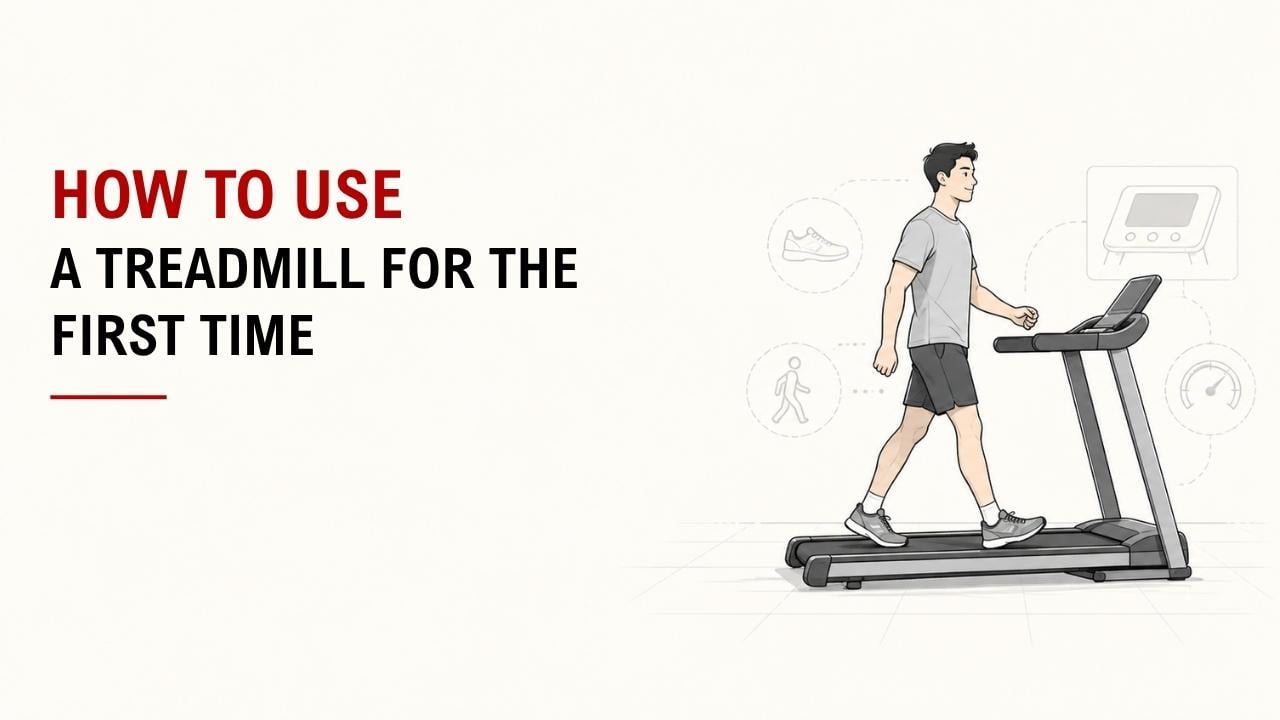

Using a treadmill for the first time and not sure what to do? The machine can look complicated, but the basics are simple.
The short answer is: start slowly, learn the controls, keep good posture, and increase speed gradually. You do not need to run right away.
As an Exercise Physiology & Biomechanics Expert at YR Fitness, I regularly look at how people walk and run on cardio equipment. I often see beginners feel much safer and more confident when they focus on balance and control before speed.
This guide shows you how to start, walk, increase speed, use incline, and stop safely. Follow the steps below and keep your first workout simple.
- Introduction
- 1. Get Familiar With the Treadmill Controls
- 2. Step Onto the Treadmill Correctly
- 3. Start With a Slow Walking Speed
- 4. Use Proper Walking or Running Form
- 5. Stop Holding the Handrails When Comfortable
- 6. Increase Speed Gradually
- 7. Add Incline Only After You Feel Comfortable
- 8. Slow Down Before You Stop
- Conclusion
1. Get Familiar With the Treadmill Controls
Before pressing Start, take a few seconds to look at the console.
You mainly need to find:
- Start: Start the treadmill belt.
- Stop: Slows and stops the belt.
- Speed: Makes the belt move faster or slower.
- Incline: Raises or lowers the treadmill deck.
- Emergency stop: Stop the treadmill quickly.
- Display: Shows information such as time, speed, distance, and calories.
You may also see heart-rate readings and built-in workout programs. Ignore those for now if they make the console feel complicated.
What should you find first?
The emergency stop.
Most treadmills use a safety key with a small clip. Attach it to your clothing before starting so the treadmill can stop if you move too far back.
I always recommend learning the basic controls before experimenting with workout programs. Your first goal is simply to stay comfortable and in control.
2. Step Onto the Treadmill Correctly
Do not step directly onto a fast-moving belt.
Start by standing on the side rails, with one foot on each side of the belt.
Then:
- Attach the safety clip.
- Hold the handrails lightly.
- Press Start.
- Choose a very slow speed.
- Step onto the belt one foot at a time.
- Begin walking naturally.
Give yourself a few seconds to adjust.
The moving floor may feel strange during your first workout. That feeling normally becomes less noticeable once you settle into a steady walking rhythm.
Why start this way?
It gives you time to understand how the belt responds before you add more speed.
3. Start With a Slow Walking Speed
Start by walking, even if you normally run outdoors.
A practical starting range is around 2–3 mph (3–5 km/h).
Walk for one or two minutes and check:
- Do you feel balanced?
- Can you walk without gripping the rails?
- Does your stride feel natural?
- Can you comfortably look forward?
If yes, increase the speed slightly.
If not, stay at the same speed or reduce it.
There is no perfect treadmill speed for everyone. Your height, balance, fitness level, and previous treadmill experience all change how a certain speed feels.
The CDC’s guide to physical activity intensity also makes this point: exercise intensity depends on how hard your body is working. Brisk walking may feel moderate for one person and much harder for another.
I would rather see a beginner walking confidently at a slower pace than struggling to keep up with the belt.
4. Use Proper Walking or Running Form
Once you feel comfortable, start paying attention to your posture.
Keep it simple.
Look Forward
Keep your eyes forward instead of constantly staring at your feet.
Looking down for too long can make your posture and balance feel less natural.
Keep Your Upper Body Relaxed
Aim for:
- Chest upright
- Shoulders relaxed
- Head in a neutral position
- Elbows slightly bent
Do not make your body stiff.
The American Heart Association’s walking guidance also recommends keeping your head lifted, shoulders relaxed, arms moving naturally, and stride comfortable.
Walk Naturally
Let your feet land naturally under your body.
You do not need to force an unusually long stride just because the treadmill belt is moving.
If you start running, use the same idea. Keep your stride controlled instead of reaching too far forward.
Let Your Arms Move
Allow your arms to swing naturally beside your body.
That usually feels better than keeping both hands fixed on the treadmill.
Still feeling unstable?
Reduce the speed first. Good form is much easier when you are not fighting to keep up with the belt.
5. Stop Holding the Handrails When Comfortable
The handrails are useful when you:
- Step onto the treadmill
- Adjust your balance
- Change settings
- Prepare to stop
Once you feel stable, try walking without holding them continuously.
Why?
Leaning heavily on the rails changes the way you naturally walk. It can also make the selected speed or incline feel easier than it really is.
Start by releasing one hand, then the other.
Keep your hands near the rails until you feel confident.
If you immediately lose balance when you let go, reduce the speed.
A treadmill should feel stable, predictable, and easy to control while you train. At YR Fitness, we focus on commercial cardio equipment built for smooth daily operation, so you can explore our equipment if you want to compare treadmill options and other cardio machines.
6. Increase Speed Gradually
Once walking feels comfortable, increase the speed in small steps.
Here is a simple progression:
Stage | What to Do | What to Check |
Easy walk | Get used to the moving belt | Balance feels comfortable |
Brisk walk | Increase your pace slightly | You can still control your stride |
Fast walk | Walk without holding the rails | Posture stays natural |
Light jog | Introduce short running periods | You remain relaxed and stable |
Run | Increase only when ready | You stay fully in control |
Do not jump directly from a slow walk to a fast run.
Increase the speed slightly, then give yourself time to adjust.
Want to start running?
Try short jogging intervals first:
- Walk for 2–3 minutes
- Jog for 30–60 seconds
- Return to walking
- Repeat if you still feel comfortable
You can gradually make the jogging sections longer.
This is one of the simplest ways to learn treadmill running without making your first workout harder than it needs to be.
7. Add Incline Only After You Feel Comfortable
You do not need a steep incline during your first treadmill workout.
Start around 0–1% incline while you learn how the treadmill feels.
Once walking feels natural, gradually increase the incline.
Experience | Incline Approach | Main Goal |
First few minutes | 0–1% | Learn the machine |
Comfortable walking | 1–3% | Add a little challenge |
More challenging walk | Increase gradually | Raise effort without rushing |
Beginner running | Keep incline manageable | Maintain good form |
Incline can make even a normal walking speed feel much harder.
So avoid increasing speed and incline at the same time when you are still learning.
Change one setting first.
Then give your body enough time to adjust before changing to another.
I often tell beginners to treat incline as an extra tool rather than a requirement. First learn to walk comfortably, then add difficulty.
8. Slow Down Before You Stop
Do not finish a fast run and immediately jump off the treadmill.
Reduce your speed gradually.
A simple finish looks like this:
- Lower your running speed.
- Walk comfortably for 2–5 minutes.
- Reduce the speed again.
- Press Stop.
- Wait until the belt completely stops.
- Step onto the side rails.
- Remove the safety clip.
- Step off carefully.
Here is why this matters.
The American Heart Association’s warm-up and cool-down guidance recommends gradually reducing exercise intensity rather than stopping suddenly. It notes that a cool-down helps your heart rate and breathing come down progressively.
Their general recommendation is 5–10 minutes of slower activity for a full cool-down. For the simple beginner session below, the original 5-minute easy walk fits neatly within that guidance.
Conclusion
Using a treadmill for the first time is simple: learn the controls, start slowly, walk naturally, increase speed gradually, and slow down before getting off. Speed and incline can come later once the machine feels familiar.
At YR Fitness, we build commercial cardio equipment for reliable everyday training. If you want to compare treadmills and other cardio machines, explore our equipment and find the setup that fits your training space and workout needs.
Related articles: