




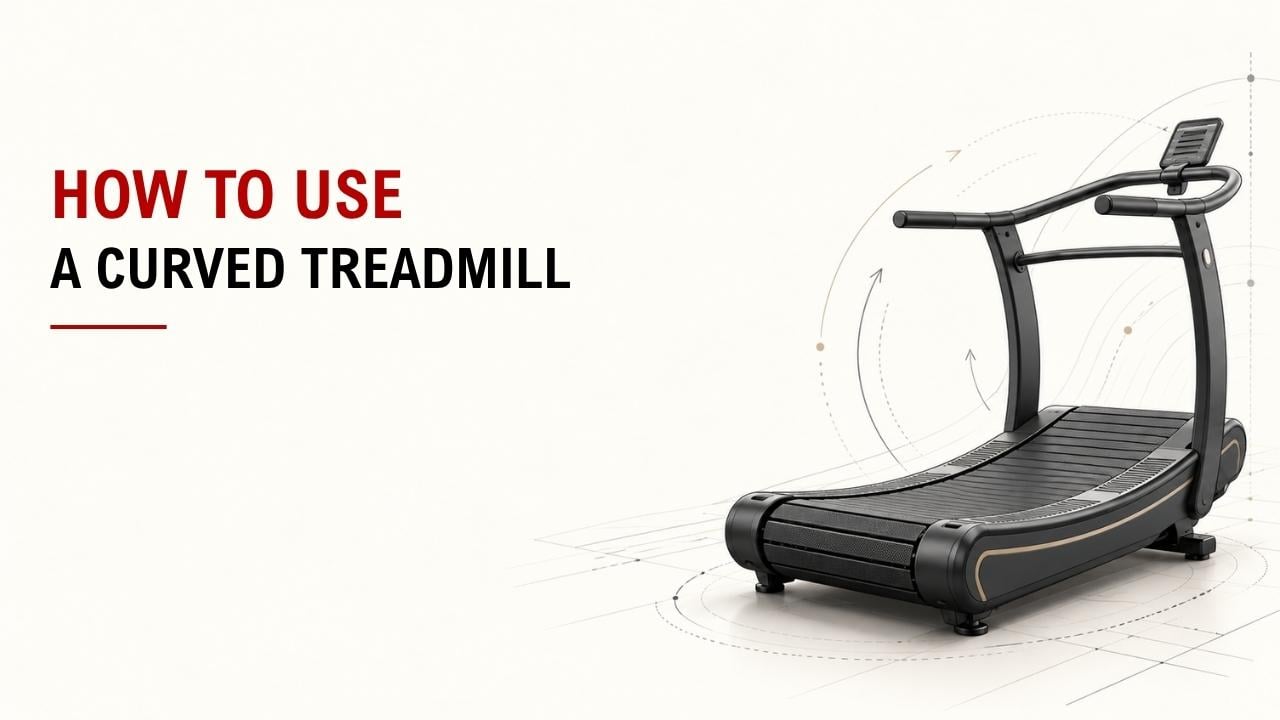

Have you tried a curved treadmill and felt unsure how to control it? Your position and pace directly affect how the belt moves.
The simple answer is: start slowly, stay near the middle, keep your posture natural, and let your movement control the belt. Small changes in position will help you speed up or slow down.
As an Exercise Physiology & Biomechanics Expert at YR Fitness, I work closely with movement mechanics and cardio equipment. I often see beginners feel much more confident once they learn how body position controls the treadmill.
Below, I’ll show you seven simple steps to use a curved treadmill safely and comfortably. Follow them in order and keep your first few sessions easy.
1. Step Onto the Treadmill Carefully
Start by holding the handrails.
Place one foot on the belt, then bring the other foot up slowly. Stay around the middle instead of stepping too far toward the front.
Before you start moving:
- Stand tall.
- Keep your feet about hip-width apart.
- Look forward.
- Make sure you feel balanced.
Why take your time here?
A curved treadmill is usually non-motorized, so your movement drives the belt. If you step aggressively toward the front, the belt may begin moving faster than you expect.
I often tell beginners to spend a few seconds simply feeling the belt under their feet before walking.
2. Start With a Slow Walk
Begin with small, easy steps.
Do not try to jog right away.
Walk naturally and let your feet move the belt underneath you. Unlike a motorized treadmill, the machine responds directly to your own movement.
Research on curved non-motorized treadmill exercise also shows that running on these machines can place different physiological demands on the body compared with a motorized treadmill.
Why start slowly?
You need a little time to learn how your position changes belt speed.
For the first minute or two:
- Keep your stride short.
- Maintain an easy rhythm.
- Stay relaxed.
- Avoid pushing hard through every step.
If the belt moves too quickly, shorten your steps and move slightly backward.
This is one of the biggest differences I notice when people switch from a regular treadmill to a curved model. You control the machine much more directly.
3. Find the Right Position on the Curve
Your position helps control your speed.
Move slightly forward on the curve, and the belt will usually move faster. Move slightly backward, and it will slow down.
For normal walking or jogging, stay around the middle.
Your Position | Typical Belt Response | What to Do |
Farther forward | Speeds up | Use when gradually increasing pace |
Middle | More stable pace | Best place for steady walking or running |
Slightly backward | Slows down | Use when reducing your pace |
You do not need large movements.
Small changes are usually enough.
Here is why this matters: curved treadmill running does not move your joints in the same way as overground running. A study comparing the two found differences in lower-body joint kinematics, which is another good reason to give yourself time to adapt. See the biomechanics research on curved treadmills.
At YR Fitness, we pay close attention to running feel, machine stability, and how naturally cardio equipment responds to the user. If you are comparing treadmill designs, look at the running area, belt system, frame stability, and movement feel rather than judging a machine only by its appearance.
4. Keep Your Body in a Natural Running Position
Once you feel comfortable walking, focus on your posture.
Keep your chest up and look forward.
Use a small forward lean from your ankles instead of bending heavily at your waist.
Your basic position should look like this:
- Head: Facing forward
- Shoulders: Relaxed
- Chest: Upright
- Arms: Moving naturally
- Knees: Slightly bent
- Feet: Landing underneath your body
Try not to lean too far forward.
I often see people attack the curve too aggressively because they think they need to force the treadmill to move. That usually makes their posture feel less natural.
Instead, stay controlled and let your pace build.
What should your feet do?
Aim for a comfortable landing underneath your body rather than reaching far forward with each step.
You do not need to force a particular foot strike. Focus on smooth, controlled movement.
5. Increase Your Speed Gradually
Ready to go faster?
Build your pace gradually.
Start with a brisk walk. Then move into a light jog before increasing your speed further.
To speed up:
- Move slightly farther forward.
- Increase your step rhythm.
- Keep your posture stable.
- Let the belt accelerate naturally.
Do not suddenly sprint from a slow walk.
I prefer increasing speed in stages because it gives your body time to adjust to the faster belt movement.
Stage | Suggested Pace | Main Focus |
Stage 1 | Easy walk | Learn belt control |
Stage 2 | Fast walk | Build confidence |
Stage 3 | Light jog | Keep posture stable |
Stage 4 | Comfortable run | Maintain smooth rhythm |
Stage 5 | Short faster intervals | Add speed while staying controlled |
Your goal is not to reach the highest speed possible.
Your goal is to stay in control.
Curved treadmills can also feel harder than you expect. One study found a higher energy cost for walking and running on a curved non-motorized treadmill compared with a motorized treadmill, so do not assume you need to match your normal treadmill speed.
6. Run Without Holding the Handrails
Once you feel stable, let go of the handrails.
Your arms should move naturally beside your body.
Holding the rails while running can change your posture and make your movement less natural.
Use the rails mainly when:
- Getting onto the treadmill
- Getting off
- Regaining balance
- Slowing down after a hard interval
During normal running, let your arms swing freely.
Still feel like you need the rails?
Slow down.
Your pace may simply be higher than your current level of control. There is nothing wrong with reducing your speed until you feel stable again.
Remember, a curved treadmill session still counts as aerobic exercise when the intensity is high enough. The CDC physical activity guidelines for adults recommend at least 150 minutes of moderate-intensity aerobic activity per week, or 75 minutes of vigorous activity, alongside muscle-strengthening work.
7. Slow Down and Stop Safely
Stopping a curved treadmill is different from pressing a stop button on a motorized treadmill.
You slow the belt by changing how you move.
Start by shortening your steps.
Then move slightly toward the rear section of the belt.
As your pace drops:
- Reduce your stride length.
- Slow your step rhythm.
- Stay upright.
- Use the rails if needed.
Once the belt is moving slowly enough, hold the rails and step off carefully.
Do not jump off while the belt is still moving quickly.
I always recommend finishing with a short, easy walk instead of stopping suddenly. It gives you time to regain your normal balance before leaving the treadmill.
Conclusion
Using a curved treadmill is simple once you understand how your body controls the belt. Start slowly, stay near the middle, keep your posture natural, and move forward only when you want more speed.
Give yourself a few sessions to become comfortable before worrying about faster running.
If you want to learn more about commercial cardio equipment and different treadmill designs, explore YR Fitness to compare equipment built around stable, practical everyday training.
Related articles: