









Thinking about buying gym equipment straight from a factory? It sounds like the easiest way to save money, right?
Yes, it can be cheaper. But only if you compare the full cost, not just the first price on the quote.
I’m George Yang, Founder and Chief Designer of YR Fitness. After decades of designing and manufacturing commercial gym equipment, I’ve seen one common mistake: buyers compare machine prices but forget shipping, taxes, installation, and spare parts.
So let’s keep this simple. This guide will help you see when factory-direct buying saves money, when it does not, and how to calculate the real cost before you pay.
- 1. Is Buying Directly from a Gym Equipment Factory Actually Cheaper?
- 2. Factory Price vs Distributor Price: What Is the Difference?
- 3. Costs You Save by Buying from a Factory
- 4. What Hidden Costs Should Buyers Consider?
- 5. When Is Buying Directly from a Gym Equipment Factory Cheaper?
- 6. How to Calculate the Real Cost of Buying Directly from a Factory
- 7. What Questions Should You Ask a Gym Equipment Factory Before Buying?
- 8. Pros and Cons of Buying Directly from a Gym Equipment Factory
- Conclusion
1. Is Buying Directly from a Gym Equipment Factory Actually Cheaper?
Usually, yes.
Buying directly from a factory often gives you a lower product price because you remove extra layers. No distributor markup. No local showroom cost. No reseller margin added on top.
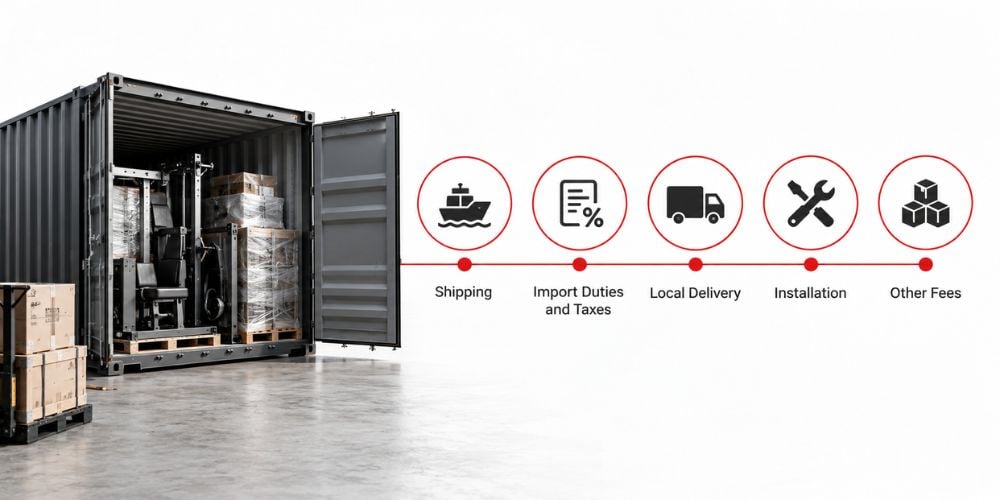
But here is the catch. The machine price is not the final cost. You still need to add freight, duties, customs fees, local delivery, installation, and sometimes inspection.
The better question is: “Which option is cheaper after the equipment is inside my gym and ready to use?”
That final number is often called the landed cost. It sounds boring, but it protects your budget.
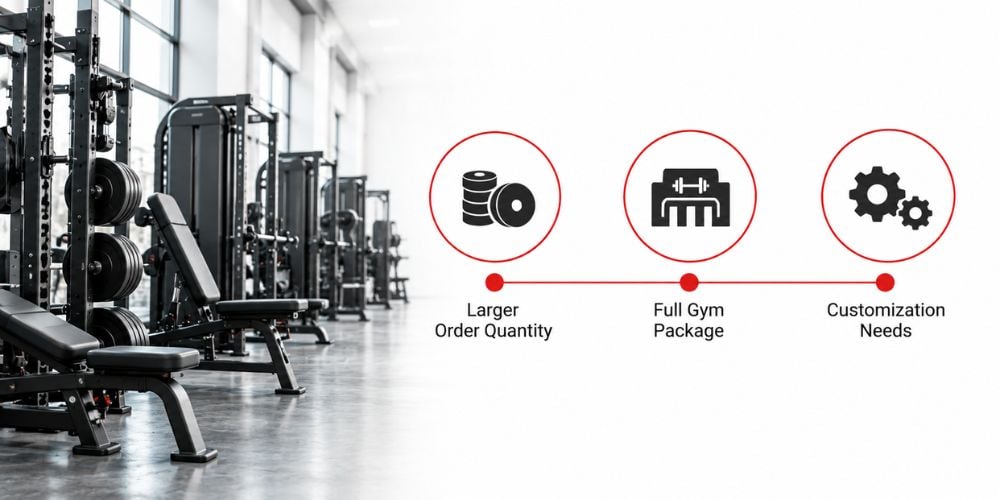
If you are buying a full gym package, factory direct can save a lot. If you are buying only 1 or 2 machines, the savings may become smaller after shipping and local costs.
2. Factory Price vs Distributor Price: What Is the Difference?
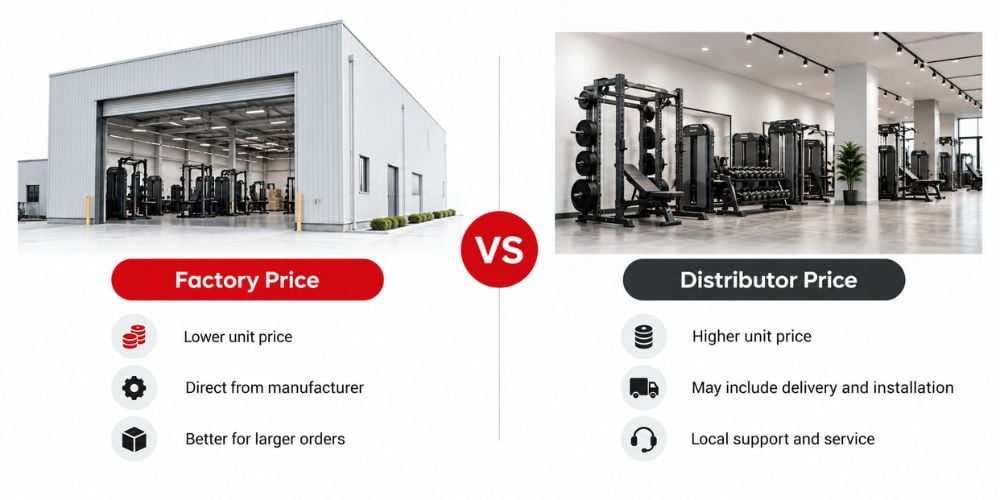
A factory price is usually lower at the start. A distributor price is usually higher, but it may already include delivery, installation, and local support.
So which one is better?
It depends on what you need. Here is a simple example for a medium commercial gym equipment package.
Cost Item | Factory Direct Estimate | Distributor Estimate | Which One Is Better? |
Equipment Package | $38,000 | $58,000 | Factory direct is usually cheaper |
Custom Color / Logo | $500–$1,500 | $1,500–$3,000 | Factory direct is usually better |
International Freight | $3,500–$6,000 | Usually included | Distributor is easier |
Import Duties And Taxes | $3,000–$5,000 | Usually included | Distributor is easier |
Customs / Port Fees | $800–$1,500 | Usually included | Distributor is easier |
Local Delivery | $800–$2,000 | Often included | Distributor is easier |
Installation | $1,500–$3,000 | Often included | Distributor is easier |
Spare Parts Support | Depends on supplier | Usually local | Distributor is easier |
Estimated Final Cost | $47,100–$57,000 | $58,000–$63,000 | Factory direct can still be cheaper |
So what does this show?
Factory direct may still win on total price. But you need to handle more steps. Distributor buying is easier. But that convenience is usually built at the price.
Here is why this matters. Trade terms like EXW, FOB, CIF, and DDP decide who pays for each part of the shipping process, and the International Chamber of Commerce explains that Incoterms® rules are used to define buyer and seller responsibilities in global trade.
At YR Fitness, we often tell buyers: do not compare factory price against distributor price too quickly. Compare factory landed cost against distributor delivered cost.
That is the fair comparison.
3. Costs You Save by Buying from a Factory
Factory buying helps most when you are buying enough equipment to make the lower unit price matter.
Not always. But often.
Can I Save On The Machine Price?
Yes, this is the main saving.
When you buy from the factory, you are closer to the production source. That usually means a lower unit price, especially for strength machines, benches, racks, free weights, and full gym packages.
For example, buying one machine may not show a big saving.
But buying 20–40 machines for a full gym? That is where the difference becomes more obvious.
Order Size | Factory Savings Potential | Why |
1–3 Machines | Low To Medium | Shipping cost per machine can be high |
10–20 Machines | Medium | Unit price savings start to matter |
Full Gym Package | High | Better packing, production planning, and container use |
Repeat Orders | High | Easier to negotiate and reorder stable models |
So yes, the factory price can be cheaper.
But the order size matters.
Can I Get A Better Price If I Buy More?
Usually, yes.
Factories can often offer better pricing when the order is larger. A full container order is easier to plan than many small separate orders.
Why? Because the factory can prepare materials, welding, powder coating, upholstery, packing, and loading more efficiently.
Freight also matters. The Freightos Baltic Index tracks container pricing across major global shipping lanes, which shows why container planning can strongly affect international buying costs.
Here is the simple idea: A half-empty container is expensive. A well-planned container is smarter.
Can I Save On Custom Colors And Logos?
Yes, direct factory buying can make customization easier and more affordable.
Common custom options include:
- Frame color
- Upholstery color
- Logo placement
- Weight stack options
- Handle or grip details
- Machine selection by training zone
A distributor may also offer customization. But many times, they still need to ask the factory to do it.
That can add time. And sometimes it costs money.
At YR Fitness, we help buyers think through customization before production starts. We do this because a gym should not feel like a random collection of machines; it should feel planned, consistent, and easy for members to use.
Small details matter. Members may not ask what powder coating process you used. But they notice when the gym looks clean, organized, and professional.
Can I Control The Quality Details Better?
Yes, and this is one of the biggest advantages.
When you talk directly to a factory, you can ask more specific questions:
- What steel tube size is used?
- How thick is the frame?
- What cable system is used?
- What pulley material is used?
- How is the surface treated before painting?
- How is the equipment packed for sea freight?
- Are spare parts available later?
These questions matter because two machines can look similar in photos but feel very different in real use.
One may feel smooth and stable. Another may shake, drag, or wear out faster.
Product safety also matters. The ISO 20957-1:2024 standard covers general safety requirements and test methods for indoor stationary training equipment.
You do not need to become an engineer. But you should ask enough questions to know what you are buying.
4. What Hidden Costs Should Buyers Consider?
This is the part many buyers miss. The quote looks good. Then the shipment starts moving, and new costs appear.
So before you decide, check these items first.
Hidden Cost | What It Means | What To Ask |
Shipping | Cost to move goods from factory or port to your country | Is this EXW, FOB, CIF, or DDP? |
Import Duties | Tax charged by customs | What tariff code applies? |
VAT / GST | Local tax charged in many countries | Is it included in the quote? |
Customs Broker | Person or company that helps clear goods | Do I need a broker? |
Port Fees | Charges at the destination port | Who pays destination charges? |
Local Delivery | Moving equipment from port to gym | Is gym-site delivery included? |
Unloading | Removing machines from truck or container | Who provides manpower or equipment? |
Installation | Assembly and setup inside the gym | Is installation included? |
Inspection | Checking goods before shipment | Can I see photos, videos, or inspection report? |
Spare Parts | Replacement parts for future maintenance | How fast can parts be supplied? |
Let’s make this practical.
What If I Import Into The U.S.?
For U.S. buyers, many physical exercise equipment products are classified under HTS 9506.91.00, but the exact code should be confirmed by a customs broker.
U.S. Customs and Border Protection also advises importers to understand customs requirements before importing goods, not after the shipment arrives.
The same idea applies in other countries.
Ask early.
Do not wait until the goods are already at the port.
What Is The Biggest Hidden Cost?
Often, it is not one big cost. There are many small costs added together.
Freight. Taxes. Port fees. Delivery. Installation. Spare parts.
That is why a machine with a lower quote can still become expensive later.
5. When Is Buying Directly from a Gym Equipment Factory Cheaper?
Factory direct is not always the best choice. But in the right situation, it can be very strong.
Am I Buying A Full Gym Package?
If yes, factory direct can make a lot of sense.
Full gym packages usually include:
- Selectorized machines
- Plate-loaded machines
- Cable machines
- Benches
- Racks
- Free weights
- Cardio machines
- Accessories
When you buy everything together, the factory can plan production and packing better.
You also get a clearer look at the whole project cost.
Am I Buying Enough to Fill a Container?
If yes, that helps.
The gym equipment is large. If your order uses container space well, shipping becomes more efficient.
A small order may still work.
But the shipping cost per machine may be high. So if you only need a few pieces, ask the factory for the packed size and freight estimate first.
Do I Need Custom Branding?
If yes, buying from the factory is usually better.
A factory can usually handle color, logo, upholstery, and machine selection more directly. This is useful if you want your gym to look consistent.
For example, a boutique strength gym may want black frames, dark upholstery, and a strong logo position.
A hotel gym may want softer colors and compact machines. Different gym. Different needs.
Do I Have Time To Wait?
Factory direct takes time. You may need to wait for:
- Order confirmation
- Production
- Quality checking
- Packing
- Sea freight
- Customs clearance
- Local delivery
- Installation
If your opening date is close, this matters. If you need machines next week, a distributor may be better.
Do I Want Better Long-Term Buying Control?
If you are planning more than one gym, factory direct can help.
You can keep the same models, colors, spare parts, and pricing structure across future branches.
At YR Fitness, we usually recommend factory direct buying for gym owners who are planning long-term growth, not just one emergency purchase. It gives you more control over equipment selection, branding, and future reorders.
6. How to Calculate the Real Cost of Buying Directly from a Factory
Do not guess. Build a simple cost table.
That is the easiest way to avoid surprises.
Step 1: What Is Included In The Factory Quote?
Start with the quotation. A good quote should include:
Quote Item | Why It Matters |
Product Name | Helps you compare the right model |
Model Number | Avoids confusion later |
Quantity | Makes the total clear |
Unit Price | Shows the machine price |
Total Price | Shows the order value |
Custom Options | Confirms color, logo, upholstery, or changes |
Packing Size | Helps estimate shipping |
Gross Weight | Helps with freight planning |
Trade Term | Shows who pays for shipping steps |
Lead Time | Helps plan your opening date |
Warranty | Shows what is covered |
Here is a simple rule. If the quote only says “gym machine price,” it is not enough.
Ask what is included.
Step 2: What Shipping Term Am I Using?
This is where many first-time buyers get confused. Here is the simple version:
Term | Simple Meaning | Best For |
EXW | Buyer handles almost everything from factory door | Experienced importers |
FOB | Factory delivers goods to China port | Buyers with freight forwarder |
CIF | Supplier ships to destination port | Buyers who can handle customs |
DDP | Supplier helps deliver with duties included | Buyers who want simpler handling |
Do not just ask, “How much is shipping?”
Ask this: Where does your responsibility end, and where does mine begin?
That one question can save you a lot of trouble.
Step 3: What Will I Pay at Customs?
After shipping, you may pay duties, VAT, GST, customs broker fees, and port charges. These costs change by country.
So the best move is simple.
Ask a local customs broker before you place the order.
Give them:
- Product type
- Invoice value
- Country of origin
- Destination country
- HS or HTS code, if available
- Shipping term
Then ask for an estimate. It does not need to be perfect. It just needs to be close enough for planning.
Step 4: What Will It Cost to Move and Install The Equipment?
The equipment still needs to get from the port or warehouse to your gym.
That may include:
- Trucking
- Unloading
- Moving machines indoors
- Elevator or stair access
- Assembly
- Electrical setup for cardio
- Floor protection
This part is easy to forget. But it affects your opening date.
For example, if your gym is on the second floor and the machines are large, moving them may need extra manpower or equipment.
So ask early: Can these machines fit through my entrance, hallway, and elevator?
Step 5: What Should I Reserve for Maintenance?
Commercial gym equipment works hard every day. So plan for future parts.
Common replacement parts may include:
- Cables
- Pulleys
- Bearings
- Pins
- Pads
- Belts
- Electronic parts for cardio machines
A good supplier should be able to explain the spare parts process.
If they cannot, slow down.
A cheap machine is not cheap if one broken part keeps it out of service for weeks.
Simple Cost Formula
Use this formula before you decide:
Real Cost = Factory Price + Shipping + Duties + Taxes + Customs + Local Delivery + Installation + Spare Parts Reserve
Here is a sample calculation.
Cost Item | Example Amount |
Factory Equipment Package | $38,000 |
Sea Freight And Export Handling | $4,500 |
Import Duties And Taxes | $3,800 |
Customs Broker And Port Fees | $1,200 |
Local Truck Delivery | $1,000 |
Installation Labor | $2,000 |
Spare Parts Reserve | $1,000 |
Estimated Real Cost | $51,500 |
Now compare that with a distributor package.
Buying Option | Quoted Price | Added Costs | Estimated Final Cost |
Factory Direct | $38,000 | $13,500 | $51,500 |
Distributor | $58,000 | $2,000 | $60,000 |
In this example, factory direct is still cheaper. But the savings are not $20,000.
It is closer to $8,500 after added costs.
That is the point. Look at the real cost, not only the quote.
7. What Questions Should You Ask a Gym Equipment Factory Before Buying?
This section is simple. Before you pay, ask better questions.
Not complicated questions. Just useful ones.
What Should I Ask About Price?
Ask:
- What is the unit price?
- What is the total price?
- What is the MOQ?
- Is customization included?
- What trade term is used?
- Are spare parts included?
- Is packaging included?
Then ask:
What is not included? That question is important.
What Should I Ask About Quality?
Ask:
- What frame material is used?
- What steel thickness is used?
- What cable system is used?
- What pulley material is used?
- What coating process is used?
- Can I see real product photos or videos?
- Can I see machines in movement?
Do not rely only on catalog photos. Ask for real proof.
What Should I Ask About Shipping?
Ask:
- What is the packed size?
- What is the gross weight?
- How many machines fit in one container?
- Can you provide loading photos?
- What documents will you provide?
- Can you work with my freight forwarder?
A good factory should know these answers. If they guess, be careful.
What Should I Ask About Warranty?
Ask:
- How long is the warranty?
- What parts are covered?
- What parts are not covered?
- How do you send replacement parts?
- Who pays the freight for warranty parts?
- How fast do you respond after delivery?
Warranty should be clear before payment. Not after a problem happens.
What Should I Ask About After-Sales Support?
Ask:
- Do you provide installation manuals?
- Do you provide maintenance guides?
- Do you provide assembly videos?
- Can I buy extra spare parts with the order?
- Who helps if a machine has a problem?
At YR Fitness, we encourage buyers to ask these questions early. It helps us recommend the right equipment, prepare the right documents, and avoid confusion after shipment.
Need a practical next step? Review the YR Fitness strength equipment page and build a rough list of machines before asking for a project quote.
8. Pros and Cons of Buying Directly from a Gym Equipment Factory
Let’s make the decision easy.
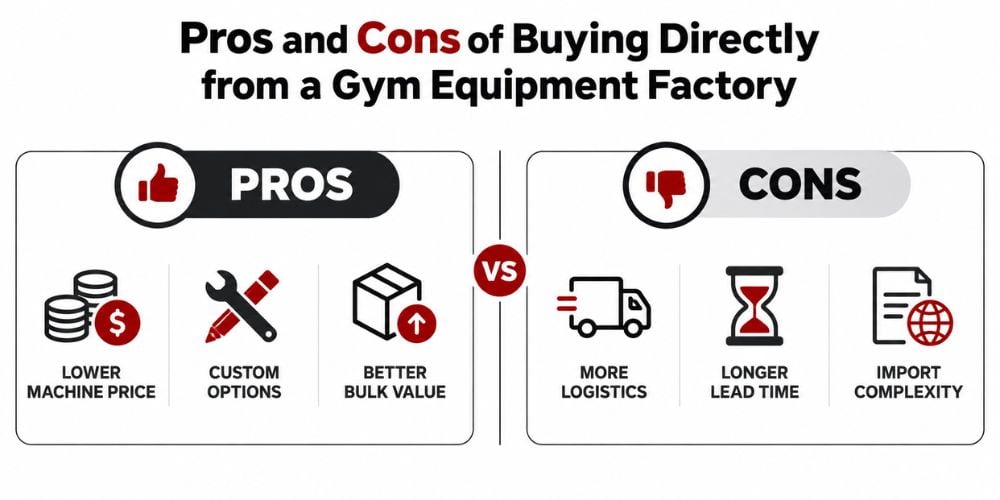
Factory direct can be a smart choice, but it is not perfect for every buyer. Here are the main points to check before you decide.
Pros
- Lower Machine Price: You buy closer to the production source, so there are fewer middle layers adding cost. This is usually helpful for full gym projects or large equipment orders.
- Better for Bulk Orders: Larger orders often get better pricing. If you are buying many machines at once, the savings can become more obvious.
- More Custom Options: You can usually request frame colors, upholstery colors, logos, and other details more easily. This helps your gym look more consistent and professional.
- Direct Factory Communication: You can ask technical questions directly to the manufacturer. This makes it easier to understand materials, movement design, packing, and production details.
- Better Long-Term Control: Factory direct can be useful if you plan to open more branches later. You can keep the same models, colors, spare parts, and buying process.
- More Specification Clarity: You can check steel thickness, cable systems, pulley quality, coating process, and packing details before production. This helps you avoid choosing equipment based only on photos.
Cons
- More Work for the Buyer: You may need to manage freight, customs, local delivery, and installation. This can feel difficult if you are buying from overseas for the first time.
- Longer Lead Time: Factory orders usually need production time before shipping. If you need equipment quickly, this may not be the best option.
- Possible MOQ Requirements: Some factories may require a minimum order quantity. If you only need a few machines, the shipping cost per unit may be too high.
- More Import Details: Duties, taxes, customs documents, and port charges must be handled correctly. A small mistake can cause delays or extra fees.
- Slower Local Support: Overseas spare parts or warranty support may take longer than local service. That is why you should confirm the support process before ordering.
- Higher Risk if the Factory is Weak: A low price is not helpful if the equipment has poor welding, weak frames, bad packaging, or unclear warranty terms. Always verify the factory before placing a large order.
Conclusion
So, is buying directly from a gym equipment factory cheaper?
Yes, it can be.
But only when the full cost is clear.
Do not stop at the machine price. Add shipping, taxes, customs, delivery, installation, spare parts, and your own time.
For large gym projects, factory direct often gives better value. For small or urgent orders, a distributor may still be the easier choice.
The best decision is simple: Compare the real cost after the equipment is ready to use.
If you want to review commercial-grade factory-direct options for your next gym project, explore YR Fitness commercial gym equipment. Start with a rough list of machines, then compare the full landed cost before you decide.
Related articles:



