

Ever wonder why the same weight feels different on two cable machines? The cable ratio is usually the reason.
The quick answer: 1:1 means roughly full resistance, 2:1 means half, and 4:1 means one-quarter. The ratio also affects cable travel.
As an Exercise Physiology & Biomechanics Expert at YR Fitness, I study how pulley systems affect resistance and movement. I use that experience to explain what these numbers really mean during training.
Below, I’ll break down 1:1, 2:1, and 4:1 cable ratios. Keep reading to quickly see which ratio fits your training best.
1. What Is a Cable Machine Ratio?
A cable machine ratio tells you how the weight stack relates to the resistance at the handle.
The rule is easy:
- 1:1: You feel roughly the full selected weight.
- 2:1: You feel roughly half the selected weight.
- 4:1: You feel roughly one-quarter of the selected weight.
Why does resistance change?
It comes down to mechanical advantage. As OpenStax explains in its guide to simple machines, pulley systems can reduce the force needed to move a load, but you pay for that advantage by moving the cable through a greater distance.
Here is why this matters in the gym.
A 40 lb setting on one machine can feel very different from 40 lb on another. The number on the stack is only part of the story.
I often tell people: check the ratio before comparing your cable numbers. It saves a lot of confusion when you switch machines.
2. 1:1 Cable Ratio
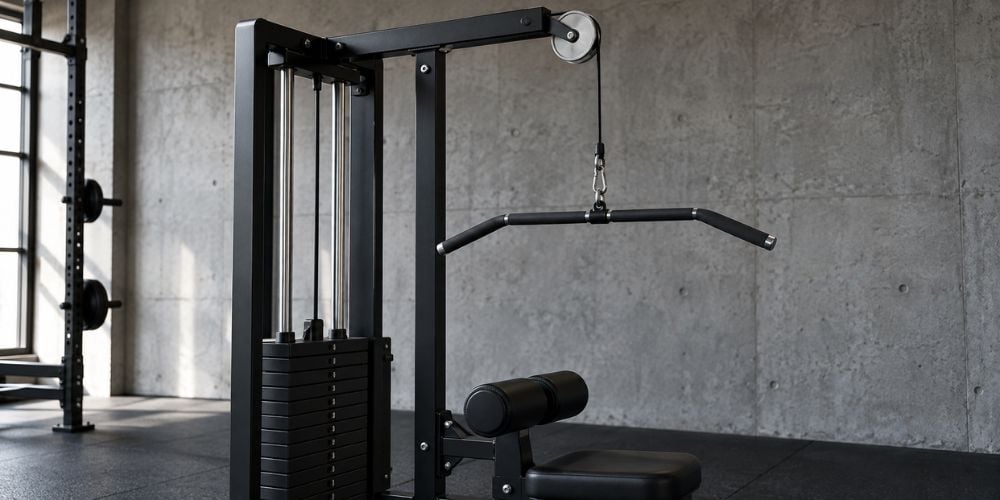
A 1:1 ratio is the most direct setup.
Select 100 lb, and the theoretical resistance at the handle is roughly 100 lb.
Simple Formula
Selected weight ÷ 1 = approximate handle resistance
So:
- 20 lb selected ≈ 20 lb resistance
- 50 lb selected ≈ 50 lb resistance
- 100 lb selected ≈ 100 lb resistance
A 1:1 setup usually feels heavier and more direct. It also lets you reach higher resistance without needing an extremely large weight stack.
You can see this approach on real equipment. For example, the Rogue CTM-1 uses a 1:1 ratio for its lat pulldown and low row, while using a different ratio for its functional-training cable.
What is the trade-off?
Cable travel.
A 1:1 system normally provides less handle travel for the same amount of weight-stack movement than a higher-ratio system.
I think of 1:1 as the strength-focused choice. You get more usable resistance from the same stack.

3. 2:1 Cable Ratio
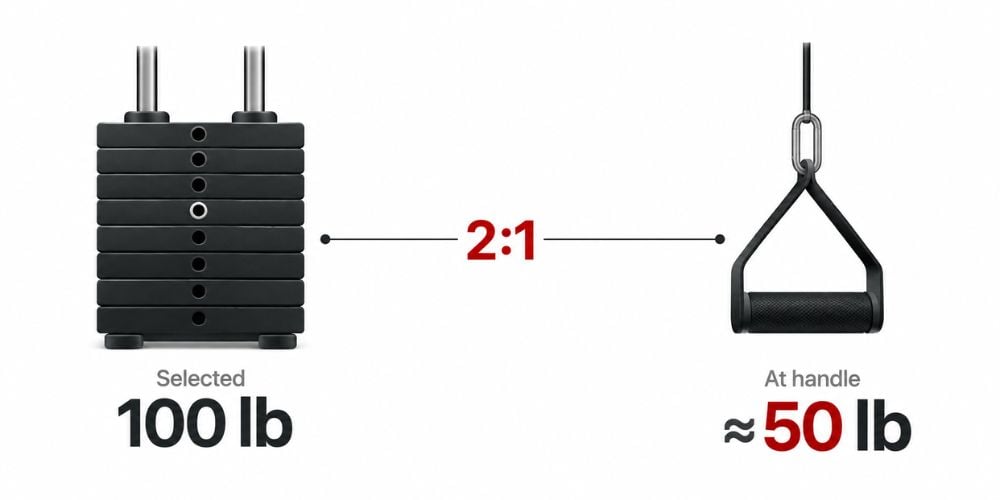
A 2:1 ratio cuts the approximate handle resistance in half.
Select 100 lb, and you feel around 50 lb at the handle.
Simple Formula
Selected weight ÷ 2 = approximate handle resistance
Weight Selected | Approx. Resistance at Handle |
20 lb | 10 lb |
40 lb | 20 lb |
60 lb | 30 lb |
100 lb | 50 lb |
Why would you want half the resistance?
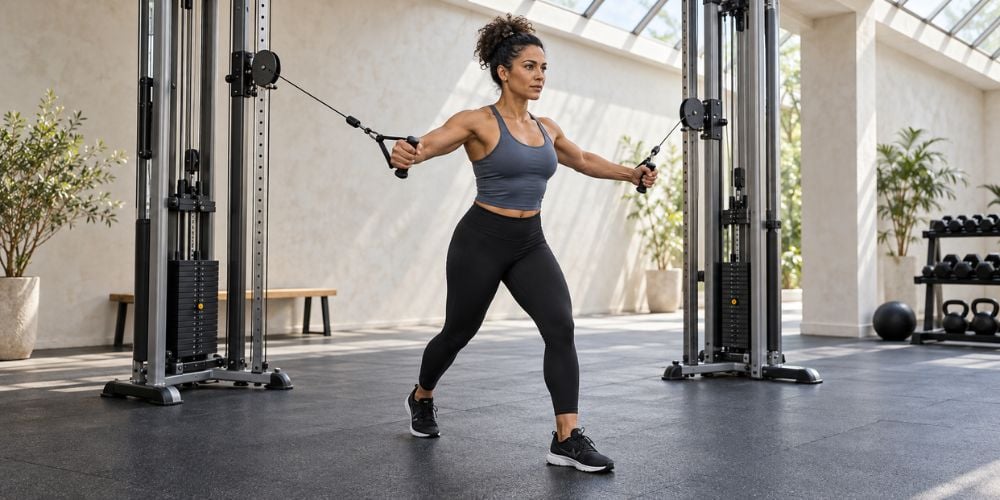
Because you normally gain more cable travel. That extra movement is useful when an exercise requires you to move farther away from the machine or through a larger range.
A 2:1 system can work well for:
- Cable flyes
- Lateral raises
- Cable curls
- Triceps extensions
- Cable lunges
- Rotational movements
The Rogue machine mentioned above is a good real-world example. Its functional-training cable uses a 2:1 ratio, while the pulldown and row operate at 1:1.
That shows something important: one ratio does not have to be better than another. Manufacturers can choose different ratios for different exercise needs.
In my experience, this balance is why 2:1 feels practical for general cable training. You still have useful resistance, but you gain more freedom to move.
If cable feel and movement quality matter to you, check out the strength equipment from YR Fitness. We focus on practical resistance paths and smooth movement, so you can compare more than just the number printed on the weight stack.
4. 4:1 Cable Ratio
A 4:1 ratio reduces resistance even further.
Select 100 lb, and you feel approximately 25 lb at the handle.
Simple Formula
Selected weight ÷ 4 = approximate handle resistance
For example:
- 20 lb selected ≈ 5 lb resistance
- 40 lb selected ≈ 10 lb resistance
- 80 lb selected ≈ 20 lb resistance
- 100 lb selected ≈ 25 lb resistance
That sounds light. So why use it?
The main benefit is cable travel.
Life Fitness, for example, lists a 4:1 cable ratio on its Dual Adjustable Pulley. The manufacturer pairs that ratio with 144 inches of cable travel and describes it as suitable for dynamic movement.
On the other hand, you need much more weight on the stack when you want heavy resistance.
For example, getting roughly 50 lb of theoretical handle resistance from a 4:1 system requires around 200 lb on the stack.
That is the key trade-off.
More cable travel = less resistance from the same stack weight.
So 4:1 is not better or worse. It simply favors cable movement over maximum resistance.
5. Which Cable Ratio Is Better?
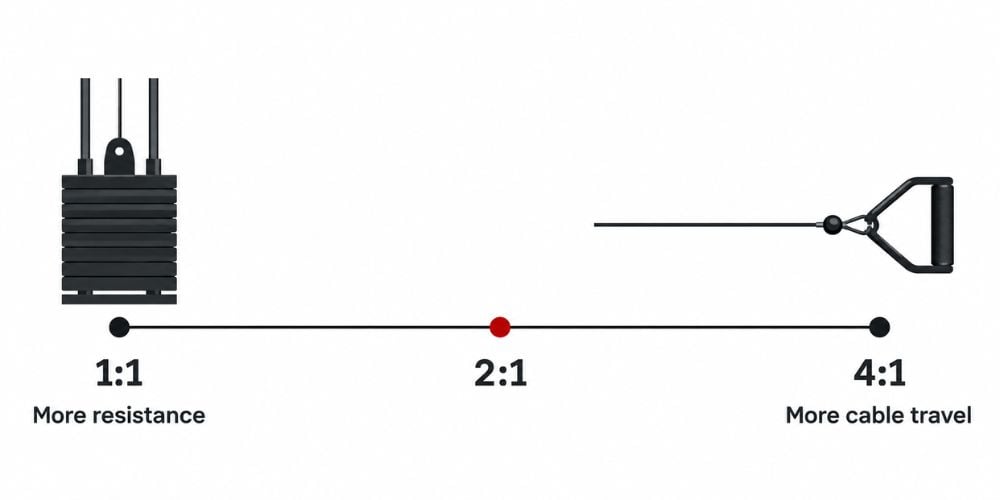
There is no single best cable ratio. It depends on what you want from the machine.
Ratio | Best For | Main Advantage |
1:01 | Heavier strength exercises | More resistance |
2:01 | General cable training | Balance of resistance and cable travel |
4:01 | Long-range and lighter movements | More cable travel |
Choose 1:1 for More Resistance
Want your stack to give you as much resistance as possible?
1:1 is the simple choice.
It works well for movements such as:
- Heavy rows
- Pulldowns
- Cable presses
- Heavy curls or extensions
You get more resistance without selecting extremely large stack weights.
Choose 2:1 for Versatility
For many fitness lovers, 2:1 is the easiest all-around choice.
You get useful resistance plus enough cable travel for upper-body, lower-body, and rotational exercises.
If I were moving between lots of different functional exercises, this is the ratio I would expect to feel especially versatile.
Choose 4:1 for More Cable Travel
Want lighter resistance and more freedom to move?
4:1 may make more sense.
It works well for long-range or faster movement patterns. It is less practical if your main goal is loading cable exercises as heavily as possible.
One thing I always keep in mind is that the ratio does not tell you whether a machine is good or bad. It simply tells you how its pulley system balances resistance against cable travel.
Conclusion
Cable ratios are easy once you know math: 1:1 means full resistance, 2:1 means half, and 4:1 means one-quarter. Just remember that friction and machine construction can make the resistance you actually feel slightly different.
Before comparing cable machines, check the ratio instead of looking only at the stack number. You can also explore YR Fitness to compare cable and strength-machine designs and see which type of resistance setup better matches the way you like to train.
Related articles: