




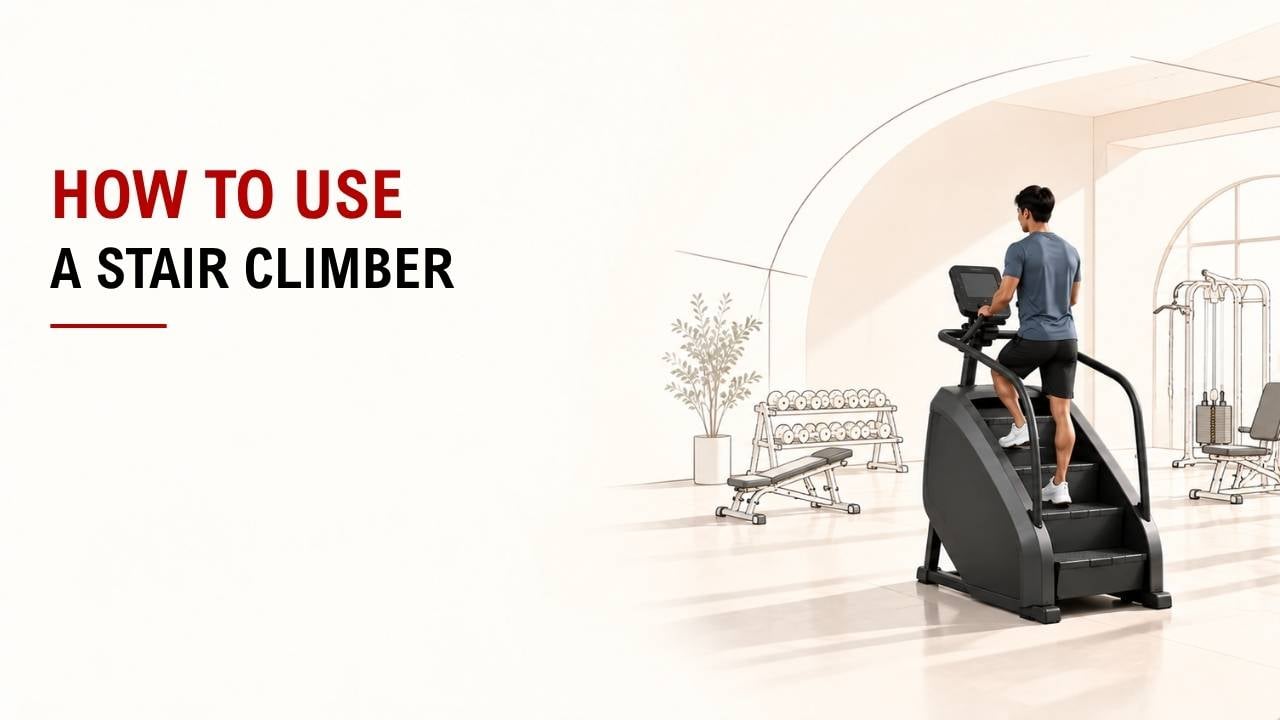

Not sure how to use a stair climber without feeling awkward or unstable? A few small changes to your setup and form can make the machine much easier to use.
The short answer is simple: step on carefully, start slowly, stand tall, place your feet securely, and keep every step controlled. Use the handrails for balance, not to hold up your body weight.
As an Exercise Physiology & Biomechanics Expert at YR Fitness, I pay close attention to posture, foot position, and movement quality. I often see beginners struggle simply because they start too fast or lean too heavily on the rails.
Below, I’ll show you exactly how to use a stair climber step by step. Follow these points in order, and the movement should feel much more natural.
1. Step Onto the Machine Carefully
Hold the handrails and step onto the machine one foot at a time.
Place both feet securely on the steps before you start. Make sure you feel balanced and know where the stop button is.
Why take your time here? Because stair climbing already challenges your balance, and the moving steps add another layer.
Mayo Clinic also emphasizes that good balance matters during stair exercise and recommends making sure you are steady before beginning.
Quick tip: Do not start the machine while you are still trying to position your feet.
2. Start at a Slow Speed
Choose a low speed for your first few minutes.
Let your body get used to the moving steps before increasing the pace. You should feel like you are climbing stairs naturally, not chasing the machine.
I usually tell beginners to find their rhythm first. Speed can come later.
How hard should it feel? At a moderate aerobic intensity, you should generally be breathing harder but still able to talk, according to CDC guide to exercise intensity.
3. Stand Tall
Keep your head up and look forward.
Your chest should stay lifted, your shoulders relaxed, and your back in a natural position. Avoid folding forward over the console.
Should you lean forward?
A small natural forward angle is fine, but you should not hang your body weight on the rails.
I often see posture break down when people get tired. If that happens, lower the speed instead of forcing the pace.
4. Place Your Feet Properly
Place most of your foot on each step.
Try to keep your heel supported instead of climbing only on your toes. This usually gives you a more stable stepping pattern.
Keep it simple:
- Place your foot securely on the step.
- Keep your knee moving roughly in the same direction as your toes.
- Keep your heel supported when possible.
- Push through the step smoothly.
Avoid letting half your foot hang off the edge.
Cleveland Clinic notes that stair-climbing machines work the glutes, quadriceps, hamstrings, and calves while also challenging balance.
If you regularly train on cardio machines, smooth movement and a stable platform can make each session more comfortable. At YR Fitness, we design commercial cardio equipment for repeated daily use, so you can explore our equipment if you want to compare different training options.
5. Take Controlled Steps
Step smoothly instead of rushing.
Let one step flow naturally into the next. You do not need exaggerated movements or very high knees.
I prefer controlled steps because they make good posture much easier to maintain.
If your feet keep hitting the steps heavily, slow down. The machine should not feel like it is pulling you along.
What Does Good Form Look Like?
Good Form | Sign You Should Slow Down |
Smooth, quiet steps | Feet hitting steps heavily |
Upright posture | Folding over the console |
Light grip on rails | Supporting yourself with your arms |
Feet securely placed | Feet slipping toward the edge |
Steady rhythm | Struggling to keep up |
Controlled breathing | Pace feels immediately overwhelming |
6. Use the Handrails Mainly for Balance
Keep a light grip on the handrails.
They are there to help you balance. Try not to support a large amount of your body weight with your arms.
Why does this matter?
When you lean heavily on the rails, your legs do less work and your normal climbing position changes.
Use the rails more when getting on, getting off, or regaining balance. During normal climbing, keep your grip light.
Cleveland Clinic also points out that using less support from the rails challenges your core and balance more, while stressing that you should do this cautiously to avoid a fall.
7. Adjust the Speed or Resistance
Once the movement feels comfortable, gradually make the workout harder.
You can:
- Increase the stepping speed.
- Increase the resistance if your machine offers it.
- Exercise for longer.
- Alternate easier and harder periods.
Do not change everything at once.
Start with a comfortable pace for several minutes. Then increase the level slightly and check whether you can still maintain good posture.
If you start leaning heavily, missing steps, or losing your foot position, reduce the level.
A harder setting only helps if you can still control the movement.
For some broader context, the current U.S. Physical Activity Guidelines recommend that adults work toward at least 150 minutes of moderate-intensity aerobic activity per week, or 75 minutes of vigorous activity, or an equivalent combination.
Conclusion
Using a stair climber is simple when you focus on the basics. Step on carefully, start slowly, stand tall, place your feet securely, take controlled steps, and use the rails mainly for balance.
From a biomechanics point of view, I would choose good movement over maximum speed every time.
If you also want to compare well-built cardio and strength equipment for regular training environments, you can explore YR Fitness equipment here and find an option that fits your training setup.
Related articles: