




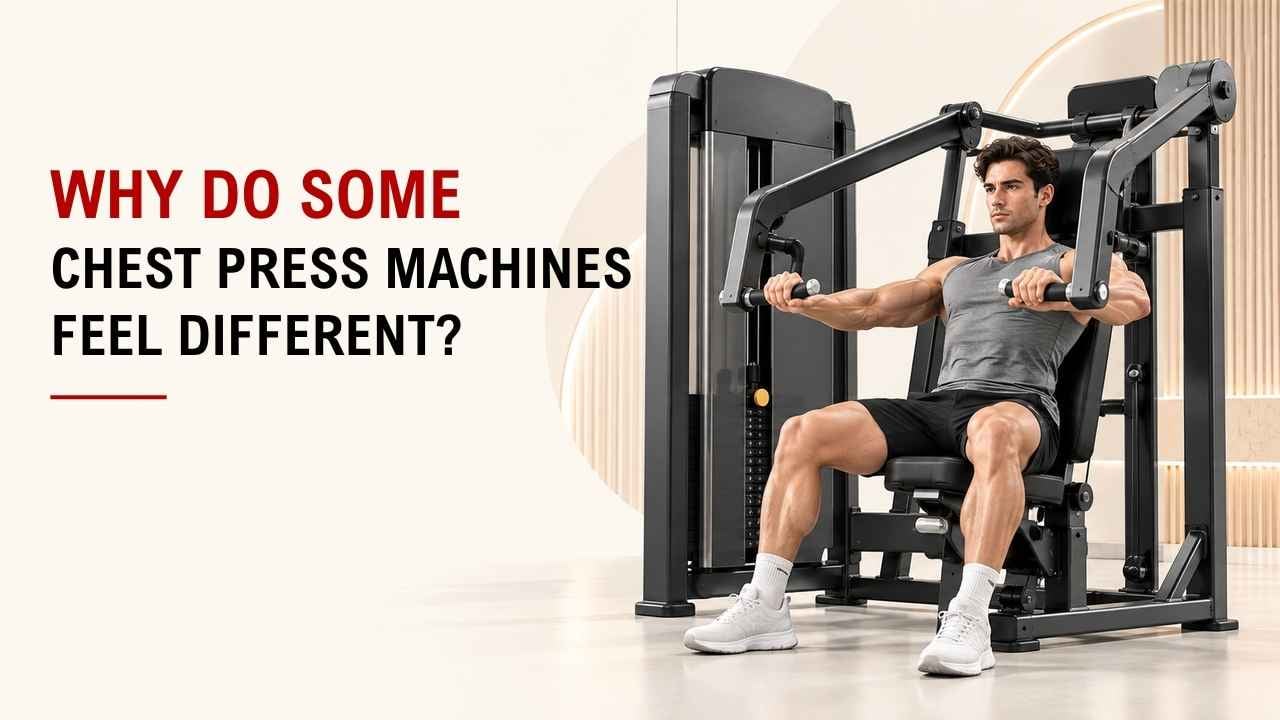

Have you ever used one chest press that felt smooth, then tried another that felt much harder? The machine design is usually the reason.
Different pressing paths, handles, seat positions, and resistance systems can change how the exercise feels.
As the founder and chief designer of YR Fitness, I have worked closely with these details across many strength machine designs. I have spent decades studying how small mechanical changes affect movement.
Below, I will break down the six main reasons this happens. You will also learn what to adjust before deciding that a machine simply does not work for you.
- 1. Different Machines Use Different Pressing Paths
- 2. Handle Position Changes How the Press Feels
- 3. Seat and Backrest Angles Change Where You Feel the Exercise
- 4. Some Machines Give You a Deeper Starting Position
- 5. Your Body Proportions Change How a Machine Feels
- 6. Machine Design Also Explains Why It Feels Different
- Conclusion
1. Different Machines Use Different Pressing Paths
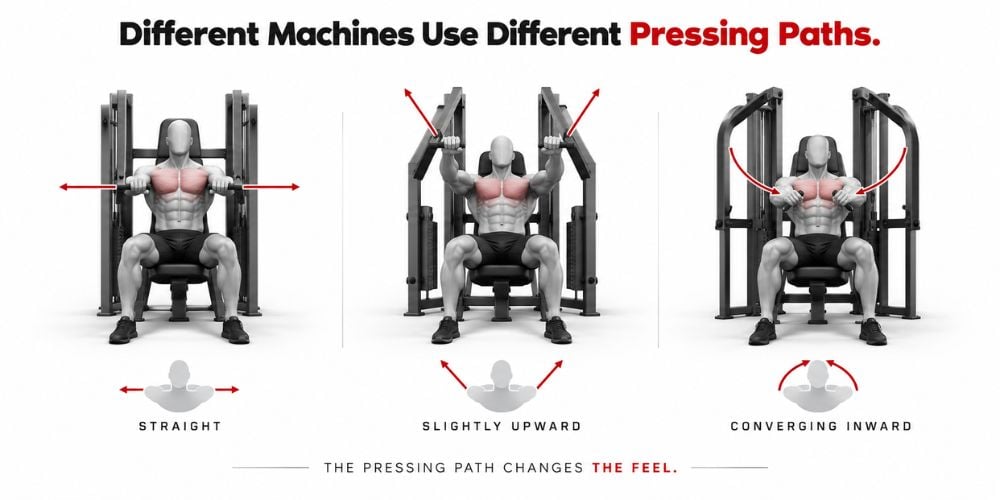
The first thing to look at is where the handles go when you press.
Some machines push almost straight forward. Others move slightly upward, while converging machines bring your hands closer together near the end of the press.
That path changes how your shoulder and elbow joints move.
Some chest press machines also let your arms move independently.
That can make the exercise feel less locked in because your left and right arms are not forced to follow one shared path.
So which path is better?
There is no single answer for everyone.
A straight press may feel stable and predictable. A converging motion may feel more natural to you because your arms can move inward as you finish the rep.
I would focus on one simple question:
Can you press smoothly without your shoulders feeling forced into an awkward position?
If yes, that movement path is probably a reasonable fit for you.
2. Handle Position Changes How the Press Feels
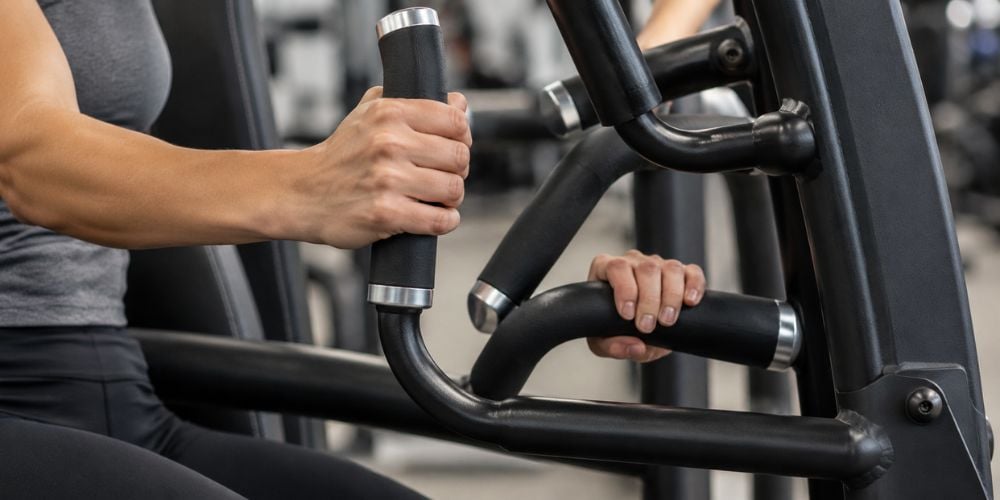
Handles can completely change your impression of a machine.
You may see:
- Wide grips
- Narrow grips
- Neutral grips
- Angled handles
- Multiple grip choices
Why does this matter?
Because your hands affect your elbows, and your elbows affect what happens at your shoulders.
A wider grip may give you a different chest stretch.
A narrower grip can change the contribution from your arms and reduce how far your elbows flare outward.
A neutral grip, where your palms face each other, may simply feel better for some shoulders.
Here is the quick comparison:
Handle setup | What you may notice | What to check |
Wider grip | More elbow flare and a different chest stretch | Shoulder comfort |
Narrower grip | Elbows stay closer to the torso | Triceps involvement |
Neutral grip | Palms face inward | Wrist and shoulder comfort |
Angled grip | Changes wrist and elbow position | Whether the path feels natural |
The handle itself matters too.
Thickness, shape, and angle can change how secure or comfortable the press feels in your hands.
Should you copy someone else’s grip?
Not necessarily.
If another handle position lets you control the weight better without discomfort, use that one.
3. Seat and Backrest Angles Change Where You Feel the Exercise
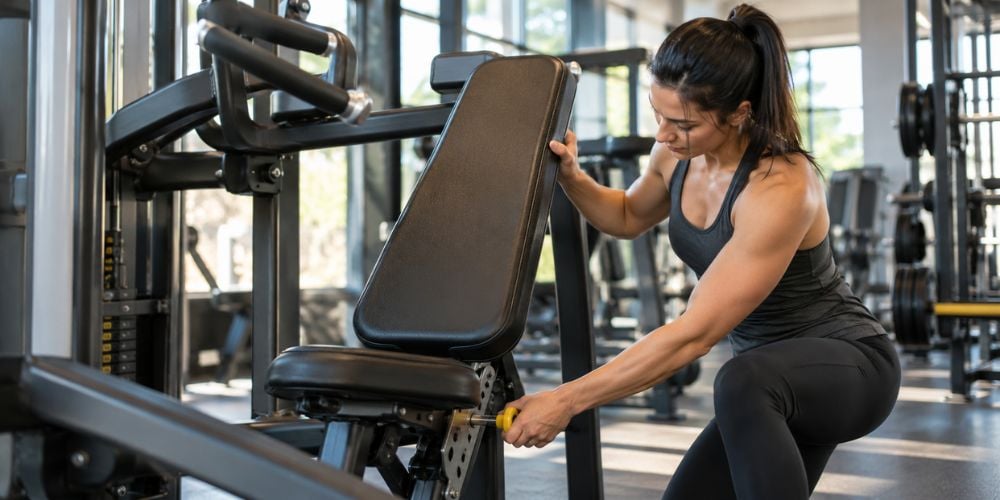
Before you blame the machine, check the seat.
It sounds simple, but this is one of the first things I look at when someone says a machine feels wrong.
If the seat is too low, the handles may sit higher relative to your chest. If the seat is too high, they may line up lower.
That changes your pressing angle.
The backrest angle matters too.
A study involving 30 trained adults tested bench press angles of 0°, 15°, 30°, 45°, and 60° at 60% of one-repetition maximum. The researchers found that the upper portion of the pectoralis major showed its highest EMG activity at 30°, while anterior deltoid activity was highest at 60°.
That study used a bench press rather than a seated chest press machine, but the practical lesson carries over: changing your torso angle changes how your pressing muscles work.
So before switching machines, try moving the seat.
One or two positions can make more difference than people expect.
Keep your back supported and see where the handles meet your body. You want a position where you can press without feeling like your shoulders are being pushed into an uncomfortable angle.
4. Some Machines Give You a Deeper Starting Position
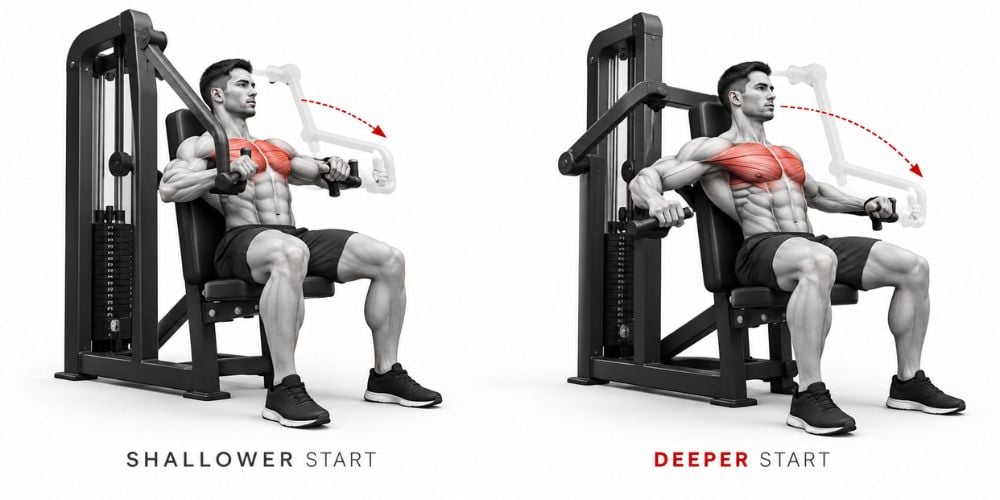
Now look at the bottom of the rep.
Where do your elbows start?
On one machine, they may stay fairly close to the sides of your body. On another, the handles may travel farther back, placing your upper arms farther behind your torso.
That creates a deeper starting position.
For some people, that extra range feels like a good chest stretch.
For others, it feels uncomfortable at the front of the shoulders.
Your mobility matters here.
So does the machine’s geometry.
Is a deeper stretch automatically better?
No.
More range is useful only if you can control it comfortably. If you have to pull your shoulders forward, twist your body, or fight the starting position before you even press, the setup may be too deep for you.
Some machines let you adjust the starting position. If yours does, test several settings with a light load first.
Want to see what these differences look like on actual equipment? On our YR Fitness chest press range, we use different layouts including seated, incline, independent, and converging designs, so you can compare arm paths, adjustable seats, and grip setups side by side. Our 61A04A converging chest press, for example, combines an adjustable seat with dual grip options and a converging arm path.
5. Your Body Proportions Change How a Machine Feels
Here is the part many lifters overlook.
You are part of the machine setup.
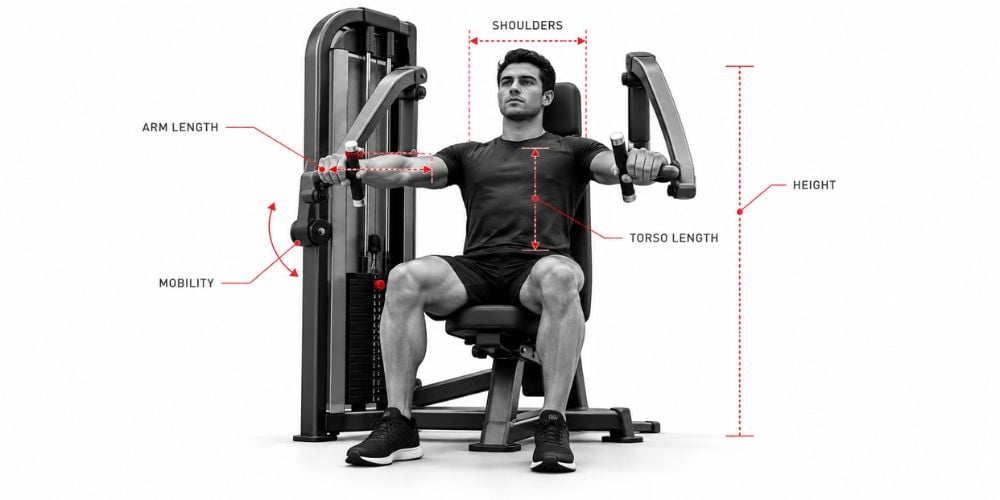
Your:
- Arm length
- Shoulder width
- Torso length
- Height
- Mobility
all affect where you sit and how far you have to move the handles.
This is not just gym talk.
Research looking at bench press performance has specifically examined arm length, body height, and shoulder width as meaningful anthropometric variables.
Another study specifically tested body mass, total arm length, and biacromial width as predictors of bench press performance.
What does that mean to you?
A person with longer arms may have to travel a larger distance.
Someone with broader shoulders may prefer a different handle width.
A shorter or taller torso can also change where the handles line up against the chest.
That is why your training partner can love a machine that feels terrible to you.
Try this before adding weight:
- Set the seat.
- Do several light repetitions.
- Check where your elbows start.
- Notice whether your shoulders stay comfortable.
- Make sure your back stays supported.
Then add weight.
It takes less than a minute and tells you far more than jumping straight into a heavy set.
6. Machine Design Also Explains Why It Feels Different
Finally, there is something you cannot fix by adjusting the seat.
The machines themselves may use completely different mechanics.
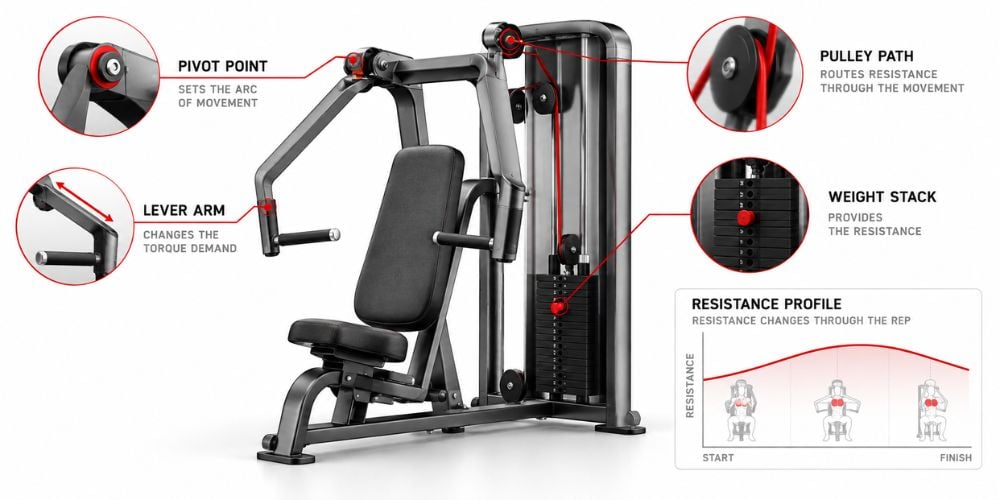
Two machines can both say “Chest Press” but have different:
- Pivot locations
- Lever-arm lengths
- Cable arrangements
- Pulley systems
- Weight stacks
- Plate-loaded arms
- Resistance profiles
Here is why this matters.
The weight you select is only part of what you feel.
The machine determines how that external resistance reaches your hands through the movement.
One machine feels hardest at the bottom.
Another seems to get difficult halfway up.
Another feels fairly even through the whole rep.
Can You Compare Weight Numbers Between Machines?
Be careful.
If you press 70 kg on Machine A but only 55 kg on Machine B, you cannot automatically say you became weaker.
The machines may use different lever lengths, pivot points, pulleys, or resistance profiles.
The number on the stack tells you what load you selected. It does not tell you that two different machines place the same resistance at your hands throughout the entire rep.
That is why chasing the same number from machine to machine is not very useful.
Instead, ask:
Can I control weight?
Do my shoulders feel comfortable?
Can I feel my chest doing the work?
Those questions tell you much more.
Conclusion
Chest press machines feel different because their movement path, handles, seat setup, starting position, and resistance mechanics are different. Your body proportions also affect how well each design fits you.
So do not judge a machine only by the weight number. Focus on comfort, control, and whether you can feel your chest working.
If you want to compare different designs, explore the YR Fitness chest press collection and look at how the handles, seats, and pressing paths differ.
Related articles: