









Is your gym machine wearing out, and you are not sure whether to repair or replace it? A small problem may be worth fixing, but repeated issues can cost you more.
The simple answer is: repair it when the problem is minor and the machine is still reliable. Replace it when repairs become frequent, expensive, or related to safety.
As the founder and chief designer of YR Fitness, I have spent decades working with commercial fitness equipment. In my experience, the key is knowing when a repair still adds useful life and when replacement makes more sense.
Below are five quick checks to help you decide. Start with repair cost, then look at age, reliability, and safety.
1. Start With the Repair Cost
First, find out what the repair will actually cost.
The replacement part is only one piece of the bill. Look at the full cost before deciding.
Cost to Check | Why It Matters |
Replacement parts | Some components are inexpensive; others can make a repair costly |
Technician labor | Complex repairs may require several hours of work |
Shipping | Large or imported parts can add extra cost |
Installation | Some components need professional fitting or calibration |
Equipment downtime | You cannot use the machine while waiting for repair |
Then compare the total with the cost of replacing the machine.
A $100 repair on an otherwise reliable machine is usually easy to justify. A major repair on an old machine that already has several worn components deserves more thought.
Here is the question I use: How much useful life am I getting after this repair?
If the repair gives you several more reliable years, fixing it can make sense. If you expect another failure soon, replacement may be the better use of your money.
2. Check the Age of the Equipment
Is an old machine automatically a bad machine? No.
A well-maintained strength machine can remain useful for many years. The more important question is how well it has aged.
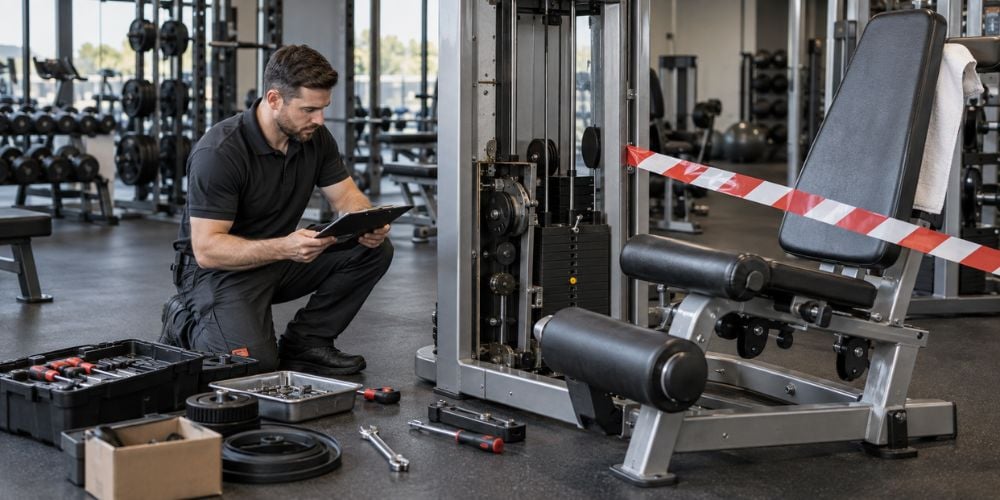
Watch for increasing noise, loose adjustments, repeated belt or cable wear, worn bearings, cracked upholstery, corrosion, electronic problems, and spare parts that are getting difficult to find.
Regular inspection helps you catch these issues earlier. For example, Life Fitness recommends inspecting strength-machine cables for wear and replacing them at the first sign of damage.
Cardio equipment deserves extra attention. Treadmills, bikes, and ellipticals contain motors, displays, control boards, belts, and other components that can become more expensive to maintain as the machine ages.
Precor’s commercial maintenance schedule, for example, includes regular checks of belts, power cords, frames, welds, electronics, and moving components.
If an older machine still runs smoothly and parts are easy to source, keep using it. If several systems are starting to fail together, replacement becomes more practical.
3. Repair It When the Problem Is Minor
A worn component does not automatically mean the whole machine needs to go.
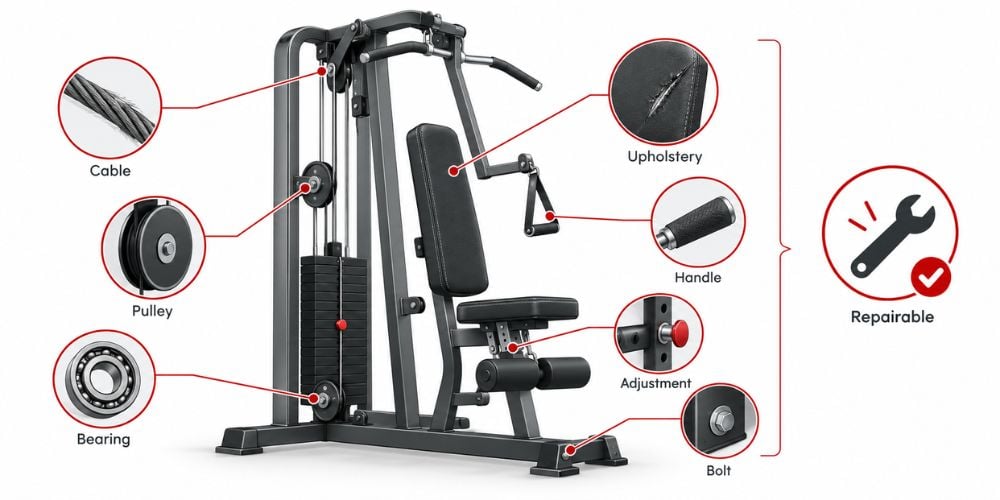
Common repairable problems include:
- Worn cables
- Loose bolts
- Damaged upholstery
- Adjustment pins
- Handles and grips
- Pulleys
- Bearings
- Walking belts
- Small plastic covers
If the frame is solid and the machine still moves correctly, repair is usually the better choice.
In my decades of design experience, I have seen plenty of equipment stay in service simply because a worn component was replaced at the right time. Good maintenance is often much cheaper than replacing a machine too early.
If you are comparing repair costs with the price of new commercial equipment, YR Fitness can help you look at durable strength and cardio options built for heavy daily use. Our goal is to help you choose equipment that makes sense for long-term operation, not simply replace a machine because one part has worn out.
4. Replace It When Problems Keep Coming Back
One repair is normal. Repairs every few weeks are different.
Maybe you replace a bearing this month, repair a cable next month, and then find a problem with the adjustment system shortly afterward. At that point, you are no longer dealing with one isolated fault.
You are maintaining a machine that may be approaching the end of its useful life.
What You Are Seeing | Repair or Replace? |
One minor problem and the rest of the machine is sound | Repair |
Parts are available and inexpensive | Repair |
Machine still performs smoothly after maintenance | Repair |
Different components keep failing | Consider replacing |
Repair costs keep increasing | Consider replacing |
Parts are becoming hard to find | Consider replacing |
Machine stays unavailable too often | Replace if downtime continues |
Performance keeps declining after repairs | Replace |
Keep a simple record of repairs and what you spend. Several small bills can add up faster than you expect.
Still unsure? Look at the pattern, not the latest breakdown.
If the machine keeps returning to normal after minor repairs, keep it. If every repair is followed by another problem, your money may be better spent on replacement.
5. Replace Equipment With Safety or Structural Problems
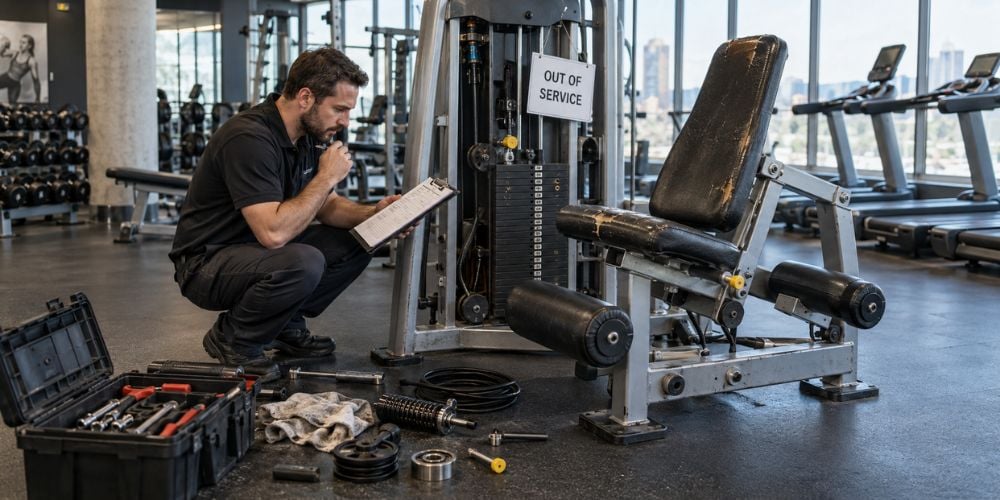
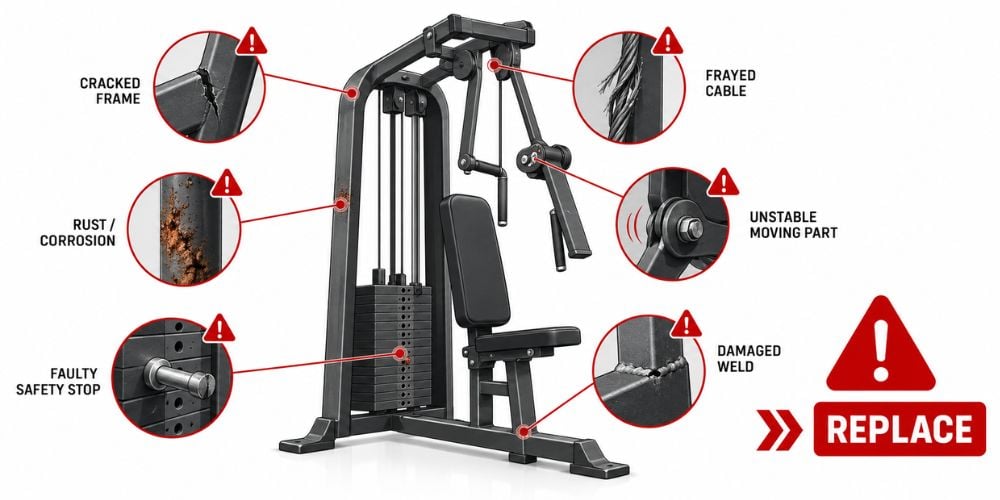
Safety problems need a different approach. Stop using the machine if a critical part looks damaged or unstable.
Watch for:
- Cracked frames
- Damaged welds
- Severe rust or corrosion
- Frayed cables
- Loose or unstable moving parts
- Faulty safety stops
- Major electrical problems
- Weight stacks that do not move correctly
If the machine was sold in the U.S., you can also check the U.S. Consumer Product Safety Commission recall database to see whether the model has a known safety issue.
If a qualified technician can restore it safely, repair may still be possible. If the frame or other critical parts are badly damaged, replacement is usually the safer choice.
When replacing equipment, check the frame, materials, movement design, spare-parts support, and overall build quality—not just the appearance.
Conclusion
Repair your gym equipment when the problem is small, the machine is still reliable, and the cost makes sense. Replace it when breakdowns keep coming back, repairs become expensive, or safety is a concern.
If you want to replace aging equipment with machines built for heavy daily use, at YR Fitness, we can help you choose commercial strength and cardio equipment that fits your space, training needs, and long-term budget.
Related articles:



