








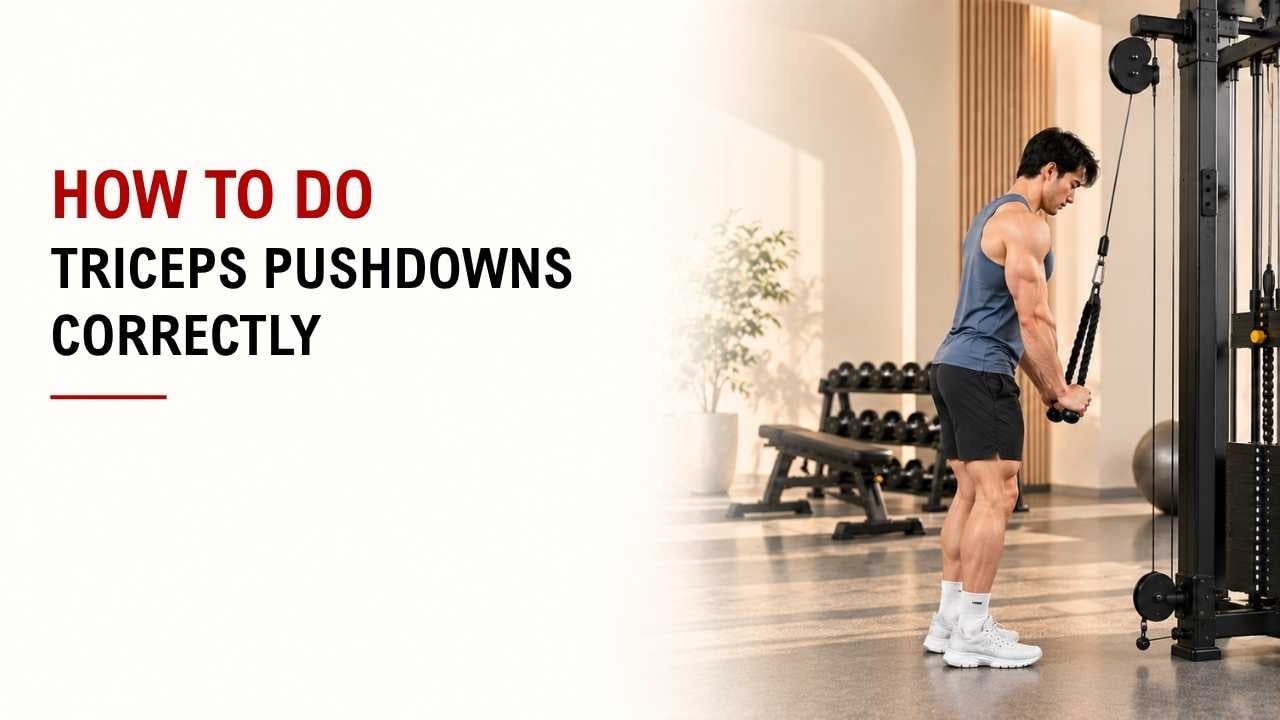

Are your triceps pushdowns turning into full-body movement? Small mistakes with your elbows, posture, or weight can quickly take tension away from your triceps.
The short answer is: keep your elbows close to your body, push the handle down by extending your elbows, and return slowly. You do not need heavy weight to make the exercise effective.
As an Exercise Physiology & Biomechanics Expert at YR Fitness, I pay close attention to joint position, resistance, and movement control. I often see pushdowns improve immediately when people reduce the weight and stop letting their elbows swing.
Below, I’ll show you the correct setup, movement, weight, and rep range. Follow these six steps to make every rep cleaner and easier to control.
1. Set the Cable to the Highest Position
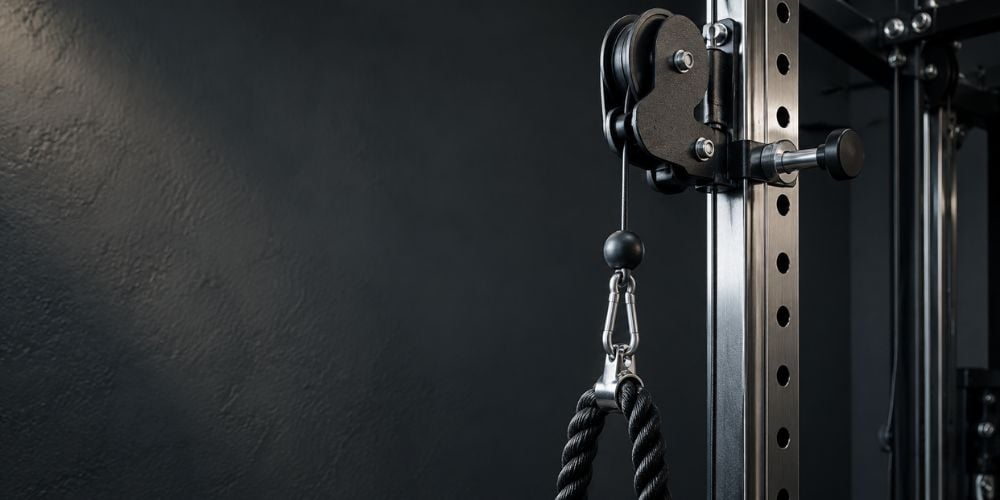
Start by moving the pulley near the top of the cable machine. This gives you the downward resistance you need for a standard triceps pushdown.
You can use several attachments:
Attachment | What It Feels Like | Good For |
Rope | More freedom for the hands | Separating the rope at the bottom |
Straight bar | Stable and simple | Basic pushdowns |
Angled bar | More neutral wrist position | Wrist comfort |
A rope or angled bar feels comfortable for many people, but there is no need to overthink it.
The American Council on Exercise triceps pressdown guide also recommends placing the pulley high, keeping the elbows near your sides, and pressing downward under control.
How heavy should you start?
Go lighter than you think you need. I would rather see 12 clean reps than 6 heavy reps with your whole body moving.
2. Get Into the Correct Starting Position
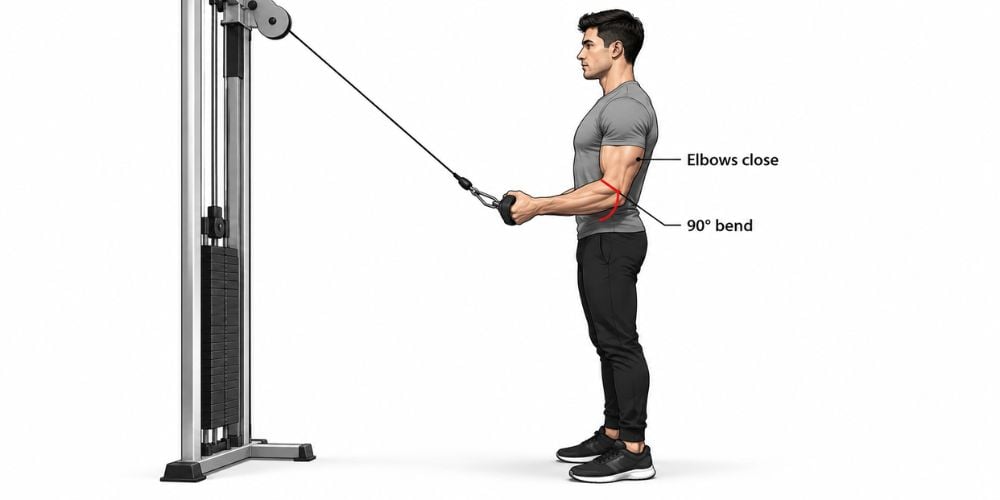
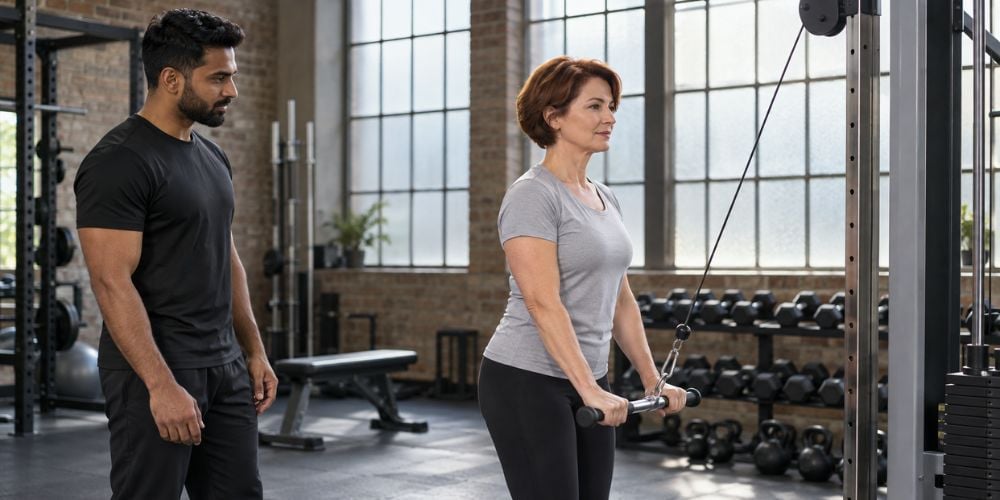
Stand close to the machine with your feet about shoulder-width apart.
Keep your:
- Chest upright
- Core lightly braced
- Shoulders relaxed
- Elbows close to your sides
Your elbows should normally start bent at roughly 90 degrees.
A small forward lean is fine if it feels natural. Just avoid bending your whole body over the attachment.
I often tell people to imagine their elbows are lightly attached to their ribs. They do not need to stay perfectly frozen, but they should not swing forward and backward.
Quick check: Are your shoulders doing most of the work?
If yes, reset your position and reduce the weight.
3. Push the Handle Down
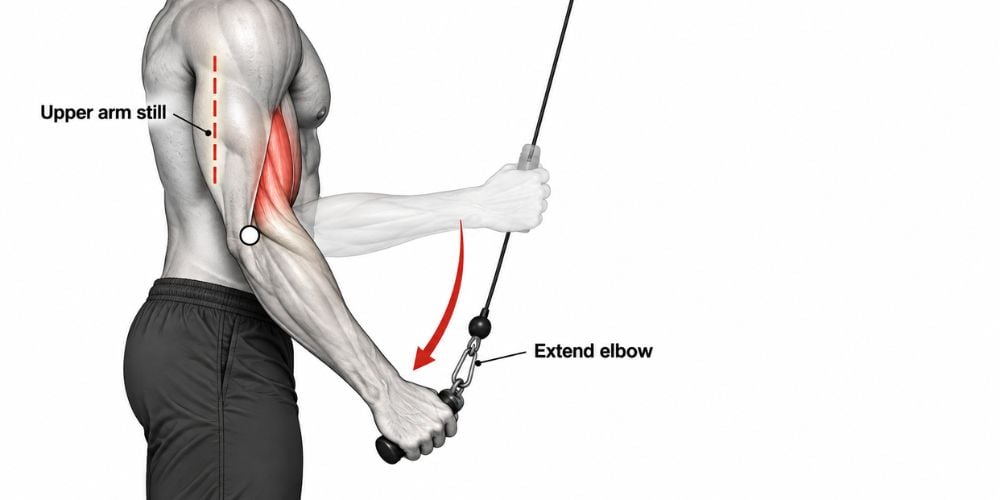
Extend your elbows and push the attachment toward the floor.
Think about moving your forearms, not your entire arms. Your upper arms should stay relatively still.
For a rope pushdown:
- Push the rope downward.
- Separate the ends slightly near the bottom.
- Keep your wrists comfortable.
- Stay in control throughout the rep.
Do not use your body weight to force the cable down.
If you need to bounce, swing your shoulders, or lean forward aggressively, the resistance is probably too heavy.
At YR Fitness, we design commercial strength equipment with stable movement and smooth resistance in mind. If you want to compare cable-machine designs used for movements like pushdowns, explore our strength equipment range.
4. Finish the Rep Without Overextending
At the bottom, your arms should be almost fully straight.
Pause briefly and squeeze your triceps. Do not force your elbows into an aggressive lockout.
I often see people keep pushing after the elbows have already straightened. That usually adds unnecessary shoulder movement instead of giving the triceps more useful work.
Use this simple cue:
Straighten. Squeeze. Stop.
Then begin the return.
5. Return Slowly
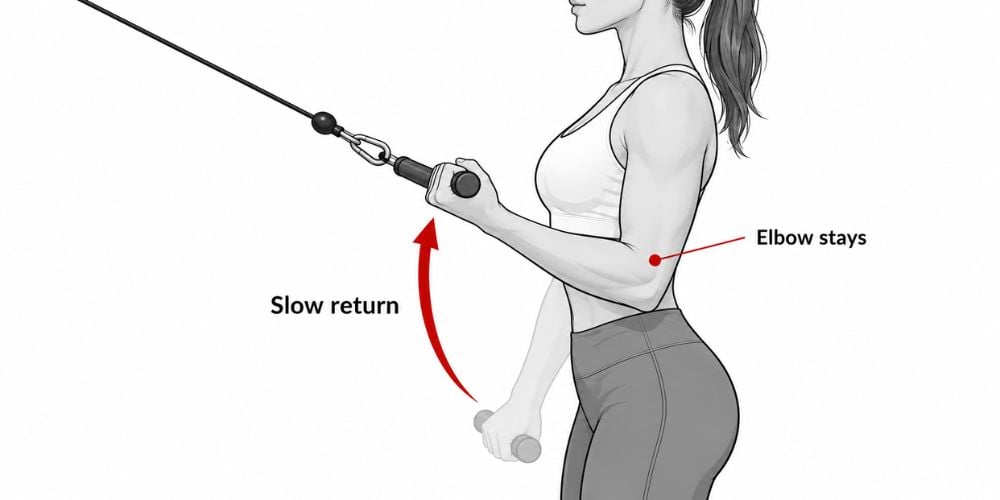
Do not let the weight stack pull your arms straight back up.
Bend your elbows slowly and let the attachment return to the starting position under control.
Think of the exercise as two equal parts:
Push down under control → return under control.
This matters because good resistance training is not only about moving the weight. The ACSM resistance-training guidance emphasizes matching load and training volume to your goal rather than making every exercise unnecessarily complicated.
Does the weight stack crash between reps?
Slow down. You should control the cable instead of letting the cable control you.
6. Use the Right Weight and Rep Range
There is no single perfect weight for everyone.
Choose resistance that lets you keep your elbows stable and your repetitions smooth.
Training Focus | Rep Range | Main Goal |
Learning technique | 10–15 reps | Control the movement |
Muscle building | 8–15 reps | Challenge the triceps |
Higher-rep training | 15–20 reps | Controlled muscular fatigue |
For many fitness lovers, 2–4 sets of 8–15 repetitions works well as part of an upper-body or arm workout.
The final few reps should feel challenging, but your technique should still look similar to the first few reps.
If your elbows start moving, your shoulders begin swinging, or you need momentum to finish the set, reduce the weight.
For overall fitness, remember that one triceps exercise is only part of the picture. The CDC physical activity guidelines recommend muscle-strengthening activity on at least 2 days per week for adults, covering the major muscle groups.
Quick Form Checklist
Before your next set, ask yourself:
- Is the cable set high?
- Are my elbows close to my body?
- Are my shoulders relaxed?
- Am I pushing through elbow extension?
- Am I controlling the return?
- Can I finish without swinging?
If the answer is yes, your technique is likely on the right track.
Conclusion
Correct triceps pushdowns are simple: keep your elbows stable, extend your arms under control, squeeze at the bottom, and return slowly. Master those basics before worrying about heavier resistance.
I recommend starting light and increasing the load only when your form stays clean.
If you want to explore cable and strength equipment built for smooth daily training, you can browse the commercial equipment available from YR Fitness.
Related articles:



