
Want to train your side shoulders with cables? Cable lateral raises are easy once your setup is right.
The simple method is to set the pulley low, raise your arm to the side, and lower it slowly. Keep the weight light enough to avoid swinging.
As an Exercise Physiology & Biomechanics Expert at YR Fitness, I work closely with exercise movement, joint position, and cable-machine biomechanics. I often see small setup changes make shoulder exercises feel smoother and easier to control.
Below, I’ll show you how to perform cable lateral raises step by step. Follow the setup and technique points, and you’ll be ready to use them in your workout.
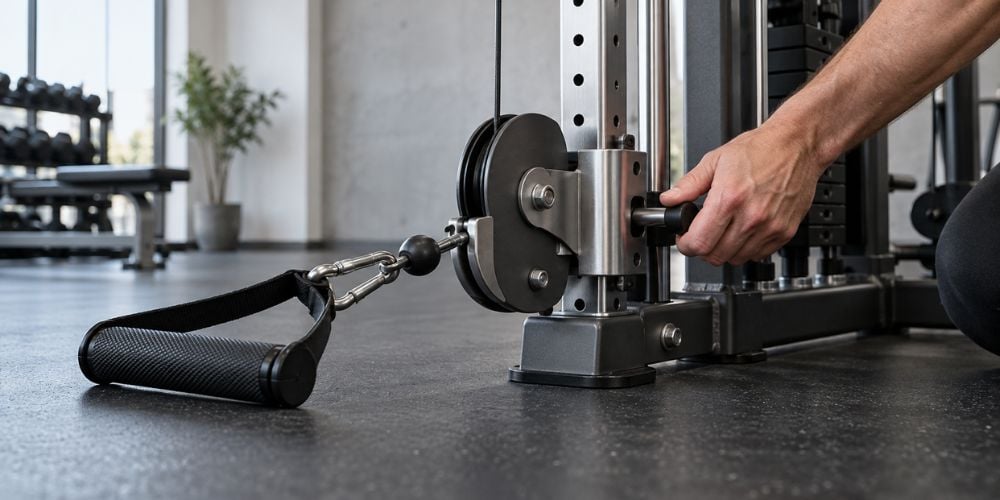
1. Set the Cable Pulley Low
Move the pulley to its lowest position and attach a single handle.
Choose a light weight for your first set. Lateral raises do not need heavy resistance to challenge your shoulders.
Stand sideways beside the machine with enough room to move your arm freely.
Why start light? If the weight makes you swing or shrug, your form will usually break down before your shoulders get the work you want.
A 2025 study comparing cable and dumbbell lateral raises found that both produced similar increases in lateral-deltoid muscle thickness in trained participants. The key takeaway is simple: cables can work well, but good training still depends on controlled resistance and consistent technique.
2. Grab the Handle With the Outside Arm
Hold the handle with the arm farthest from the machine.
For example, if the machine is on your left, hold the handle with your right hand.
Let the cable pass across the front of your body. Keep your wrist straight and your grip comfortable.
Here is the basic setup:
Check | Position |
Pulley | Lowest position |
Body | Sideways to the machine |
Working arm | Farthest from the machine |
Grip | Comfortable and neutral |
Cable path | Across the front of your body |
Elbow | Slightly bent |
This position gives the cable a clear path while letting your working arm move out to the side.
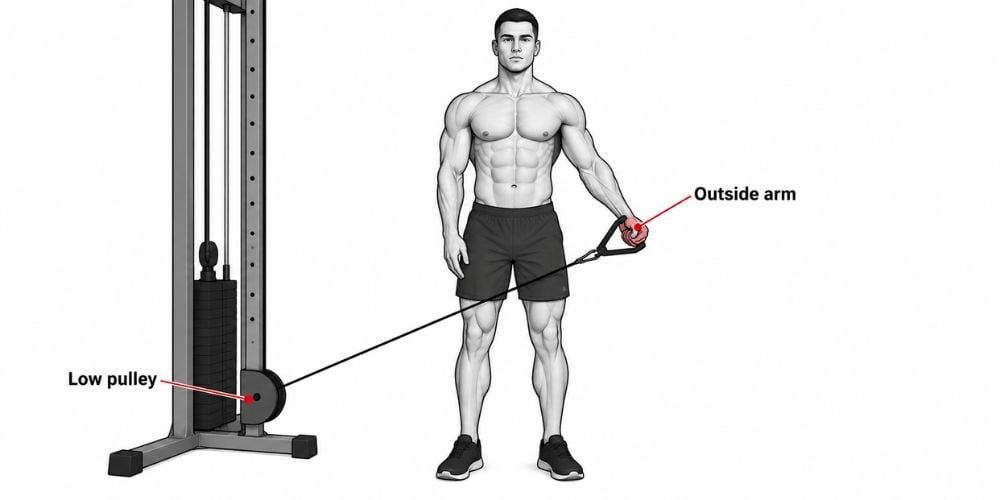
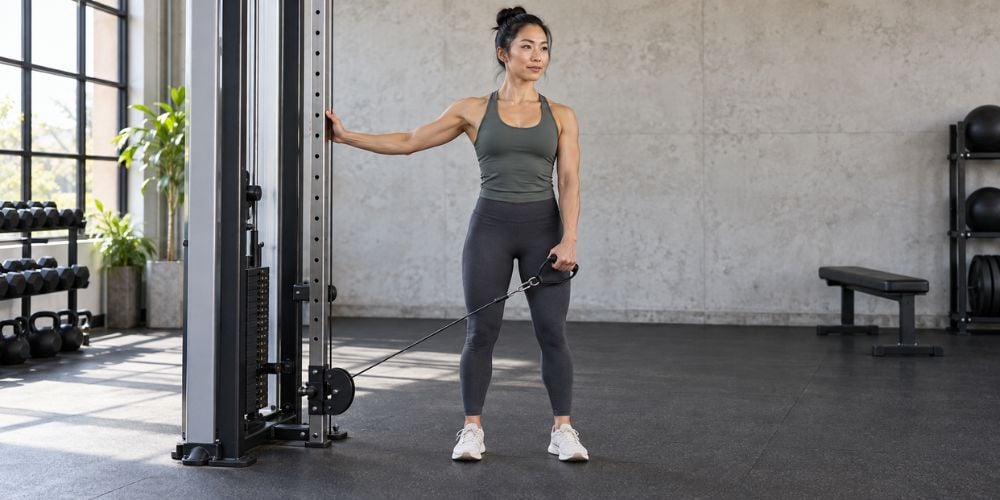
3. Set Your Starting Position
Stand tall with your feet around shoulder-width apart.
Keep a small bend in your knees and brace your core so your body does not rock.
Your working elbow should stay slightly bent. Do not lock your arm completely straight.
Let your hand start near your opposite thigh or slightly in front of your body. Keep your shoulder down instead of shrugging it toward your ear.
Not sure what to focus on? Think about keeping your body quiet while your shoulder moves the arm.
Research comparing different lateral-raise positions found that arm and shoulder rotation can change how the deltoid and surrounding muscles are recruited. You can read the lateral-raise EMG study on PubMed for the full comparison.
4. Raise Your Arm Out to the Side
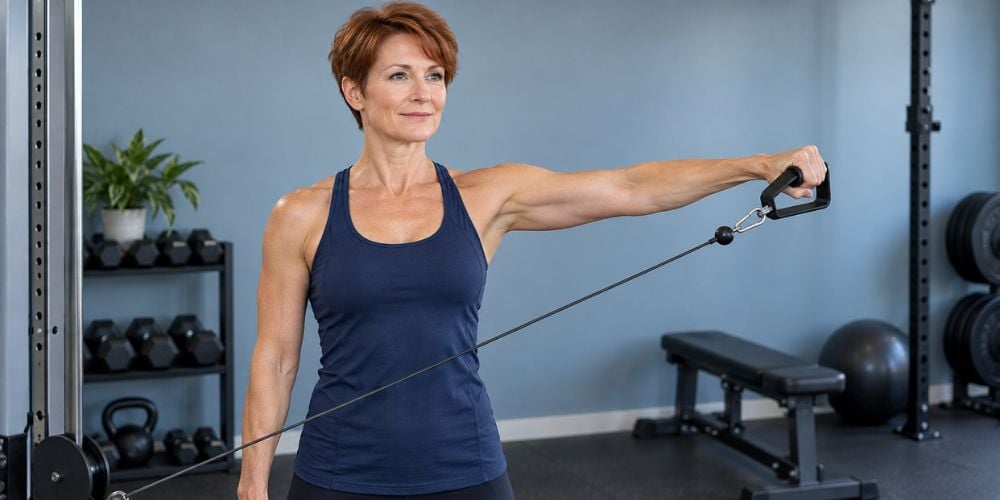
Raise your arm outward in a smooth, controlled motion.
Lead slightly with your elbow and keep the same small bend throughout the rep.
Lift until your arm is roughly parallel with the floor, or until you reach a comfortable shoulder height.
I usually suggest thinking about moving your elbow away from your body instead of trying to lift the handle as high as possible. This often makes movement easier to control.
Avoid:
- Swinging your torso
- Leaning backward
- Shrugging your shoulder
- Bending and straightening your elbow during the rep
The goal is simple: keep most of the movement coming from your shoulder.
If cable exercises are a regular part of your routine, you can explore YR Fitness to compare commercial cable and functional training equipment. We design our cable systems with practical pulley adjustment and smooth movement in mind, which can make exercises like lateral raises easier to set up and control.
5. Pause at the Top
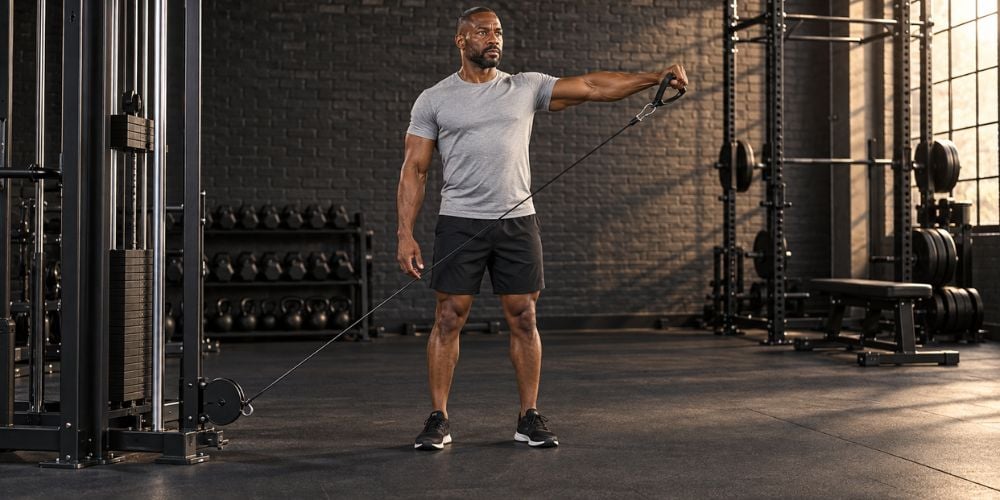
Pause briefly when your arm reaches shoulder height.
You do not need to hold the position for several seconds. A short pause is enough to stop momentum and keep the rep controlled.
Try to feel the side of your shoulder working. Keep your neck relaxed and your shoulder away from your ear.
What if you have to shrug to reach the top? The weight is probably too heavy, so reduce it and try again.
Smooth reps matter more than forcing the handle higher.
6. Lower the Cable Slowly
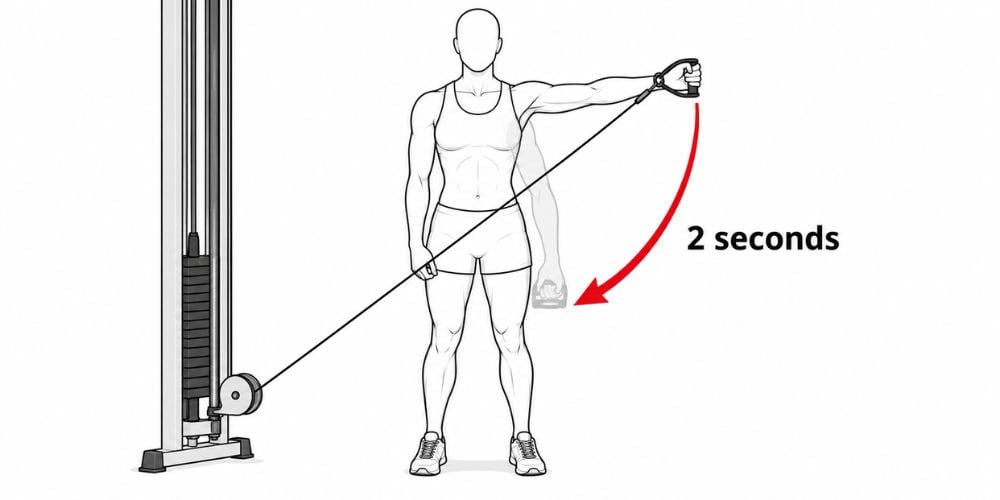
Lower your arm back toward the starting position under control.
Do not simply let the weight pull your arm down.
Take around 2 seconds to lower the handle. Keep some tension on your shoulder at the bottom before starting the next rep.
I often see people control the lift but rush the way down. Slowing the lowering phase can make even a light weight feel much more challenging.
Also, do not let the weight stack crash between reps.
7. Use the Right Sets and Reps
You do not need extremely heavy weights for cable lateral raises.
For most fitness lovers, this is a practical starting point:
Training Level | Sets | Reps | Rest |
Beginner | 2–3 | 12–15 | 45–90 sec |
Regular training | 3–4 | 10–15 | 45–90 sec |
Higher-rep shoulder work | 3–4 | 15–20 | 45–90 sec |
Choose a resistance that lets you complete every rep without swinging.
If your body starts leaning or your shoulder begins shrugging, reduce the weight.
The current ACSM resistance-training position stand also emphasizes progressive resistance training and notes that training variables such as volume should match your goal. For muscle growth, the broader weekly training volume matters more than trying to make one isolation exercise excessively heavy.
Quick Cable Lateral Raise Checklist
Before each set, check these points:
- Pulley is in the lowest position
- Outside arm holds the handle
- Core stays stable
- Elbow remains slightly bent
- Arm moves outward to around shoulder height
- Shoulder does not shrug
- Weight comes down slowly
Keep these points consistent, and the exercise should feel much more controlled.
Conclusion
Cable lateral raises are straightforward: set the pulley low, keep your body stable, raise your arm to the side, pause briefly, and lower it slowly.
Use a manageable weight and focus on smooth movement instead of lifting heavy. I would rather see 12 controlled reps than six reps with your whole body swinging.
If cable training is a regular part of your workouts, you can explore YR Fitness to see commercial cable and strength equipment designed for practical, controlled daily training.
Related articles: