




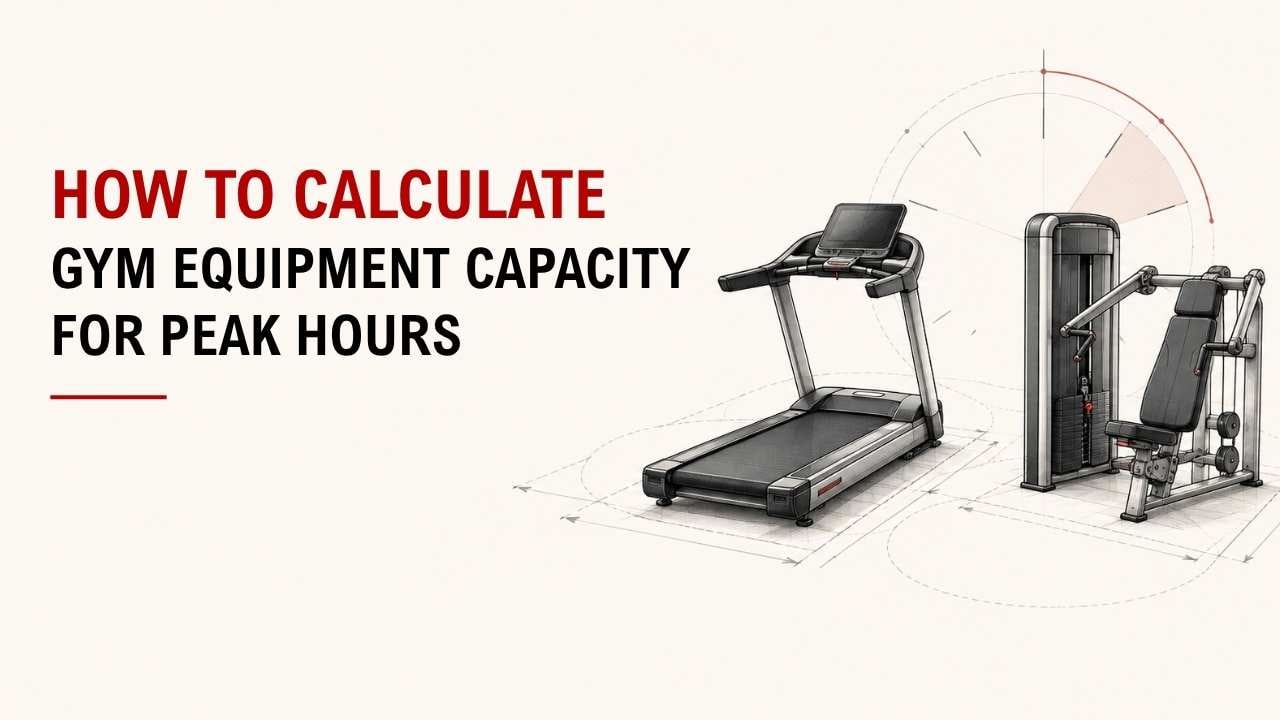

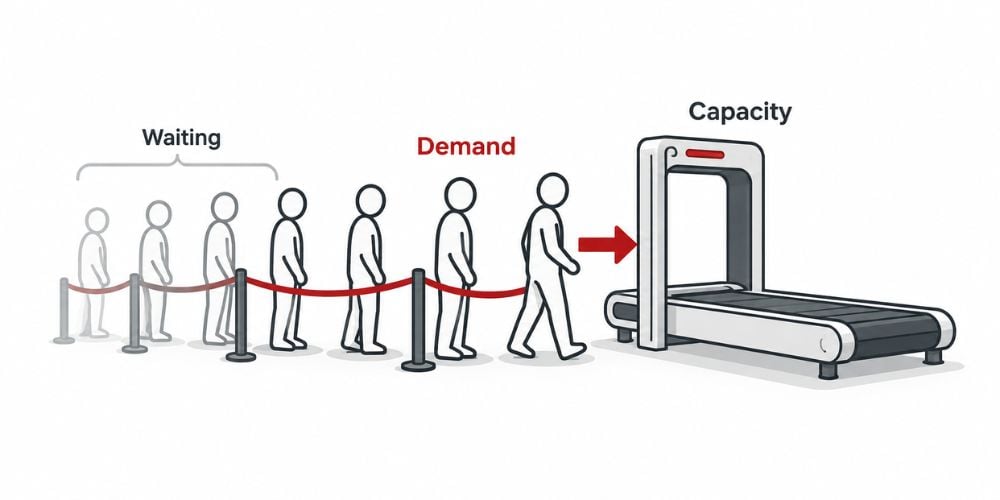
Have you noticed certain gym machines are always busy during peak hours? That can mean demand exceeds available equipment capacity.
The quick answer is simple: count peak-hour users, estimate equipment demand, and compare it with how many people each machine can serve. This shows where capacity is falling short.
As an Ergonomics Engineer at YR Fitness, I study how equipment quantity, floor space, and user flow work together. I often see capacity problems caused by the wrong equipment mix rather than too few machines overall.
Below, I’ll show you seven simple steps to calculate peak-hour capacity. Keep reading to quickly spot where waiting and congestion may happen.
- 1. Find Your Peak-Hour Visitor Count
- 2. Estimate How Many People Use Each Training Area
- 3. Calculate How Many Users One Machine Can Handle
- 4. Calculate Total Equipment Capacity
- 5. Compare Peak Demand With Available Capacity
- 6. Add a Buffer for Real Gym Conditions
- 7. Decide Where You Need More Equipment
- Quick Capacity Formula
- Conclusion
1. Find Your Peak-Hour Visitor Count
Start with the busiest hour of the day.
Use check-in data or count how many people are training during common busy periods such as 5 PM to 7 PM.
For example:
- Peak-hour users: 120 people
- Time period: 6 PM to 7 PM
Your starting number is:
Peak-hour visitor count = 120
I recommend checking several busy days instead of relying on one evening. Monday may look very different from Friday.
One important note: this calculation measures equipment capacity, not the legal maximum occupancy of a building. ACSM’s Health/Fitness Facility Standards and Guidelines also treats facility design and equipment as part of broader fitness-facility planning.
2. Estimate How Many People Use Each Training Area
Not all 120 people will want the same equipment.
Split them into simple training areas:
Training Area | Example Share | Users from 120 Members |
Cardio | 25% | 30 |
Strength Machines | 30% | 36 |
Free Weights | 25% | 30 |
Functional Area | 20% | 24 |
Use:
Users in training area = Peak-hour visitors × Percentage using that area
For example:
120 × 30% = 36 strength-machine users
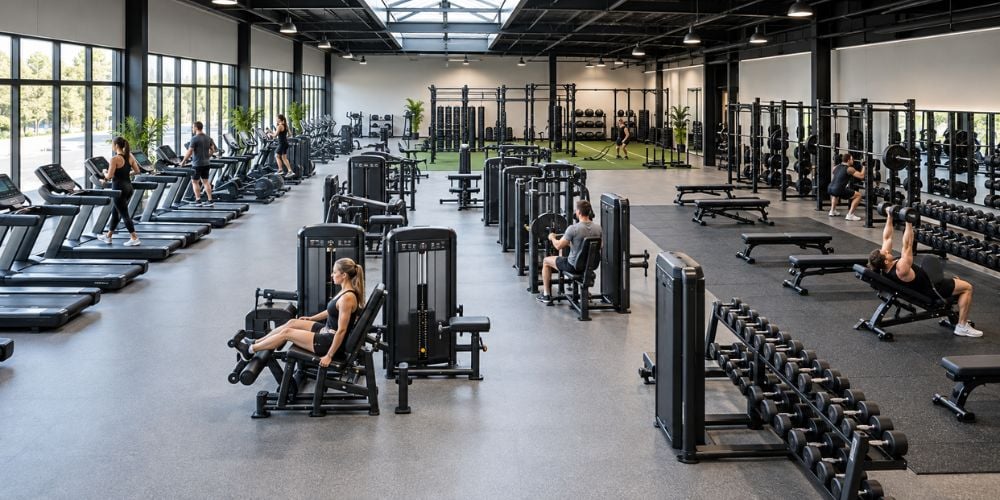
What if your treadmills are always full but the functional area is quiet? Adjust the percentages to match what you actually see.
Real observations will usually give you better numbers than guesses.
3. Calculate How Many Users One Machine Can Handle
Next, estimate how long one person normally uses a machine.
Use:
Users per hour = 60 ÷ Average minutes per user
If someone uses a chest press for about 10 minutes:
60 ÷ 10 = 6 users per hour
Here is the quick reference:
Average Use Time | Approximate Users Per Hour | Hourly Capacity | Gap | What It Means |
5 minutes | 1200% | 15 | 5 | More demand than capacity |
10 minutes | 600% | 12 | -4 | Capacity available |
15 minutes | 400% | 6 | 4 | More demand than capacity |
20 minutes | 300% | 12 | -4 | Capacity available |
These are estimates. People also rest, adjust seats, change weights, or pause between sets.
In my experience, realistic numbers are much more useful than assuming everyone trains as quickly as possible.
4. Calculate Total Equipment Capacity
Now multiply the capacity of one machine by how many machines are available.
Total hourly capacity = Number of machines × Users per machine per hour
For example:
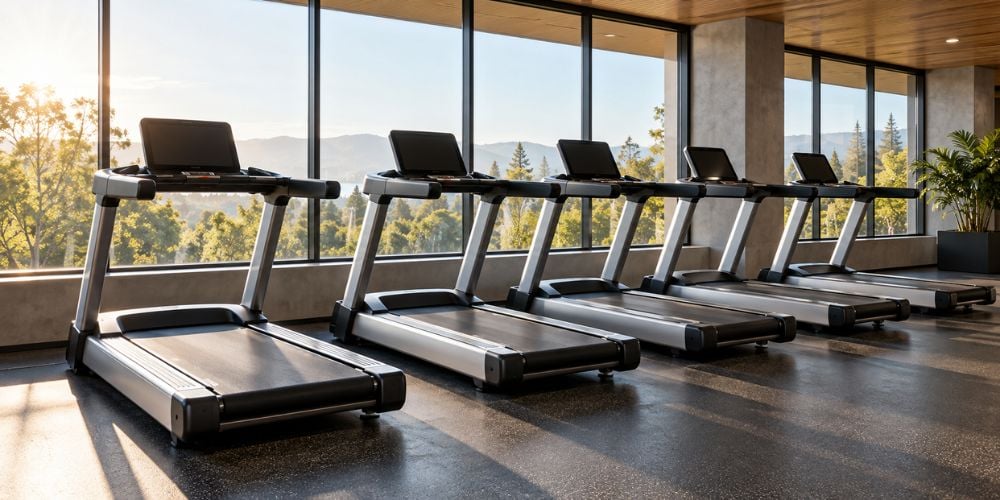
- 5 treadmills
- Average treadmill session: 20 minutes
- Each treadmill serves about 3 users per hour
So:
5 × 3 = 15 treadmill users per hour
If around 20 people want a treadmill during that hour, your capacity is too low.
The same method works for leg presses, chest presses, cable stations, bikes, rowing machines, and other equipment.
And remember, adding another station also requires physical space. For context, Life Fitness lists its commercial Integrity+ treadmill at about 209 × 92 × 142 cm, showing why equipment footprint matters when increasing capacity. See the commercial treadmill specifications for reference.
If certain stations keep becoming bottlenecks, adding several identical machines is not always the best answer. At YR Fitness, we offer commercial strength and cardio equipment that can help spread users across more training options while making better use of available floor space.

5. Compare Peak Demand With Available Capacity
Now comes the useful part: compare demand with capacity.
Use:
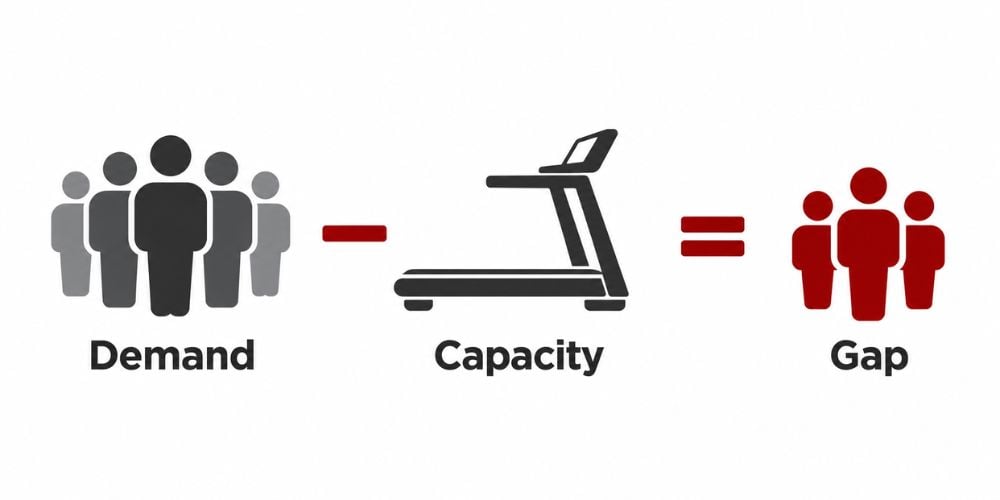
Capacity gap = Peak demand − Available capacity
For example:
Equipment | Peak Demand | Hourly Capacity | Gap | What It Means |
Treadmills | 20 | 15 | 5 | More demand than capacity |
Chest Press | 8 | 12 | -4 | Capacity available |
Leg Press | 10 | 6 | 4 | More demand than capacity |
Exercise Bikes | 8 | 12 | -4 | Capacity available |
A positive number means demand is higher than capacity.
A negative number means you currently have spare capacity.
So where is the problem here? Treadmills and leg presses.
Those are the stations most likely to create waiting during peak hours.
6. Add a Buffer for Real Gym Conditions
Do not assume every machine will be available every minute.
Real gyms have:
- Rest periods
- Equipment adjustments
- Cleaning time
- Maintenance
- Members waiting between sets
- Different workout speeds
A machine that theoretically serves six people per hour may comfortably serve only four or five.
This is why I treat theoretical capacity as the maximum, not the target. A little spare capacity makes busy periods much easier to handle.
For example, if you expect 20 treadmill users per hour, planning for exactly 20 leaves no room for longer workouts or unavailable machines.
7. Decide Where You Need More Equipment
Finally, look for your biggest capacity gaps.
Pay more attention to equipment that:
- Regularly has people waiting
- Appears in many workout programs
- Has few good substitutes
- Stays occupied for long periods
- Becomes crowded at the same time each day
Do you need more of every machine? No.
If chest presses have spare capacity but leg presses constantly have a queue, another leg-training station may make more sense than another chest machine.
You can also spread demand by offering different exercises for the same muscle group. That gives people alternatives instead of forcing everyone to wait for one popular station.
Quick Capacity Formula
You can reduce the whole process to three calculations:
Peak demand = Peak-hour visitors × Percentage using the equipment
Hourly machine capacity = Number of machines × (60 ÷ Average use time)
Capacity gap = Peak demand − Hourly machine capacity
For example:
120 visitors × 15% treadmill demand = 18 users
If you have five treadmills and each handles three users per hour:
5 × 3 = 15 users
Then:
18 − 15 = 3-user capacity gap
That tells you treadmill demand is higher than the available capacity.
Conclusion
Peak-hour capacity comes down to four things: how many people arrive, what they use, how long they use it, and how many stations are available. Calculate the capacity gap first, because it quickly shows where waiting is most likely.
If you want more training capacity without adding extra machines, please compare the commercial equipment options from YR Fitness. Choose equipment that gives people useful alternatives and makes better use of the space you already have.
Related articles: