








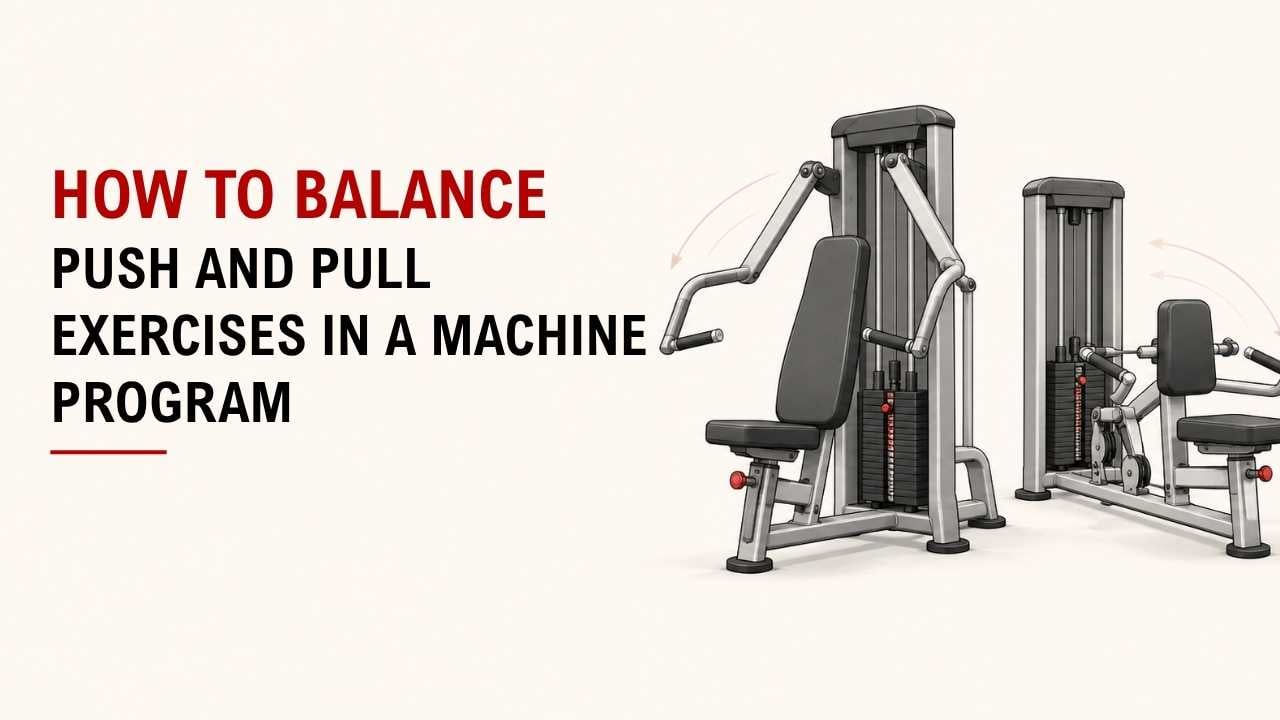

Are you doing more pushing than pulling exercises? This can leave some muscles undertrained and affect your strength.
The fix is simple: start with a 1:1 push-to-pull ratio, pair opposite movements, and balance your weekly sets. This helps you train your muscles more evenly.
As an Exercise Physiology & Biomechanics Expert at YR Fitness, I focus on how exercise movements affect muscle development. I often see better training balance when people give their back as much attention as their chest and shoulders.
Below, I’ll share five simple ways to balance push and pull exercises in your machine workouts. Use these tips to build a more balanced routine.
1. Know Which Machines Are Push and Pull
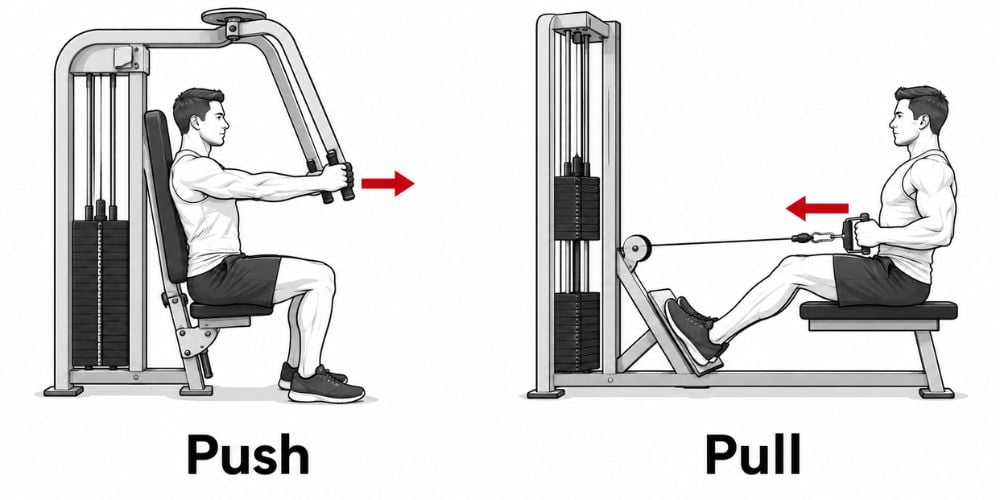
Before balancing your workout, you need to know which machines train pushing muscles and which train pulling muscles.
Push exercises involve pressing or extending against resistance. Upper-body pushing movements mainly target your chest, shoulders, and triceps.
Pull exercises involve drawing resistance toward your body or pulling it downward. These movements mainly target your back and biceps.
Here’s a quick comparison:
Push Machines | Main Muscles | Pull Machines | Main Muscles |
Chest Press | Chest, triceps | Seated Row | Back, biceps |
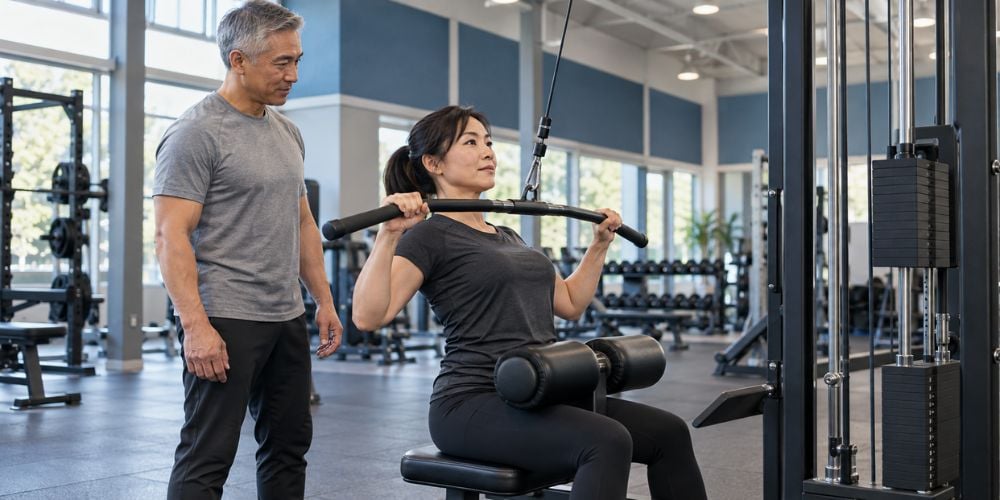
Shoulder Press | Shoulders, triceps | Lat Pulldown | Lats, biceps |
Leg Press | Quads, glutes | Leg Curl | Hamstrings |
Leg Extension | Quadriceps | High Row | Upper back, lats |
Quick tip: Chest presses and shoulder presses are upper-body pushing exercises. Rows and pulldowns are pulling exercises.
What About Your Legs?
Lower-body exercises work a little differently.
A leg press mainly trains your quadriceps and glutes, while a leg curl focuses on your hamstrings.
Not every leg exercise fits perfectly into a push-or-pull category. Instead of forcing a strict ratio, make sure you’re training your quads, hamstrings, and glutes.
The goal: Train all your major muscle groups without leaving anything behind.
This also matches the CDC’s muscle-strengthening recommendations, which encourage adults to train all major muscle groups at least twice weekly.
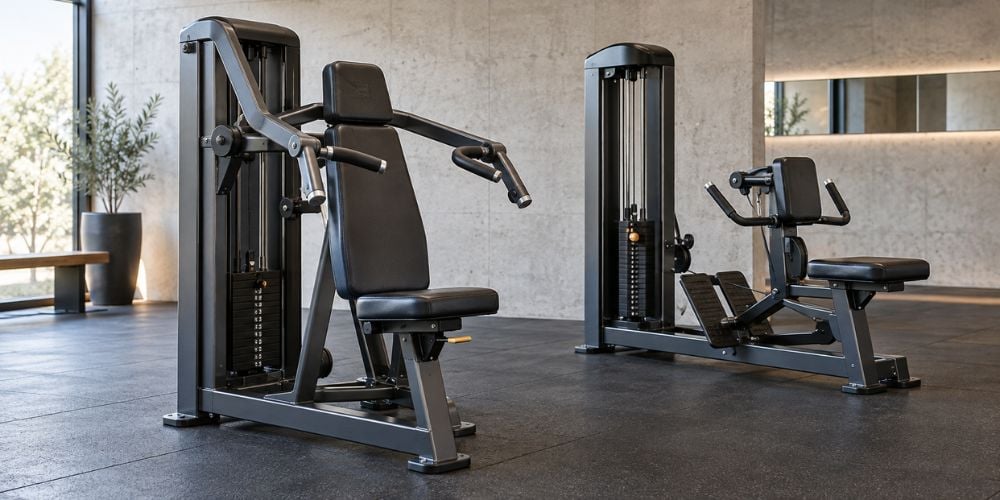
2. Start With a 1:1 Push-to-Pull Ratio
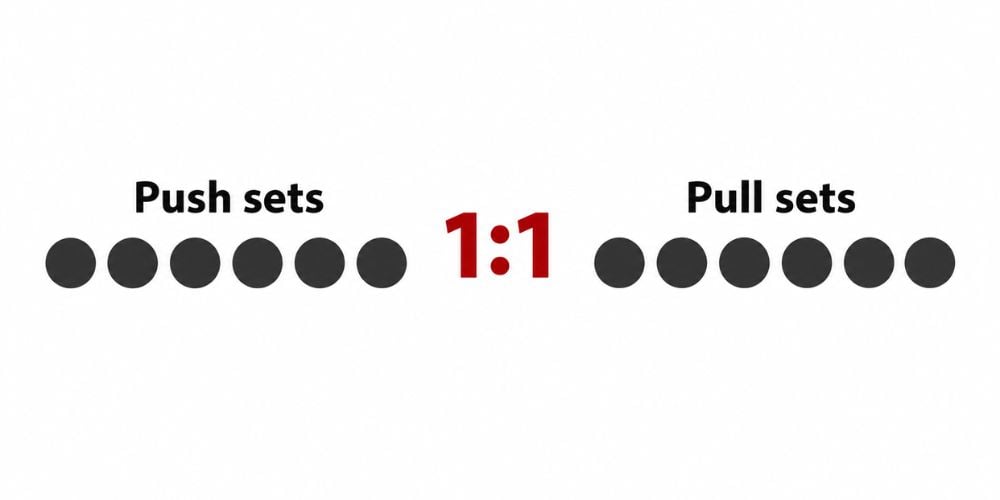
One of the easiest ways to balance your upper-body workouts is to start with a 1:1 push-to-pull ratio.
This means performing roughly the same number of working sets for pushing and pulling exercises.
For example:
- Chest Press: 3 sets
- Seated Row: 3 sets
- Shoulder Press: 3 sets
- Lat Pulldown: 3 sets
That’s 6 pushing sets and 6 pulling sets.
Why does this matter?
It helps you avoid spending most of your workout training your chest and shoulders while neglecting your back.
I often see people count exercises without checking their total sets. But doing three chest exercises and two back exercises doesn’t tell you the full story.
How to Check Your Weekly Balance
Let’s say you train your upper body twice per week.
Your weekly sets might look like this:
- Chest Press: 6 pushing sets
- Shoulder Press: 6 pushing sets
- Seated Row: 6 pulling sets
- Lat Pulldown: 6 pulling sets
Total: 12 pushing sets and 12 pulling sets.
That’s a 1:1 ratio.
Count your challenging working sets, not warm-up sets. Also remember that equal set counts don’t always mean equal effort, so pay attention to the weights and repetitions you use.
Do You Need a Perfect 1:1 Ratio?
No. It’s a useful starting point, not a strict training rule.
Some people benefit from extra pulling exercises, especially when they want to develop their back muscles.
Your ideal training volume depends on your goals, experience, and recovery.
The American College of Sports Medicine’s 2026 resistance training guidelines also emphasize consistency and individual needs over complicated workout rules.
My Advice: Start with equal pushing and pulling sets. Adjust your training once you understand how your body responds.
3. Pair Push and Pull Machines in One Workout
Want an easier way to organize your machine exercises?
Pair pushing and pulling movements instead of performing several similar exercises in a row.
This gives your workout a clear structure and helps you train different muscle groups.
Here are three combinations worth trying.
Chest Press + Seated Row
- Perform 10–12 chest press repetitions.
- Rest briefly before switching machines.
- Perform 10–12 seated row repetitions.
- Rest and repeat for 3 rounds.
The chest press targets your chest and triceps. The seated row trains your back and biceps.
These movements complement each other because they work opposite upper-body movement patterns.
Shoulder Press + Lat Pulldown
- Perform 10–12 shoulder press repetitions.
- Rest before switching machines.
- Perform 10–12 lat pulldown repetitions.
- Repeat for 3 rounds.
The shoulder press strengthens your shoulders and triceps. The lat pulldown targets your lats and biceps.
This combination gives you both vertical pushing and pulling movements.
Leg Press + Leg Curl
- Perform 10–15 leg press repetitions.
- Rest before moving to the leg curl machine.
- Perform 10–15 leg curl repetitions.
- Repeat for 3 rounds.
The leg press trains your quadriceps and glutes, while the leg curl focuses on your hamstrings.
This helps you cover different lower-body muscle groups without making your workout complicated.
Should You Rush Between Machines?
No. Pairing exercises doesn’t mean skipping recovery.
Around 60–90 seconds of rest may work for moderate sets. Heavier or more demanding sets may require longer breaks.
I recommend learning each machine separately before combining exercises. Once your technique feels comfortable, alternating movements becomes easier.
Want to build a balanced push-and-pull workout? At YR Fitness, we design commercial strength machines with carefully developed movement paths and adjustable settings to support controlled exercise.
Explore our strength equipment to see how chest presses, seated rows, lat pulldowns, and lower-body machines can fit into your training routine.
Explore Strength Training Equipment →
4. Follow a Simple Balanced Machine Workout
Not sure how to put everything together?
Try this beginner-friendly workout. It balances upper-body pushing and pulling while covering your major lower-body muscle groups.
Balanced Push and Pull Machine Workout
Order | Machine Exercise | Sets | Reps |
1 | Chest Press | 3 | 10–12 |
2 | Seated Row | 3 | 10–12 |
3 | Shoulder Press | 3 | 10–12 |
4 | Lat Pulldown | 3 | 10–12 |
5 | Leg Press | 3 | 10–15 |
6 | Leg Curl | 3 | 10–15 |
Here’s what you’re training:
- 6 upper-body pushing sets: Chest, shoulders, and triceps.
- 6 upper-body pulling sets: Back and biceps.
- 3 leg press sets: Quadriceps and glutes.
- 3 leg curl sets: Hamstrings.
Your upper-body push-to-pull ratio stays at 1:1.
How to Perform This Workout
Step 1: Warm Up for 5–10 Minutes
Start with a treadmill, stationary bike, or other light cardio machine. Perform a few lighter practice repetitions before your working sets.
Step 2: Choose Manageable Weights
Select resistance that allows you to finish your repetitions with proper technique.
Don’t worry about lifting heavy immediately.
Step 3: Follow the Exercise Order
Alternate upper-body pushing and pulling movements before moving to your leg exercises.
Step 4: Rest Between Sets
Take around 60–90 seconds for moderate sets. Rest longer when needed to recover.
Step 5: Keep Your Movements Controlled
Avoid swinging, bouncing, or forcing the weight.
Stop your set when you can no longer maintain good technique.
How Often Should You Do This Workout?
Beginners can start with 2 sessions per week on nonconsecutive days.
As your strength and recovery improve, you can gradually increase to 3 weekly sessions.
If six exercises feel overwhelming, begin with 1–2 sets per exercise. Build up to the full workout when you’re comfortable.
This approach follows the general principles of progressive resistance training, which supports gradually adjusting training demands as your fitness improves.
Quick Reminder: You don’t need to feel completely exhausted after every workout. Consistency and gradual progress matter more.
What if Your Gym Doesn’t Have Every Machine?
You can replace exercises with similar movements.
For example:
- Seated Row: Use a high row machine.
- Chest Press: Choose another suitable machine chest press variation.
- Lat Pulldown: Try an assisted pull-up machine.
- Leg Curl: Use another suitable hamstring exercise.
The goal isn’t to use the exact same machine every time.
What matters is training the right muscle groups while maintaining balanced pushing and pulling volume.
5. Balance Your Weekly Training Schedule
A balanced workout is a good start. But your weekly training schedule matters just as much.
You don’t need to train pushing and pulling muscles every day. Instead, organize your sessions so both movement types receive enough attention.
Here are three simple options.
Option 1: Two Days Per Week
Best for: Beginners and people with busy schedules.
- Monday: Balanced Full-Body Machine Workout
- Thursday: Balanced Full-Body Machine Workout
Train both pushing and pulling muscles during each session.
This schedule gives you several days between workouts for recovery.
Option 2: Three Days Per Week
Best for: People who want to train more regularly.
- Monday: Balanced Full-Body Workout A
- Wednesday: Balanced Full-Body Workout B
- Friday: Balanced Full-Body Workout A
The following week, switch to Workout B, Workout A, and Workout B.
Both workouts should include pushing, pulling, and lower-body exercises.
You can change individual machines or exercise order to keep your routine interesting. Just adjust the number of sets so your total weekly volume remains manageable.
Conclusion
Balancing push and pull exercises doesn’t need to be complicated. Start with a 1:1 upper-body set ratio, pair opposite movements, and plan your weekly workouts.
Focus on good form, manageable weights, and steady progress.
Want to explore more machine training options? Visit YR Fitness to discover commercial strength equipment that supports balanced workouts and different fitness goals.
Related articles:



