









Want to build muscle with machines but are not sure how to organize five training days? You do not need a complicated routine to make progress.
The short answer is: train chest + triceps, back + biceps, legs, shoulders + arms, then upper body. Keep most exercises around 8–15 reps, control each rep, and gradually increase your workload.
As an Exercise Physiology & Biomechanics Expert at YR Fitness, I work closely with strength-training movements and how people use gym machines. I often see better progress when lifters follow a repeatable plan instead of changing exercises every week.
Below is the complete 5-day workout with exercises, sets, reps, and simple form cues. Follow it in order, choose weights that match your strength, and adjust when needed.
5-Day Workout at a Glance
Here’s the full 5-day split at a glance. Use this as your weekly roadmap, then follow the detailed exercises and form tips below.
Day | Main Focus | Main Goal |
Day 1 | Chest + Triceps | Pressing strength and chest volume |
Day 2 | Back + Biceps | Vertical and horizontal pulling |
Day 3 | Legs | Quads, hamstrings, and calves |
Day 4 | Shoulders + Arms | Delts plus extra arm work |
Day 5 | Upper Body | Extra balanced upper-body volume |
Days 6–7 | Recovery | Rest or light activity |
The general structure also lines up with the idea of training all major muscle groups regularly. The CDC muscle-strengthening guidelines recommend including the legs, hips, back, abdomen, chest, shoulders, and arms across your strength work.
1. Day 1: Chest + Triceps
Start with your main pushing muscles.
- Machine Chest Press: 4 sets × 8–12 reps
- Incline Chest Press: 3 sets × 8–12 reps
- Pec Deck: 3 sets × 10–15 reps
- Cable Triceps Pushdown: 3 sets × 10–15 reps
- Machine Triceps Extension: 3 sets × 10–12 reps
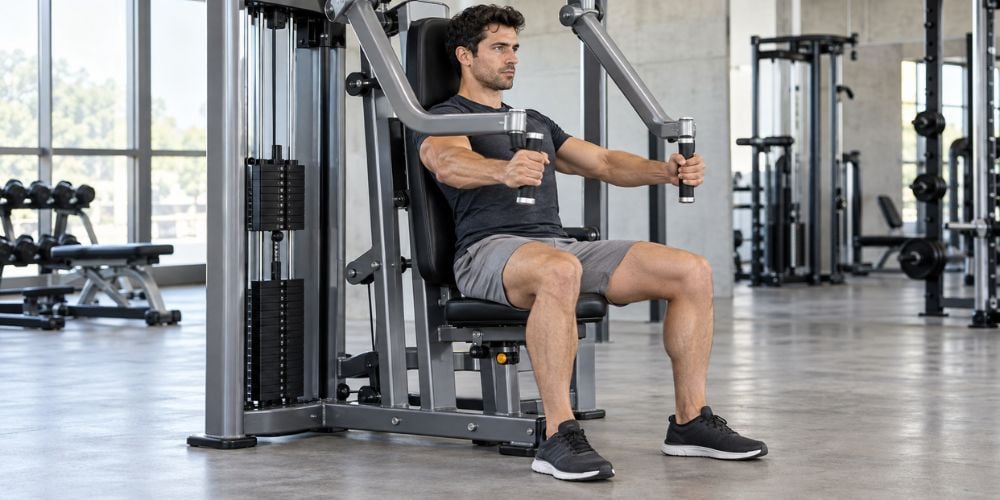
Machine Chest Press
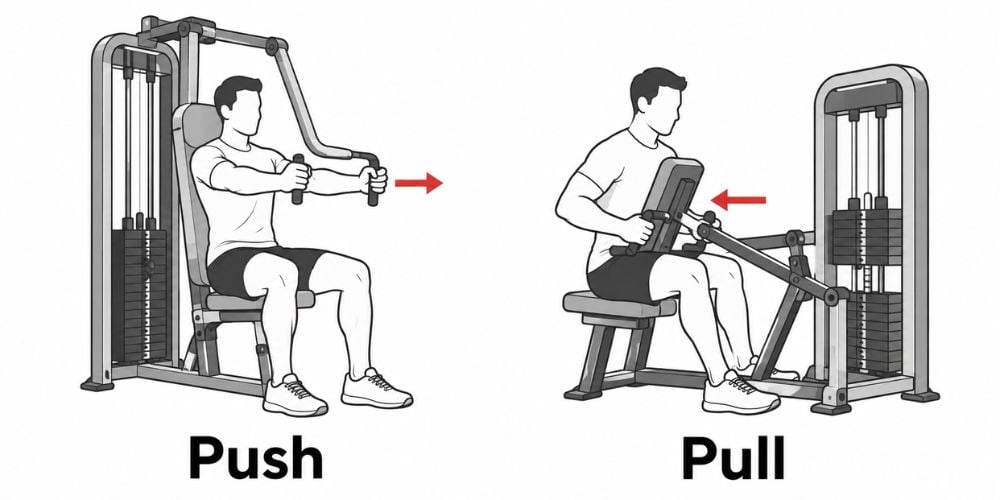
Set the seat so the handles sit around mid-chest level. Press forward without letting your shoulders roll forward.
Lower the handles slowly instead of bouncing into the next rep.
Incline Chest Press
Use the incline press to place more emphasis on your upper chest. Keep your back against the pad and your shoulders controlled.
Pec Deck
Bring the handles or pads together in front of your chest. Keep a slight bend in your elbows and control the return.
Should you use maximum weight?
No. Use a weight that lets you complete the full movement cleanly.
Triceps Work
Finish with cable pushdowns and machine triceps extensions. Keep your elbows fairly stable instead of moving your whole upper body.
I prefer clean reps here over heavier weight with poor control.
2. Day 2: Back + Biceps
Now switch from pushing to pulling.
- Lat Pulldown: 4 sets × 8–12 reps
- Seated Row Machine: 4 sets × 8–12 reps
- High Row Machine: 3 sets × 10–12 reps
- Machine Biceps Curl: 3 sets × 10–15 reps
- Cable Curl: 3 sets × 10–15 reps
Lat Pulldown
Secure your thighs under the pads. Pull the bar toward your upper chest while keeping your torso controlled.
Avoid pulling the bar behind your neck.
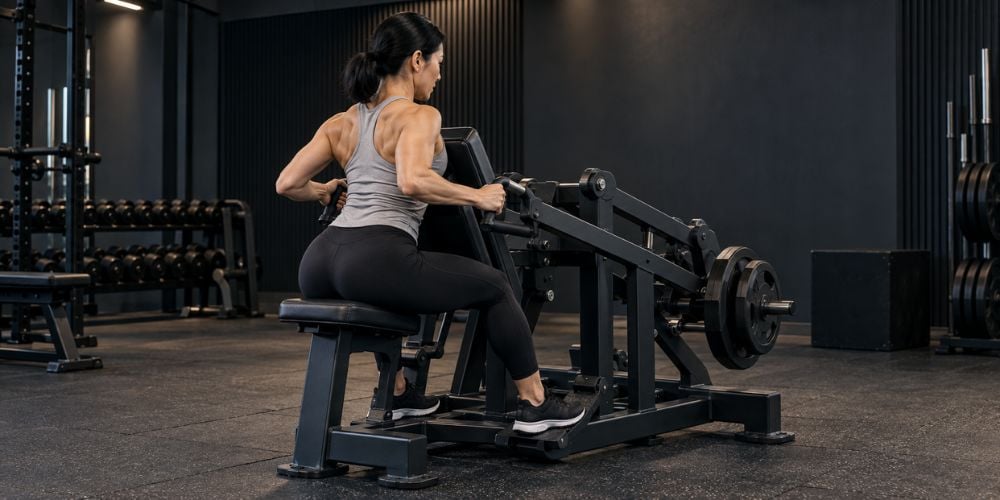
Seated Row
Pull the handles toward your lower ribs. Think about moving your elbows backward rather than simply pulling with your hands.
Pause briefly, then return slowly.
High Row
The high row gives your upper back another pulling angle. Use chest support if your machine provides one.
Biceps Curls
Your biceps are already working during rows and pulldowns. Finish them with machine curls and cable curls.
Feeling your forearms more than your biceps?
Lower the weight and keep your elbows more stable.
3. Day 3: Legs
Your upper body gets a break today.
- Leg Press: 4 sets × 8–12 reps
- Hack Squat Machine: 3 sets × 8–12 reps
- Leg Extension: 3 sets × 10–15 reps
- Seated or Lying Leg Curl: 3 sets × 10–15 reps
- Calf Raise Machine: 4 sets × 12–15 reps
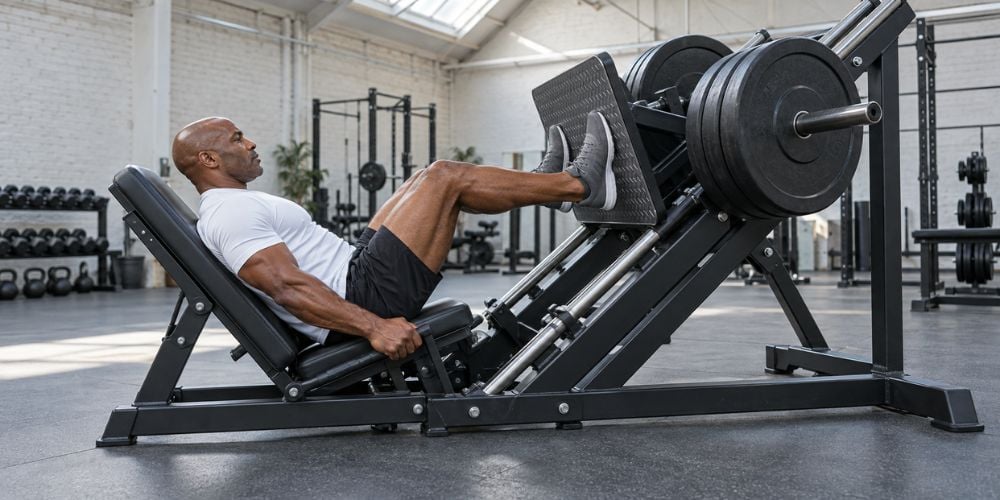
Leg Press
Place your feet comfortably on the platform. Lower the sled to a depth you can control without your lower back excessively rounding away from the pad.
Hack Squat
Keep your back supported and lower yourself under control. Push through the platform without aggressively snapping your knees into a locked position.
Leg Extension and Leg Curl
Use the leg extension for your quadriceps and the leg curl for your hamstrings. Slow down the lowering phase instead of rushing through the reps.
I often see lifters add weight too quickly on these machines. A controlled set usually gives you more useful training than simply moving a heavier stack.
Calf Raise
Use a full comfortable range. Lower your heels before pushing back onto the balls of your feet.
At YR Fitness, we design commercial strength machines around controlled training movements such as pressing, rowing, squatting, extending, and curling. If you want to compare how different machine designs support these exercises, explore our strength equipment and see which movement styles match your training.
4. Day 4: Shoulders + Arms
Today gives your shoulders most of the attention while adding extra work for your arms.
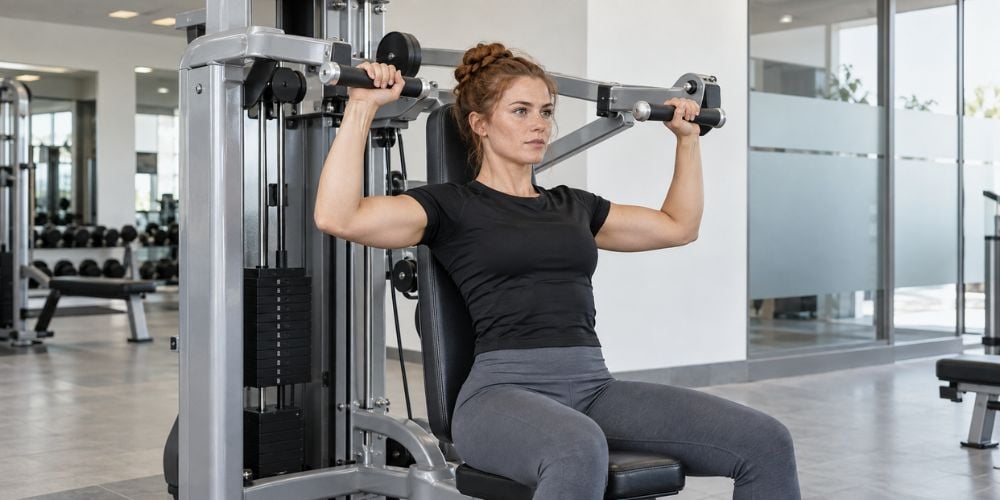
- Machine Shoulder Press: 4 sets × 8–12 reps
- Lateral Raise Machine: 3 sets × 12–15 reps
- Reverse Pec Deck: 3 sets × 12–15 reps
- Machine Biceps Curl: 3 sets × 10–12 reps
- Cable Triceps Pushdown: 3 sets × 10–12 reps
Shoulder Press
Set the seat so the handles begin around shoulder height. Press upward while keeping your back supported.
Avoid turning the movement into a large back arch.
Lateral Raise
Raise your arms until they are around shoulder height. Keep your shoulders down instead of shrugging toward your ears.
Reverse Pec Deck
Face the pad and open your arms backward. Focus on your rear shoulders and upper back.
Use moderate weight. This exercise does not need to be extremely heavy.
Arms
Finish with one biceps exercise and one triceps exercise. You already trained both earlier in the week, so you do not need excessive extra volume.
5. Day 5: Upper Body
Finish the training week with another upper-body session.
- Chest Press: 3 sets × 8–12 reps
- Lat Pulldown: 3 sets × 8–12 reps
- Seated Row: 3 sets × 10–12 reps
- Shoulder Press: 3 sets × 10–12 reps
- Pec Deck: 2–3 sets × 12–15 reps
- Cable Curl or Pushdown: 2–3 sets × 12–15 reps
Keep This Day Balanced
Do not feel that you have to beat every weight you used earlier in the week. After four training days, some fatigue is normal.
Use the chest press for pushing, the pulldown and row for your back, and the shoulder press for your delts. Finish with lighter isolation work.
I like to treat Day 5 as a quality-volume day, not another all-out workout.
That matters because every set does not need to reach complete muscular failure. A systematic review on training to failure found no clear evidence that momentary failure is superior to non-failure training for muscle hypertrophy.
What About the Weekend?
Use Days 6 and 7 for recovery.
Walking, light cycling, mobility work, or complete rest can all work depending on how you feel.
6. How Heavy Should You Train?
For most exercises in this plan, stay mainly within 8–15 reps. The weight should feel challenging near the end of the set, but you should still be able to control the movement.
The American College of Sports Medicine resistance-training guidance has long used the 8–12 repetition range as a practical starting point for novice resistance training and emphasizes gradually increasing the workload as you adapt.
Here is an easy way to judge your weight:
What Happens During Your Set? | What to Do |
You cannot reach the bottom of the rep range with good form | Reduce the weight |
You reach the top of the range comfortably | Add a small amount of weight |
Your form breaks down badly | Reduce the load or stop the set |
Every set feels very easy | Increase the resistance |
Final reps are difficult but controlled | Keep the weight and build reps |
How Do You Progress?
Keep it simple.
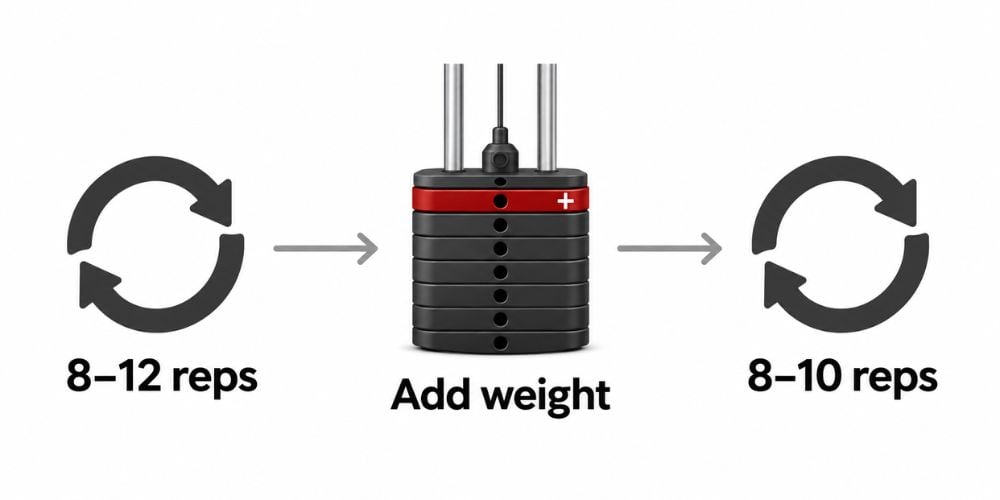
If your chest press target is 8–12 reps, progression could look like this:
- Week 1: 10 reps
- Week 2: 11 reps
- Week 3: 12 reps
- Week 4: Add a small amount of weight and return to 8–10 reps
Then build upward again.
That is progressive overload in a practical form.
Conclusion
A 5-day machine workout split does not need to be complicated. Train chest and triceps, back and biceps, legs, shoulders and arms, then finish with an upper-body day while gradually increasing your workload.
Stay consistent, control your reps, and give yourself enough recovery between sessions.
If you want to see the machine types used throughout this routine, explore YR Fitness and compare strength equipment for chest, back, shoulders, arms, legs, and cable training.
Related articles:



