










Are you unsure what to charge for personal training sessions? Different trainers can charge very different rates.
Start with your local market, experience, costs, and the value you provide. Your price should also cover the unpaid work you do outside each session.
As the founder of YR Fitness, I have spent decades working with trainers and fitness professionals. I have seen that clear value makes pricing much easier for clients to accept.
Below, I will walk you through local pricing, experience levels, session formats, packages, and a simple pricing formula. You should be able to finish this guide with a much clearer idea of what your sessions need to cost.
1. Check What Trainers in Your Area Charge
Start locally.
Look at independent trainers, private studios, and nearby gyms. Compare prices for:
Training Type | What to Check |
30-minute session | Local starting rates |
45-minute session | Difference from 30 and 60 minutes |
60-minute session | Standard private training rate |
Partner training | Price per person |
Small group training | Price per person and group size |
Online coaching | What support is included |
The American Council on Exercise recommends considering what your local market can support rather than choosing a rate in isolation.
Should you simply undercut everyone else?
No. Being the cheapest trainer does not automatically make you the easiest trainer to hire.
Instead, compare yourself with trainers who have similar qualifications, experience, and services.
For example, if comparable trainers charge $50 to $70 for a one-hour session, charging $25 may make clients question your experience. Charging $120 may also be hard to justify unless your service clearly supports that rate.
Here is the basic idea:
Local Comparison | What It May Mean |
Typical rate: $50–$70 | Useful market reference |
Your rate: $25 | Possibly too low |
Your rate: $50–$70 | Within the local range |
Your rate: $120 | Needs a clear premium reason |
You can also check broader income data for perspective. The U.S. Bureau of Labor Statistics reported a median annual wage of $46,180 for fitness trainers and instructors in May 2024, although this is an employment earnings figure rather than a recommended session rate.
Use market prices as a reference, not a rule.

2. Price Based on Your Experience
Once you know the local range, decide where you fit inside it.
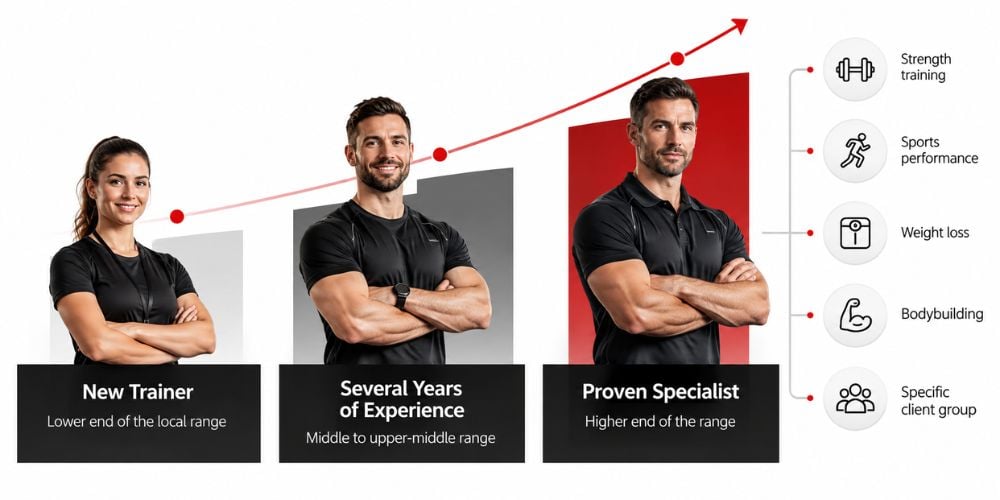
A simple framework looks like this:
Trainer Level | Pricing Position |
New trainer | Lower end of the local range |
Several years of experience | Middle to upper-middle range |
Proven specialist | Higher end of the range |
If you are new, you probably do not need to charge what a trainer with ten years of experience charges.
On the other hand, you do not need to stay at beginner prices forever.
Qualifications can support your rate. The Bureau of Labor Statistics notes that employers commonly prefer fitness trainers who hold certification.
Clients also care about results.
Strong testimonials, good client retention, and a history of helping people reach their goals can give you a stronger reason to move your rate upward.
Specialization matters too. You may be able to charge more if you have proven experience in areas such as:
- Strength training
- Sports performance
- Weight loss
- Bodybuilding
- Training a specific client group
Ask yourself one question: Why should a client pay more to train with me?
If you have a clear answer, your pricing becomes much easier to explain.
3. Set Different Prices for Different Session Types
One price does not need to cover every service you offer.
Why? Because the amount of attention you provide and the number of people you can train per hour change.
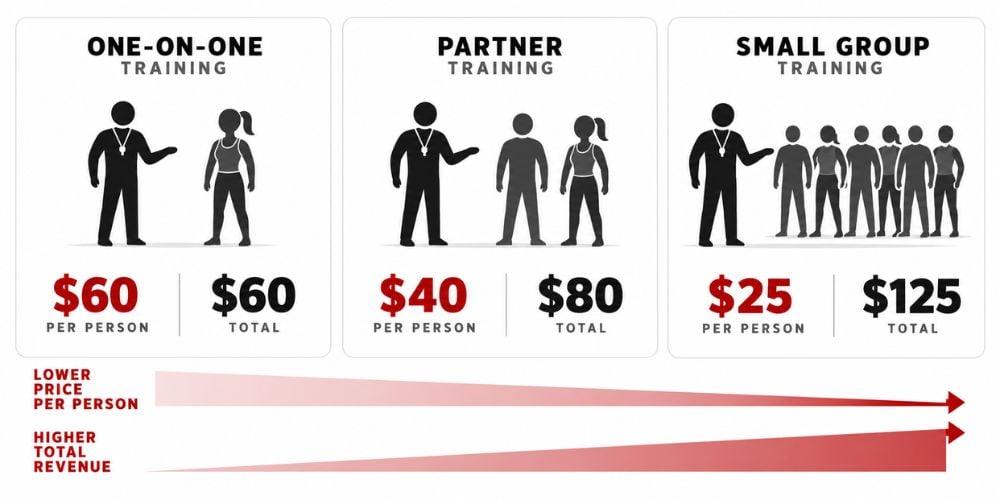
Example Session Pricing
Session Type | Example Price | Your Revenue |
60-minute private session | $60 per person | $60 |
Partner session | $40 per person | $80 with 2 clients |
Small group session | $25 per person | $125 with 5 clients |
These numbers are examples, not recommended market rates.
Your real rates should depend on your location, experience, expenses, and service level.
One-on-One Training
Private training should normally carry the highest price per person.
The reason is simple: one client receives your full attention for the session.
Example: 60-minute private session = $60
Partner Training
With partner training, each client can pay a little less while you earn more for the hour.
For example:
Private training: $60 per person
Partner training: $40 per person
Two clients, paying $40 gives you $80 for the same hour.
Small Group Training
Small group sessions can take the same idea further.
Five clients paying $25 each gives you $125 for the session.
The client gets a more affordable option, while your total hourly revenue increases.
This is also consistent with NASM’s explanation that semi-private and small-group training can lower the individual cost by sharing training time.
Online Coaching
Online coaching is different.
Do not price it only by the number of minutes you spend on a video call.
Think about everything included:
- Workout programming
- Weekly check-ins
- Exercise feedback
- Progress tracking
- Messaging support
The more ongoing work you provide, the more the service needs to cost.
If you eventually move from client homes or rented space into your own training studio, equipment becomes another cost your sessions need to support. At YR Fitness, we build commercial strength and cardio equipment for regular training use, so you can explore commercial gym equipment options here when calculating what a private training space may require.
4. Offer Packages Instead of Only Single Sessions
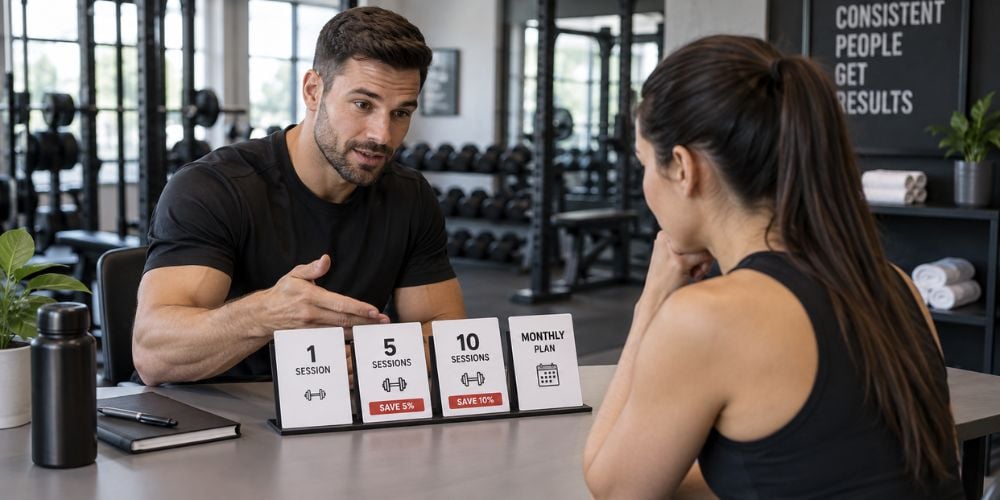
Single sessions are useful, but packages can give both you and the client more consistency.
Keep them simple.
Package | Example Price | Effective Price Per Session |
1 session | $60 | $60 |
5 sessions | $285 | $57 |
10 sessions | $550 | $55 |
Monthly training plan | Fixed monthly price | Depends on sessions included |
The client gets a small saving for making a larger commitment.
You get more predictable bookings.
How big should the discount be?
Usually, it only needs to be large enough to make the package attractive. You do not want to discount so heavily that your hourly income stops making sense.
I prefer keeping the choices simple. Too many packages can make an easy decision feel complicated.
Packages can also help with consistency.
Someone who has already purchased ten sessions has a stronger reason to keep showing up than someone who has to decide whether to buy another session every week.
5. Charge More When Your Service Offers More
A 60-minute session is not always just a 60-minute session.
Two trainers may both spend an hour with a client while providing very different levels of service.
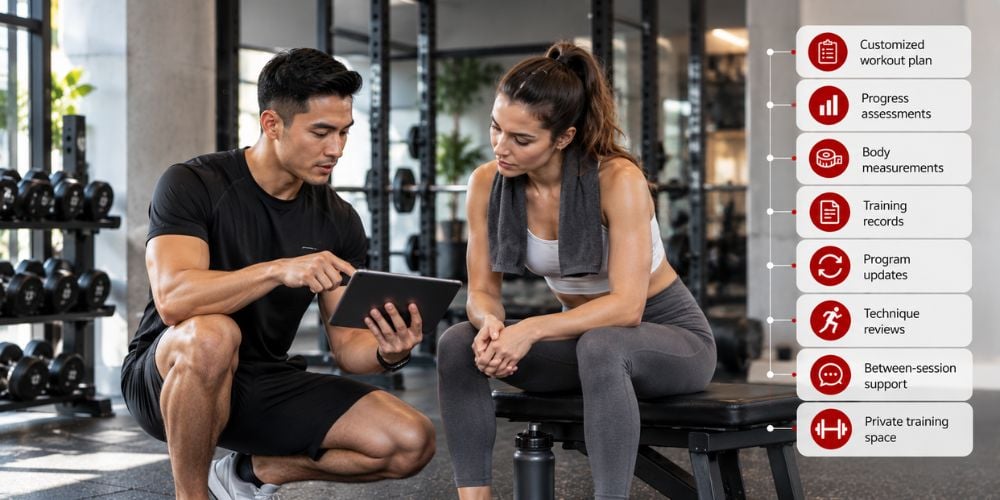
Your price can reflect extras such as:
Added Service | What the Client Gets |
Customized workout plan | Training built around their goals |
Progress assessments | Clear measurement over time |
Body measurements | Additional progress data |
Training records | History of workouts and performance |
Program updates | Training changes as progress occurs |
Technique reviews | More detailed exercise feedback |
Between-session support | Help outside appointments |
Private training space | Greater privacy and convenience |
The important part is making the value visible.
Instead of simply saying:
“My sessions cost $80.”
You could say:
“The $80 session includes one hour of private coaching, an individualized training plan, progress tracking, and program adjustments based on your results.”
Same price. Much clearer value.
Use a Simple Pricing Formula
Still unsure where your rate should land?
Start with this:
Session Price = (Target Monthly Income + Monthly Business Expenses) ÷ Number of Paid Sessions Per Month
Suppose you want to earn $4,000 per month and have $1,000 in monthly business expenses.
Calculation | Amount |
Target monthly income | $4,000 |
Monthly business expenses | $1,000 |
Total needed | $5,000 |
Paid sessions per month | 80 |
Minimum per session | $62.50 |
So:
$5,000 ÷ 80 = $62.50 per session
At that point, charging $40 would probably be too low for your target.
Depending on your market, experience, and service, you might instead set your standard rate around $65 or $70.
Do Not Forget the Hours Nobody Pays For
A common mistake is treating one paid session as one hour of work.
But you may also spend time on:
- Programming workouts
- Replying to clients
- Scheduling
- Marketing
- Administration
Those hours still count.
If you are self-employed in the United States, taxes also need to be part of your planning. The IRS Self-Employed Individuals Tax Center explains the federal tax responsibilities that may apply, while its estimated tax guidance explains when estimated payments may be required.
If you work outside the U.S., check the equivalent tax and self-employment rules where you live.
The key question is not “How much do I earn during the session?”
It is: “How much do I earn for all the work needed to deliver that session?”
That number is much more useful.
Final Thoughts
Personal trainer pricing does not need to be complicated.
Check your local market, consider your experience, price each session type clearly, and make sure your rate covers both your costs and the value you provide.
If you want to build or upgrade a professional training space, we at YR Fitness can help with commercial-grade strength equipment made for regular training use.
Explore YR Fitness equipment and find options that fit your training setup and budget.
Related articles:



