






Over the past three decades, I’ve lived and breathed gym equipment. During these years, I’ve worked with gym owners of different countries and different scales, serving 1,000+ gyms — from boutique studio concepts in the U.S. to mega comprehensive fitness centers in the Middle East. I’ve witnessed, over and over, what happens when a layout is done right… and when it’s done wrong.
Some owners, with a tight budget, turned an 80㎡ space into a private-training studio bringing in over $1,500 per day. Others invested hundreds of thousands of dollars, only to face congestion, complaints, and idle machines within three months — all because the layout design wasn’t scientifically planned.
These experiences drilled one truth into me:
What determines the success or failure of a gym is never how many machines you cram in — it’s whether the space has been truly “designed.”
That’s why I wrote this Ultimate Guide to Gym Layout.
I want to share the layout insights I’ve seen, studied, and repeatedly validated over 30 years — in the simplest, most direct way possible. Whether you’re preparing to open your first gym, or planning to expand and upgrade existing locations, you’ll find practical strategies and executable answers here.
Quick Comparison
Size Range | Equipment + Basic Fit-Out Budget (USD)* | Typical Annual Revenue(USD)* (Ohio) | Typical Annual Revenue(USD)* (Jakarta) | Recommended Business Model | Functional Area Mix Reference | Member Capacity |
|---|---|---|---|---|---|---|
< 50 m² | 8k – 15k | 180k – 300k | 48k – 96k | PT / Reformer / Small Group Classes | Cardio 10% | Machines 20% | Free Weights 20% | Functional Training 50% | 6–12 |
50–100 m² | 12k – 25k | 300k – 420k | 84k – 144k | PT + Small Group Classes | Cardio 15% | Machines 25% | Free Weights 25% | Functional Training 35% | 10–18 |
100–300 m² | 20k – 45k | 600k – 900k | 180k – 300k | Membership + PT | Cardio 20% | Machines 35% | Free Weights 25% | Functional / Group 20% | 25–60 |
300–800 m² | 45k – 120k | 960k – 1.44M | 300k – 480k | Membership + PT + Group Classes | Cardio 20% | Machines 35% | Free Weights 25% | Group Classes 15% | Functional / Recovery 5% | 60–150 |
800–1500 m² | 120k – 250k | 1.56M – 2.16M | 480k – 780k | Premium Membership + Multiple Class Lines | Cardio 18% | Machines 32% | Free Weights 25% | Group Classes 15% | Recovery / Lounge 10% | 150–350 |
≥ 1500 m² | 250k – 500k+ | 2.16M – 3.0M+ | 720k – 1.08M | Mixed-use Facility (Pool / SPA / Courts) | Cardio 15% | Machines 30% | Free Weights 25% | Group Classes 15% | Recovery / Leisure 15% | 350–700 |
Table 1: Gym Area × Budget × Zone Ratio × Business Model
Note: “The above numbers are typical revenue ranges inferred from publicly available IHRSA U.S. market data by area range. They are for layout and investment estimation reference, and are not official ‘averages.’”
“The figures for Jakarta, Indonesia are inferred from MarketLine’s estimate of Indonesia’s total gym revenue (~$600M) and RentechDigital’s count of 2,454 fitness centers, and are used as planning references for investment estimation and layout by area range.”
Before diving into layout strategies for different size ranges, this quick comparison table helps establish a critical understanding.
A gym’s size doesn’t only determine how much equipment you can fit. More importantly, it determines:
- the ratio of functional zones,
- the circulation flow (member pathways),
- and the maximum capacity the space can truly carry.
By comparing different size ranges in terms of budget, zone ratios, and capacity, you’ll clearly see the natural spatial logic within each size range. You don’t need to memorize all the numbers — just understand the rules behind them. That alone will steer your layout in a correct and sustainable direction from day one.
The Core Principles of Gym Layout
After seeing the quick comparison across size ranges, many gym owners ask a new question:
“Why does changing the area automatically change zone ratios, capacity, and equipment structure? What’s the logic behind it?”
To understand the essence of gym layout, we must think in three dimensions: member experience, business operations, and cost structure. Only when these three are aligned can a layout truly create value — instead of being a shallow exercise in “stuffing equipment into a room.”
1. Member Experience Principle — determines whether members want to come, and want to stay
I’ve seen countless gyms with premium machines and famous brands… yet they can’t retain members. The problem usually isn’t bad equipment. It’s the space feeling “uncomfortable to train in”:
- People constantly pass through the squat rack area.
- The dumbbell zone is so cramped that full movements can’t be performed.
- Cardio areas feel like steam rooms.
- Group class studios sit right next to main walkways, blasting noise into the whole gym.
Members might not be able to explain what’s wrong — but they can feel it clearly: “This place is hard to train in.”
Member experience comes down to three questions:
- Is the circulation flow smooth?
- Is the space safe?
- Is the atmosphere inviting enough to make people want to train?
When these are right, members feel “comfortable, professional, and willing to come often.” Even a small gym can build a strong reputation. When they fail, even the best equipment can’t save the experience.
2. Business Operations Principle — determines whether the space naturally makes money
Experience brings people in, but operational efficiency determines whether the gym can stay profitable.
Different size ranges correspond to different revenue structures:
- Small spaces rely on personal training or small group classes.
- Mid-sized gyms must balance memberships and PT sales.
- Large gyms can support diversified programming.
Choosing your area is essentially choosing your business model.
What limits revenue is not “off-peak hours” — it’s whether peak hours become crowded. The higher your real capacity, the more memberships you can sell and the more stable satisfaction becomes. And capacity is almost entirely determined by layout.
PT conversion is also shaped by layout:
- Without assessment zones, demo areas, or semi-private teaching space, trust-building is difficult.
- A well-planned PT zone naturally enhances professionalism through flow and visual separation.
In other words, layout is the structural blueprint of your gym’s profit model.
3. Cost Principle — determines whether your spending turns into real value
Rework is the most painful and expensive cost in a gym. Misplaced vents, poor soundproofing, incorrect flooring, irrational free-weight setups… these issues often reveal themselves only after opening — and can only be fixed by demolition and rebuilding, which may cost several times more.
The core of cost control is avoiding these invisible losses:
- Buying great equipment is pointless if layout errors lead to low utilization.
- Airflow, lighting angles, aisle widths, pillar positions, and load-bearing zones — if missed at the start — become long-term hidden costs.
A good layout doesn’t necessarily make you spend more. It saves you from the money you’d bleed through rework later.
Gym Area Segmentations: Standard Layout Strategies from 50㎡ to 1500㎡
Industry distribution shows that gyms are not “bigger equals more mainstream.” The market is dominated by small and mid-sized spaces. Micro gyms 50–100㎡ and 100–300㎡ take the largest share, mid-sized community gyms remain stable, and large commercial gyms above 300㎡ drop sharply in number. Flagship mega centers are rarer still.

Image 1: Common Area Distribution in the Industry
Earlier we already built a consensus through the quick comparison: area decides functional-zone ratios, and functional-zone ratios decide layout direction. This chapter’s task is to break down that “space pattern” into each area range, so you can find your fitting answers: what to prioritize, what to give up, and how to create higher operational efficiency with the same area.
1. Under 50㎡: Ultra-small PT Studio / Specialized Training Space
Before we go into detail about standard layout strategies for spaces smaller than 50 square meters, here’s a short interior design video for a gym of around 50 square meters to help you establish a clear visual baseline.
In spaces under 50㎡, layout follows one rule: maximize the area where training actually happens. You cannot provide a full “all-in-one gym,” but you can provide high-density training and high-value coaching services. That’s why functional training and teaching zones dominate, while cardio and reception are compressed to the minimum.
In real-world commercial gyms, effective area segmentation depends not only on square footage, but also on how professionally designed equipment fits into each zone. At YR Fitness, this is where layout planning and equipment design work together. Our strength machines, cardio equipment, and accessories are all self-designed with precise movement angles and compact commercial footprints, making it easier to allocate space efficiently across free weight areas, selectorized zones, and cardio sections.

Image 2: Functional Area Share (%) — Gyms < 50 ㎡
This range’s layout is essentially “one training core plus equipment arranged against the wall.” Near the entrance you only need a small consultation or assessment corner. The center should stay open so it can switch rapidly between PT and micro group sessions. Multi-functional trainers, dumbbell racks, and mirrors belong along the perimeter, keeping movement free in the middle. Here, professionalism isn’t shown by completeness of the equipment list, but by whether full movements can happen smoothly and safely.

Table 2: Recommended Equipment by Budget — Gyms < 50 ㎡
Case 1: A 50㎡ Boutique PT Studio
In many gym owners’ minds, 50㎡ means “you can only fit a few machines and can’t look professional.” But this client’s project proved the opposite logic: a small space doesn’t mean fewer functions; it means functions must be more precise. We defined this ~50㎡ space as a “boutique PT + small group class hybrid model,” and the goal was not to pile in equipment, but to make every square meter serve training and conversion.
Project Background & Challenges
The client’s situation was typical:
- Small space, but wanted to support PT training, free-weights progression, cardio warm-up, and functional training.
- Limited budget, couldn’t buy repetitive machines.
- Wanted a space that “looks professional, films well, and trains comfortably” — not a storage room full of gear.
Failure in this case usually happens in two places:
- First, the main training zone gets squeezed by fixed machines, so classes can’t unfold;
- Second, circulation flow and safety radii are messy, causing interference during peak hours.
Therefore, from the very beginning we used a “function-first” logic to reverse-drive the layout.
Final Equipment Structure
- Cardio entry device: 1 treadmill for warm-up and pre-training heart-rate prep.
- Free-weights zone: dumbbell rack + adjustable bench (covers push/pull, upper-body shaping, light strength work).
- Functional training core: a dual-pulley / multi-function trainer (handles multi-plane cable work, PT instruction, advanced functional training).
- Selective strength machines: 2–3 foundational upper/lower-body machines along the right wall (to complete fixed-path training needs and enhance “visible professionalism”).
The core principle of this equipment structure is: one functional-training core covers 60% of training movements, free weights cover 30%, and a small number of machines cover “experience completeness.”
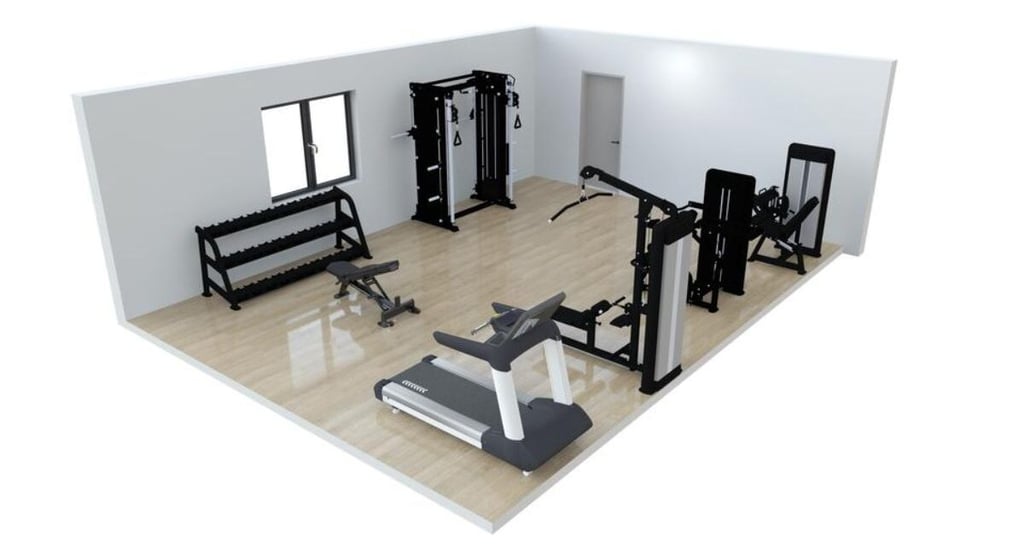
Image 3: Layout of a 50㎡ gym
Layout Solution: Even 50㎡ Can Achieve “Open Center + Perimeter Mounting”
From the final floor plan, this layout has three key points.
- Leave a complete central main training zone to ensure classes can unfold. You’ll see that the middle of the space remains clearly open. This is the most important “strategic blank” in small areas. Whether it’s 1-on-1 PT or a 2–4 person small group class, as long as the central space is intact, training content can switch quickly without being interrupted by equipment pathways.
- Free weights and functional training form a same-side “training chain.” The left window side holds the dumbbell rack and bench, while the rear side holds the multi-function trainer. The distance is short and the path is straight, so coaches can complete upper-body work, core work, and multi-angle cable training on one single teaching line. This significantly improves PT session efficiency: movement demos, equipment switching, and loading adjustments all happen smoothly.
- Machines stay along the wall so they don’t invade the main zone or safety radius. The strength machines on the right are arranged close to the wall, ensuring usability while avoiding conflict with the central training zone. This “wall-side machines + open center” structure is the most standard solution for a 50㎡ PT studio to avoid congestion and raise capacity.
Landing Results/Feedback
After the project entered operation, the client’s feedback concentrated on three points:
- Training experience was clearly better than comparable venues of the same size. Members’ first impression of the space was “clean, smooth, and professional.” Even during peak time, it didn’t feel crowded.
- PT teaching became more efficient and movement instruction more complete. The central main zone plus short “training-chain” routing allowed coaches to finish multiple training types within one session without repeatedly making trainees wait, detour, or switch areas.
- Overall revenue per square meter stayed stable and equipment utilization was balanced. The functional-training core and free-weight zone became high-frequency areas, while the machine zone served as a steady supporting area. There was no typical small-studio problem of “queues in one area and idleness in another.”
For a 50㎡ PT studio to make money, it doesn’t rely on “stuffing the space with equipment.” It relies on turning space into a training field that supports high-frequency teaching and high-efficiency conversion. The value of this case is that it provides a replicable standard model for the 50㎡: open center + perimeter mounting + functional-core priority.
2. 50–100㎡: Small PT Studio / Boutique Small-Group Gym
A 50–100㎡ space isn’t large enough for a “fully equipped gym,” but it is just large enough to do one thing extremely well: make classes and personal training the space’s primary productivity engine. The key layout words in this range are not “more,” but compact, high-frequency, and easily switchable. If a sub-50㎡ gym is a “single-core training room,” then a 50–100㎡ gym is a mature boutique training system — able to serve 1-on-1 PT while also running 2–6 person small-group classes in a stable, repeatable way.

Image 4: Functional Area Share (%) – Gyms 50 – 100㎡
Within the 50–100㎡ range, the functional-zone ratio logic is very straightforward: the main training zone must still take the largest share, but both the free-weight zone and the machine zone need to grow alongside it. The reason is that this range has already begun to form a complete training structure. Members won’t only come for PT sessions anymore; they’ll also train independently at a higher frequency. So while you increase class density, you still need to make sure the training experience doesn’t feel thin or incomplete.

Table 3:Recommended Equipment by Budget (Gyms 50-100㎡)
At its core, the 50–100㎡ layout model is “two cores + a looped circulation path.”
- Core 1 is the main training zone (in the center or along the main axis). This is the primary stage for PT coaching, warm-ups, functional training, and small-group classes. It must remain fully open and intact, allowing movement paths to expand and letting coaches complete multi-movement combinations and class switches within the same area.
- Core 2 is the free-weight zone (against the wall, with continuous mirrors and a full safety radius). In the 50–100㎡ range, this area should be more “system-like” than in sub-50㎡ spaces. Dumbbell racks, benches, and basic barbell/plate positions should form a compact strength chain, so members still feel a strong sense of professionalism even during independent training.
Case: 100㎡ Boutique Training Gym
Many 100㎡ gyms seem to have decent equipment, but still give off a loose feeling — training doesn’t flow smoothly, the space doesn’t look visually aligned, and classes feel hard to drive. The problem usually isn’t the machines; it’s that the space lacks a clear training center and visual center.
This client’s final solution worked because, within the same 100㎡, it got two things right: it placed the training activity center in the middle, and it placed the visualization of training on the mirror wall. That allowed the gym to support PT and independent training while also running stable 2–6 person small-group classes — and at the experience level, it felt far more like a true boutique studio.
Final Equipment Structure
This 100㎡ project ultimately adopted the combination of: one class/functional-training core + one fixed machine strength chain + one free-weight support system + a minimal but complete cardio entry.
- Cardio entry: 2 treadmills (warm-up + basic conditioning)
- Fixed strength machine chain: multiple foundational machines aligned in sequence (complete push / pull / leg structure)
- Free-weight zone: dumbbell rack + benches / free-training positions (for higher intensity ceilings and PT extensions)
- Functional training / small-group core: central open main zone + mat-training stations (the primary class stage)
A large open training area is reserved in the center. On the right side, mat-training and small-tool stations support warm-ups, core work, stretching, and 2–6 person small groups. This central area is the revenue core of the entire 50–100㎡ gym — most PT and class movements happen here.
The ratio logic behind this structure is:
- use the open class-core zone to cover about 50% of training scenarios (PT coaching / small groups / functional training);
- use a complete machine chain to cover 35–40% of foundational strength needs;
- use free weights to fill the remaining 15–20% for intensity ceilings and advanced movements;
- and keep cardio at an entry-level setup.


Image 5 & 6: Layout of a 100㎡ gym
Layout Plan
The reason this layout works is that it fits three training scenarios into one space without them conflicting:
- During PT sessions, coaches can complete warm-ups and functional training in the central main zone, then switch quickly to the machine chain or free-weight chain. The path is short, so efficiency stays high.
- During small-group classes, the central open zone becomes the class stage, while the upper machine area and lower free-weight area can still be used by independent members — avoiding “zone-grabbing” conflicts.
- During independent training, the machine chain and free-weight chain form the base structure, while the central space (outside class times) continues to serve as a stretching/core/small-tool area, raising overall utilization.
For a 100㎡ range, space value comes from multi-time-slot reuse, not from “stuffing everything in all at once.”
Execution Results/Feedback
Post-launch feedback focused on three outcomes:
First, peak hours still don’t look crowded. Because the central zone is intact and circulation paths are short, members naturally spread into the machine chain, free-weight chain, and functional core. Peak density doesn’t pile into a single bottleneck.
Second, the switching cost between classes and PT is very low. Coaches don’t need to make trainees detour around equipment or wait for spots, so session rhythm stays stable — which improves class experience and renewal willingness.
Third, utilization between machines and open zones is more balanced. There were no classic problems like “machines queued while the open zone sat empty,” or “open zone crowded while machines stayed idle,” which shows the zone ratios and layout structure were correct.
3. 100–300㎡: Community Membership Gym / PT Hybrid Gym
Before we go into detail about standard layout strategies for spaces 250 square meters, here’s a short interior design video for a gym of around 250 square meters to help you establish a clear visual baseline.
Once a gym enters the 100–300㎡ size range, its spatial logic goes through a real qualitative shift. In the first two ranges (<50㎡ and 50–100㎡), the core question is whether classes and PT can run smoothly. But in the 100–300㎡ range, the core question becomes: can the training structure be complete, and can a membership model stay stable?
This size range is not so small that you’re forced to rely only on boutique classes, and not so large that you can carve out many separate rooms. If 50–100㎡ is a “boutique training system,” then 100–300㎡ is the full skeleton of a community-style commercial gym — able to carry more members, sustain longer operating cycles, and generate profit primarily through training structure, not just coaching density.

Image 7: Functional Area Share (%) – Gyms 100 – 300㎡
From the bar chart you’ll notice a very clear shift: strength machines and free weights become the main characters of this range, while the functional training core steps back into a role that is “important, but no longer half the gym.”
- Machines (35%) + Free weights (25%) together take over 60% of the training area. Because in the 100–300㎡ range, membership becomes the primary income source, and independent training frequency rises sharply. Members come more often, stay longer, and spread across more training items. That means the space must provide a complete machine-based strength chain and a complete free-weight chain.
- Cardio rises to about 20%. This is the baseline for membership gyms. Cardio doesn’t need to be the main battlefield, but it must be adequate, smooth to use, and able to absorb peak traffic. If cardio is too small, peak-hour congestion feels worse; too large, and it steals area from strength zones. Around 20% is a typical stable ratio.
- Functional training drops to about 15%. Important note: it gets smaller, but not weaker. In this range, functional training is more like the engine for classes and PT, rather than the main training stage for the whole gym. It must stay open, switchable, and coachable — but it doesn’t need to dominate area the way it does in boutique ranges.
- Front desk / auxiliary areas stay around 5%. Community gyms should compress support areas to the minimum usable scale and return space to training itself. Operational efficiency comes from training-area productivity, not from oversized counters.
In one sentence: the ratio shift in the 100–300㎡ range reflects a return to the membership model, and that requires a complete training structure.

Table 4: Recommended Equipment by Budget (Gyms 100-300㎡)
Layout Model for 100–300㎡:
Three parallel training chains + one high-reuse class/functional core
- Strength Machines Chain A continuous chain along one side, covering the foundational push / pull / leg / shoulder / core structure. This gives independent training a clear order and path.
- Free Weights Chain A systematic setup on the opposite side: squat positions, benches, and a dumbbell chain forming an independent, safe high-intensity zone.
- Cardio Chain Placed on the perimeter in a linear distribution. It absorbs peak traffic without intruding into strength cores.
- Functional Training / Class Core Not the largest area, but it must be complete. It needs to support classes, warm-ups, movement switching, and connect to both strength chains with short paths.
The efficiency of 100–300㎡ gyms comes from three training chains plus one reusable core, not from creating more zones.
Case 1: A 250㎡ Community Hybrid Gym
Many 200+㎡ gyms fall into the same trap: they look well-equipped, but peak hours feel crowded. The reason is almost always the same — the strength zone is fragmented, the class zone has no real “home court,” and circulation crosses too often.
This 250㎡ project (training area only, excluding reception, bathrooms, etc.) succeeded because it used a very clear structure to separate three types of training behavior naturally: where independent strength training happens, where PT happens, and where classes happen. Each behavior owns a complete space.
Final Equipment Structure
This 250㎡ project adopted: a high-reuse class/functional core + a complete strength machine chain + a systematic free-weight chain + a linear cardio entry.
- Cardio entry: 3–4 treadmills + 1–2 ellipticals/bikes (covers peak traffic distribution and basic conditioning)
- Strength machine chain: 8–10 foundational machines aligned as a chain (full push / pull / leg / shoulder / core coverage)
- Free-weight chain: 1–2 squat/rack spots + benches + dumbbell chain (a fully independent high-intensity area)
- Functional training / small-group core: Rig / multi-function rack + open floor + small tools (main stage for classes and PT)
- Auxiliary support corner: mat work / assessment nook / recovery spot (small area, but required for a closed training experience loop)
The ratio principle behind this structure is:
- use the machine chain + free-weight chain to cover 60%+ of independent training and strength needs;
- use about 15% functional core to carry classes and PT;
- use about 20% cardio chain for stable peak distribution;
- and compress auxiliary areas to the minimum usable scale.

Image 8: Layout of a 250㎡ gym
You can see the typical layout strategy in the plan:
- Machines form a continuous training chain along one wall. Most selectorized machines are aligned in a straight line, with a complete movement structure and short training paths. The purpose is simple: during peak hours, members don’t spill into the center and create bottlenecks. The machine chain absorbs most independent-training traffic on its own.
- Free weights and squat/rack zones form the high-intensity chain on the opposite side. Squat racks, platforms, and the dumbbell chain stay on the same side with full safety radii, creating an independent high-intensity area. This is critical: once free weights are cut through by circulation, they become the biggest source of peak-hour accidents and congestion.
- A clean, high-reuse open core is reserved in the center. In a 250㎡ gym, this area doesn’t need to be the biggest, but it must be complete and uncluttered. It supports warm-ups, functional training, small-group classes, and PT transitions. Notice how short the distance is from this core to both strength chains — switching during coaching is extremely efficient.
- Cardio sits along the perimeter and handles entry-level traffic distribution. Treadmills and bikes line the edge, avoiding fragmentation of training space while keeping non-strength traffic at the outer ring.
After landing, this structure typically produces three verifiable outcomes: peak hours don’t look crowded, independent training paths feel natural, and PT/class transitions become smooth — because the space is designed around high-reuse and peak controllability.
Execution Results/Feedback
After opening, feedback on this 250㎡ layout focused on three layers:
First, members naturally spread between the machine chain, free-weight chain, and central functional core. Paths stay short and intersections stay low, so even when it’s busy, density doesn’t pile into one point. The client’s most direct feeling was, “It doesn’t look crowded at peak hours,” which raised members’ perception of professionalism and comfort.
Second, PT and class execution became smoother, and coaching rhythm stayed stable. The central core could handle warm-ups, functional training, and small groups, while both strength chains sat within short walking distance. Coaches could switch scenarios inside one session with almost zero waiting.
Third, equipment utilization stayed more balanced. The strength machine chain absorbed most independent training traffic; the free-weight chain handled intensity and advanced work; and the functional core was reused for stretching, core work, and small tools outside class time.
Case 2: 250㎡ Community Membership Gym
In the 200–300㎡ range, the biggest risk isn’t lack of area — it’s fragmentation. Machines get scattered, free weights mix with circulation, and the class zone gets squeezed into a corner. The result is usually: enough equipment, but crowded peaks; PT hard to deliver; members feel training is “not smooth.”
This 250㎡ layout is typical because it doesn’t chase “more functions.” Instead, it organizes limited area into four clear training structures: a cardio distribution ring, a machine strength chain, a free-weight chain, and a high-reuse functional core. The goal is straightforward: let members spread naturally at peak hours, and still keep every zone productive during off-peak hours.
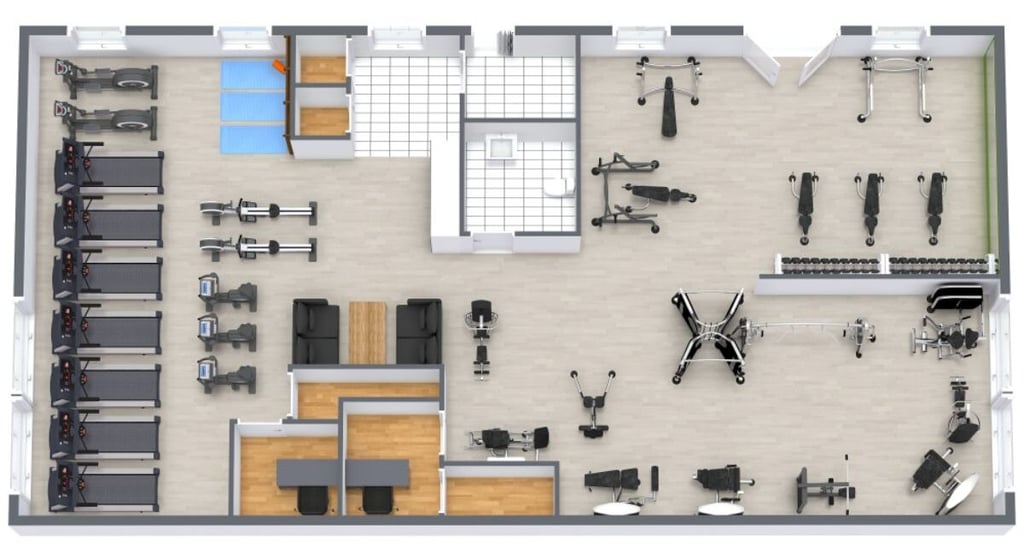
Image 9: Layout of a 250㎡ gym
Layout interpretation: one distribution ring, two strength chains, one reusable core
This 250㎡ model can be summarized as: perimeter cardio distribution → central machine chain → right-side free-weight chain → central/right-central reusable open core.
The outer cardio ring absorbs warm-ups and low-intensity traffic first, which naturally guides the main flow inward and to the right. The machine chain provides a clear foundational strength path; the free-weight chain provides intensity ceilings and professionalism; and the open core acts as the engine for PT and classes, repeatedly “transforming” across different time slots.
This is the most reliable way for mid-size gyms to raise capacity without adding area.
Case Source Note: The 250㎡ floor plan shown in Case 2 is a publicly available online example. All copyrights belong to the original designer or publishing platform. We cite this case only to explain the typical layout structure and functional-zone logic of mid-size gyms, helping gym owners understand planning methods more directly. This does not represent any official endorsement by YR Fitness regarding the venue’s actual operation, equipment brands, or investment outcomes. If the original author/platform has any objection to this citation, please contact us and we will add attribution or remove it immediately.
4. 300–800㎡: Mid-size Membership Gym / Community Flagship
Once a gym reaches the 300–800㎡ size range, it finally enters a truly full-service commercial stage. Unlike the 100–300㎡ range, where the goal is mainly to complete the three training chains, here you need to start thinking at a higher operational level: Which zones are long-term, high-frequency profit modules? Which zones act as peak-hour traffic buffers? Which zones are future growth engines for differentiated services?

Image 10: Functional Area Share (%) – Gyms 300–800㎡
From the functional-area ratios, you’ll see that this range begins to take on the standard shape of a stable commercial gym. Machines remain the largest block (around 35%), free weights hold around 25%, cardio stays steady at about 20%, functional training sits around 15%, and front desk/support areas remain near 5%. These ratios aren’t random. They appear because training behavior in the 300–800㎡ range becomes more layered: some members come for consistent machine-based strength training, some pursue progressive free-weight work, some need reliable cardio buffering during peak hours, while functional training must carry classes, PT, and trend-driven programs — but no longer dominates the main battlefield.
You can read it this way: primary revenue comes from high-frequency strength training (machines + free weights), stable experience comes from a sufficient cardio buffer, and growth potential comes from functional training and class areas.
If you oversize the functional zone in this range, you’ll squeeze the long-term high-frequency strength area. But if you undersize it, you lose the space needed for future class expansion, PT upgrades, and differentiation.

Table 5: Recommended Equipment by Budget (Gyms 300-800㎡)
At around the 500㎡ mark, equipment structure enters a mature stage of fully formed training chains + high-reuse across time slots. Compared with the 100–300㎡ range, the value here is no longer just “making strength training complete,” but ensuring that members with different goals and intensities naturally spread out during the same time period — and that PT and group classes can still run smoothly even at peak hours.
So the equipment list in this range is built around one core logic: use three training chains + one class/functional core to separate training behaviors and maximize space efficiency.
Case: A 500㎡ Mid-size Membership Gym
500㎡ is the most typical — and easiest to stabilize — mid-size commercial area within the 300–800㎡ range. The goal of this project was very clear: rely on a stable membership base, while keeping room for PT and small-group class growth. So instead of adding more rooms, the strategy was to let training behaviors naturally layer within an open plan.
Final Equipment Structure
This 500㎡ project adopted a combination of: complete cardio buffering + a large machine strength main zone + a systematic free-weight intensity zone + a functional training / small-group core.
- Cardio buffering equipment: about 8–10 treadmills plus several ellipticals/bikes/rowers, forming a stable conditioning belt that handles peak distribution and entry warm-ups.
- Main strength machine zone: roughly 15–20 core machines (full coverage of chest press, rows, pulldowns, shoulder press, leg press, leg extension/curl, hip abduction/adduction, abs/back core, etc.), grouped into one continuous main area.
- Free-weight intensity zone: 2–3 squat/rack stations + bench/adjustable-bench sets + a complete dumbbell chain (mainstream weight gradients covered), plus a dedicated landing area for deadlifts/Olympic lifts.
- Functional training / small-group core: rig/multi-function rack + open floor + small tools (kettlebells, battle ropes, medicine balls, TRX, plyo boxes, etc.), supporting both PT and 4–10 person small groups.
- Auxiliary support points: stretching mat area, assessment nook, storage and hydration/supply points (small footprint but completes the experience loop).
The ratio principles behind this structure are:
- use machines + free weights to cover around 60–65% of mainstream strength needs;
- use about 20% cardio to form a stable peak buffer;
- use about 15% functional core for classes and PT growth;
- and keep support areas at the minimum usable scale.
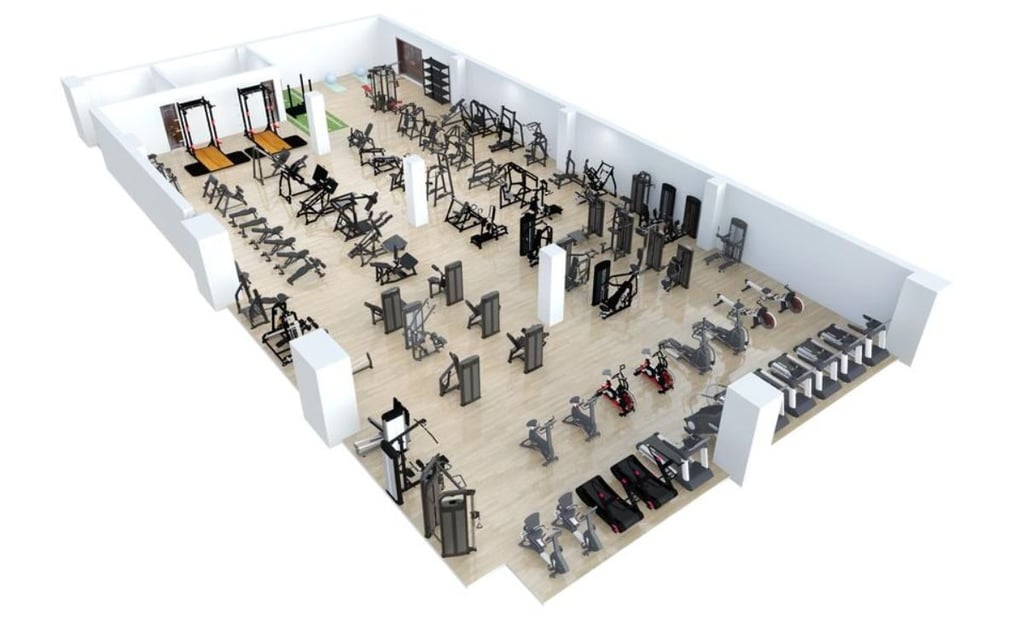
Image 11: Layout of a 500㎡ gym
Layout Highlights
This 500㎡ layout works because it breaks training traffic into three natural paths:
Path 1: the “cardio → strength machines” mainstream path.
Cardio sits along the perimeter in a linear arrangement. After finishing cardio, members flow directly into the machine main zone without cutting through the free-weight area — reducing circulation conflict from the start.
Path 2: the “free-weight intensity” path.
Squat racks, dumbbells, and benches are grouped systematically and are not crossed by the main aisle, giving high-intensity training a stable safety radius.
Path 3: the “functional training / class” path.
The central functional core is a high-frequency warm-up, core, and stretching area during non-class hours. During class hours, it quickly transforms into a group-training stage. It also stays within short distance of both strength axes, making PT and class switching highly efficient.
For a 500㎡ gym, space value comes from peak distribution + layered training behavior + multi-time-slot reuse. This raises your capacity ceiling without needing extra area.
Execution Results/Feedback
After operating for a while, member feedback converged into a very tangible experience:
- Many members said that even at peak hours, “it’s busy, but I don’t feel squeezed while training.” That’s because traffic naturally spreads into the cardio belt, machine main zone, free-weight zone, and central functional core. Each zone has clear boundaries, so people don’t need to constantly yield to each other.
- Free-weight users especially felt a clear boost in safety. When squatting or deadlifting, no one cuts behind them, and there is less spot-competition between machines and dumbbells. That makes advanced trainees more willing to stay long term.
- For newer members, the clearest benefit was that the circulation felt easy to follow. From entry warm-up to strength training and finally stretching, the full sequence is intuitive — no searching for routes, no detouring around equipment. Many people said, “training here feels smooth,” and that smoothness directly increases visit frequency and renewal willingness.
5. 800–1500㎡: Premium Full-service Gym / Flagship Community Club
When a gym reachs the 800–1500㎡ size range, the layout logic goes through a second qualitative shift. In the earlier ranges, the core goals are “complete training structure” and “controllable peak capacity.” But at this size, the gym starts to gain real business-format expansion capability: group classes can become a truly independent zone, specialty programs can be operated seriously, and recovery and social areas now have a strong, practical reason to exist.
Precisely because of this, many owners make the opposite mistake in this range. They assume that “since the space is big enough, we can just add more things,” and end up slicing the venue into disconnected islands: cardio scattered, machines scattered, free weights scattered, group class zones with no system. The result is predictable — still crowded at peak hours, still empty off-peak. The key in 800–1500㎡ is not “adding more,” but building a coherent system.

Image 12: Functional Area Share (%) – Gyms 800–1500㎡
A very typical steady-state flagship structure looks like this:
- Cardio — 18% Compared with the 100–300㎡ or 300–800㎡ ranges, cardio drops slightly, but still plays a strong buffering role. The reason is simple: flagship clubs serve a broader mix of members, and cardio acts as both “entry-level training” and a peak-hour pressure valve. It can’t be missing or too small, but it also shouldn’t steal area from the true profit core — strength and classes. Around 18% usually means cardio is large enough to avoid queues at peak hours while not squeezing strength or class value.
- Strength Machines — 32% This is the flagship’s stable foundation. In this range, machines must not only cover a full push / pull / leg / glute / shoulder / back / core chain, but also support segmented training by user groups: beginner-friendly lines, female-preference lines, upper/lower-body chains, and rehab/light-load chains should each follow a clear zoning logic. About 32% supports this “complete + segmented” structure.
- Free Weights — 25% Free-weight share continues to rise, and that signals something important: a flagship club’s reputation is often built not on cardio, but on the professionalism and intensity ceiling of its free-weight area. At 25%, you can form a clear intensity main chain — racks, dumbbells, platforms for Olympic/deadlift work, and a functional power corner — while still keeping proper safety radii and comfort.
- Group / Specialty Programs — 15% In this size range, whether the class zone becomes a fully independent system directly determines whether you can achieve higher ticket values and stable repeat purchase. Fifteen percent is enough for one standard group-class studio (or multi-purpose class room) plus one specialty zone (for example Pilates / boxing / a FreeStyle studio combination). The key here is not adding more rooms, but ensuring the class area has a clear entrance, sound isolation, and a closed flow loop — so classes don’t disturb training spaces, and class exits don’t flood the main aisle.
- Recovery / Social — 10% This is the differentiation label between flagship clubs and normal community gyms. Recovery isn’t “two yoga mats.” It should support stretching, relaxation, light recovery, and even short social stays. Ten percent matters because it increases post-workout lingering, boosts perceived premium value and renewal willingness, and also reduces peak-hour density pressure.
In one sentence: the 800–1500㎡ ratio structure is essentially “strength as the core, classes as value-add, recovery as experience upgrade.”
At this scale, gym layout decisions become more complex, as operators must balance premium member experience with operational efficiency and long-term durability. This is where working with a professional commercial equipment manufacturer makes a measurable difference.
At YR Fitness, we support flagship gyms by offering a complete one-stop solution that covers strength machines, free weights, cardio equipment, and functional training accessories — all designed with commercial-grade durability. This allows gym owners to maintain consistent design language, spacing standards, and traffic flow across multiple training zones without mixing incompatible equipment brands.
Table 6: Recommended Equipment by Budget (Gyms 800-1500㎡)
Layout Model for 800–1500㎡: “Four systematic chains + two independent business cores + one main circulation loop”
If we summarize a flagship layout in the simplest model, it should look like this:
- Cardio Chain Linear and concentrated along the perimeter or window side. It absorbs peak traffic and entry-level conditioning needs without fragmenting the central floor.
- Machines Chain A continuous band, segmented by body region or user group, forming a stable path for independent training.
- Free Weights Chain A fully independent zone with a clear intensity progression logic: racks → dumbbells → platforms → power/assist corners. It must not be cut through by the main aisle.
- Functional / Open-Floor Chain It doesn’t need to be the largest, but it must be complete and clean, and it should connect to both strength chains with short paths. This is the daily engine for PT coaching and small-group training.
- Group Class Core An independent studio with a clear entrance, sound insulation, and a pre-/post-class buffer. Whether this area is system-based is what truly defines a “flagship.”
- Recovery / Social Core Close to the training core but off the main aisle, acting as a “second stop after training” to extend stay time and experience.
At the same time, the club’s circulation must follow a main loop, allowing members to naturally complete a full cycle of warm-up → training → refuel → recovery, instead of repeatedly crossing and conflicting inside the floor.
Case: A 1000㎡ Full-service Gym
This 1000㎡ plan (training-focused, with necessary front desk and support areas included) is a very typical mature full-service club skeleton. Its key success is that each training chain forms a continuous, coherent block, while leaving natural buffer space between training and classes so traffic can be guided smoothly.
Final Equipment Structure
This 800–1500㎡ (about 1000㎡) project adopted a combination of: high-capacity cardio entry + a complete strength machines chain + a deep free-weight / plate-loaded intensity chain + an independent functional/class zone + a closed-loop assessment & recovery support area.
- Cardio entry equipment: 10 commercial treadmills + 2 curved treadmills + 2 stair climbers + 2 ellipticals + 2 upright bikes + 2 recumbent bikes + 2 air rowers + 2 air bikes (handles peak distribution and basic conditioning, acting as the first “entry-level training touchpoint”)
- Strength machines chain: Full selectorized coverage of push / pull / shoulder / chest / back / arms / core / glutes & legs, totaling about 30 machines (e.g., chest press, fly, shoulder press, lateral raise, various pulldown/row units, biceps/triceps, abs/back, hip abduction/adduction, leg extension/curl, seated/standing leg press, calf work, etc., forming the high-frequency independent training “main trunk zone”)
- Free weights / plate-loaded intensity chain: 4 power racks + 2 Smith machines + about 30 plate-loaded strength pieces (multi-angle bench/press/pulldown/row units, leg press/linear press, V squat, pendulum squat, hack squat/press combo, hip thrust, lunge stations, calf work, etc.) plus a full dumbbell system and multiple bars (Olympic bars, safety squat bar, trap bar, hex bar) with plates (forming an independent intensity zone and the “second main stage” for advanced strength work)
- Functional training / class core: 2 dual-cable functional trainers + one 9-station integrated rig + small tools (med balls/wall balls, mats, TRX/bands) + open training floor and a short sprint turf lane (supports small groups, PT instruction, warm-ups, and corrective training)
- Auxiliary support points: assessment/evaluation corner + mat-based stretch & recovery area + member rest/social zone (kept at the minimum usable scale but ensuring a complete training loop)
The ratio logic behind this structure is:
- use machines + free-weight/plate-loaded chains to cover about 55–60% of independent strength needs and stabilize peak traffic;
- use about 18% cardio for entry buffering and conditioning baseline;
- use about 15% functional/class space to generate continuous class and PT value;
- and use about 10% recovery/social support to increase stay time and renewal willingness.

Image 13: Layout of a 1000㎡ gym
Layout Plan
Training Structure: three main chains clearly zoned
Cardio is placed along one edge in a linear belt, with treadmills, bikes, and ellipticals forming a continuous strip. Perimeter cardio serves two purposes: first, it absorbs beginners and low-intensity traffic; second, it acts as a peak-hour pressure valve so not everyone floods into strength zones at once.
The strength machines zone forms a large, continuous training surface in the middle of the gym, covering a full movement chain (push, pull, legs, shoulders, core). Notice it isn’t scattered — it’s intentionally one coherent block. In a 1000㎡ club, if machines get chopped into fragments, peak traffic rebounds into the same main aisle and congestion instantly spikes.
The free-weight zone is independent on the other side, with a clear intensity layering: racks/squat stations, bench training, dumbbell lines, and specialty high-intensity corners each in their own sub-area. The underlying rule is simple: free weights must not be crossed by main circulation. This plan executes that cleanly, so intensity training stays stable without exporting risk or interference to the whole venue.
Functional / Class Core: acting as a “traffic guider” in a large club
The upper functional/small-group area (including turf/open mat zones and switchable training bays) is placed in a very strategic position: close to both strength chains but not compressing them. That allows it to be reused at high frequency in three scenarios:
- During class hours, it becomes the main stage for HIIT/functional small groups.
- During PT hours, it supports warm-up, posture coaching, and movement instruction.
- Outside class hours, it becomes a member-used zone for stretching, core work, or small-tool training.
This “spillover core” is a size-range advantage that only works above ~800㎡: it stitches classes and independent training into the same system, rather than separating them into two disconnected businesses.
Execution Results/Feedback
Members’ feedback typically concentrates on three very direct experience outcomes:
First, during training they “don’t get interrupted by others.” The free-weight area feels calm, movement radii for squats, deadlifts, and dumbbell work stay intact, and almost no one cuts directly through your space. For strength-focused members, this sense of safety and order directly increases training frequency and stay length.
Second, at peak hours they can “still find where they belong.” Cardio users stay at the perimeter, machine users naturally go to the middle, free-weight users enter the intensity zone, and members looking for classes or stretching remain around the functional core. The venue doesn’t become chaotic just because it’s busy — which is crucial for renewals and referrals.
Third, class experience feels more like a boutique studio, not “an empty corner inside a big gym.” The functional core’s position and buffer space allow class members to flow naturally into strength or recovery areas afterward, without bursting straight into the main aisle. Members feel that classes and training are connected, creating a more complete experience.
6. 1500㎡ and Above
Spaces in this category typically follow a multi-format, compound business model. Layout should prioritize business-format zoning first (pool / courts / rehab / fitness / dining, etc.), which is beyond the scope of this article and will not be expanded here.
Differences in Layout by Region

Image 14:Regional Differences in Area Layout
The radar chart is used to present, under the same area, how different regions prioritize five space types: cardio / machine strength / free weights / group class & functional / recovery & stretching.
When reading the radar chart, what matters isn’t the height of a single point, but the “shape.”
- North America’s shape stretches toward free weights, showing that the strength core is both an experience center and a traffic absorber.
- The Middle East expands toward cardio and machines, so cardio and machine-strength shares stay steadier and more experience-heavy.
- Southeast Asia protrudes on the group class & functional axis, implying monetization relies more on group class and functional-training popularity.
- Europe is more balanced overall, but its recovery axis rises, reflecting high sensitivity to stretching, rehab, and recovery spaces.
The value of this chart is that it lets you see each region’s “training priority map” at a glance. With the same 200–300㎡, you can’t maximize every function, but you must make the locally most important one top-tier. Otherwise, even following a standard model can still lead to mismatched experience.
Gym Layout Design Process

Image 15: Gym Layout Design Process (Step-by-Step)
Before we get into the details, I’m putting the full layout workflow up front. This 6-step sequence is the same logic we apply across different countries and size ranges. Read the diagram first, then use the explanations below to understand what each step really means — and how to execute it in your own project.
Step 1. Functional Zone Planning
The first step of layout is never selecting equipment. It is first confirming what tasks the space must complete. You need to break the venue into several operable functional modules and clarify the ratio and role of each: which zones handle high-frequency training needs, which take on professionalism and traffic absorption, which correspond to classes or PT revenue, and which must yield to flow, safety radius, and auxiliary functions. Once functional zones are fixed, you’re essentially locking in your training structure and future revenue structure. The goal of this stage is simple: get a clear sketch of zone ratios and relationships. Don’t draw equipment yet — only “zones.”
Step 2. Gym Style Positioning
Style is not decoration taste. It is the “constraint” that determines layout temperament and user perception. Once style is fixed, entrance visual focus, lighting layers by zone, material texture, and mirror/display positioning all have a clear direction. More importantly, style directly affects how each functional zone “does its job”: strength zones need power, class zones need scene, recovery zones need calm, and entrance needs brand. Many gyms look “well-equipped but not premium,” not because they didn’t spend enough, but because style positioning was missing and spatial expression became inconsistent. At this stage, what you need to do is define in one clear sentence what experience your venue wants to convey, and then translate it into atmosphere principles for the entrance, training core, and key zones.
Step 3. Equipment List
The equipment list must follow functional zones, not “trending equipment rankings.” The professional logic is: first confirm the training tasks each zone carries; then decide which equipment is “structurally necessary,” which is “experience enhancement,” and which is a bonus when budget allows. This makes your list naturally match spatial ratios and avoids the awkwardness of “buying great equipment but not being able to fit it, or fitting it but not using it well.” At this stage you must also consider footprint, safety radius, training paths, and engineering conditions (power, vents, noise, etc.), because these hard constraints decide whether the list can truly land.
Step 4. Circulation Planning
Circulation is not just “leaving a few aisles.” It is the key structure that keeps the space running smoothly during peak hours. Mature circulation usually follows a main spine plus several branch lines: the main spine brings members from the entrance into the training core and then naturally splits them into zones; branch lines circulate inside each zone and avoid cross-traffic. Two kinds of conflicts must be handled: conflicts between high-traffic areas and high-risk areas (such as main aisles cutting through free-weight safety radii, or class exits rushing directly into dumbbell zones), and conflicts between training sequence and spatial paths (whether the common behavior sequence of warm-up → machines → free weights → stretching aligns with the way the space guides movement). Smooth flow raises your capacity ceiling; chaotic flow makes even a large venue feel crowded.
Step 5. 3D / CAD Plan
Before entering CAD/3D, the first four steps should already be structurally stable. This step turns “ratios and flow” into a real, buildable space. At the CAD level you must align equipment dimensions, spacing, safety radii, pillar grids, vents, lighting positions, sockets, power, and fire-evacuation routes in one shot, ensuring drawings are buildable and construction does not trigger rework. At the 3D level you verify whether key scenes truly work — whether the entrance has a visual anchor, the strength zone has a sense of center, the class zone has atmosphere, and the PT zone has professionalism and privacy. The value of 3D isn’t showing off visuals; it’s finding problems that “look right but feel wrong” before construction.
Step 6. Budgeting and Execution
In the final stage, the key is letting the budget follow the layout, rather than following impulsive equipment buying. You need to split the budget into two parts: one part is the key investments that determine space efficiency and experience ceiling (main aisle width, free-weight flooring, class soundproofing, HVAC and fresh air, power points and vents, etc.); the other part is the “nice-to-have upgrades” after the structure is right. Many venues overspend or suffer long-term hidden costs not because equipment is expensive, but because early layout didn’t include engineering and experience factors, forcing demolition and rebuild after opening. It’s recommended to reserve at least 10–15% contingency for on-site unknowns, and to continuously re-check key positions during construction (power, vents, lights, equipment landing) to avoid “correct drawings but distorted on-site reality.”
Commonly Overlooked Problems in Gym Design
Many gyms look “well-zoned and fully equipped” on paper before opening, but once they start operating they quickly expose congestion, complaints, heat, noise, or rework issues. The reason is usually not insufficient area, but that the layout failed to account for some “engineering-level hidden variables” early on. The following six items are the most frequent and also the easiest to overlook layout risk points I’ve seen across different countries and area ranges:
First, load-bearing capacity.
Dynamic impact loads in free-weight areas are far higher than standard commercial floors. Residential or regular commercial floors are often 250–300 kg/㎡, while free-weight areas usually need 500–800 kg/㎡, and instantaneous impact from deadlifts/platforms can be even higher. If load-bearing is not calculated clearly, the typical consequences are floor vibration, complaints from downstairs, or even forced shutdown and rectification. In layout planning you must place free-weights and platforms on the strongest structural positions and reserve damping and buffering layers.
Second, noise and vibration.
Low-frequency vibration from treadmills, sound spillover from group classes, and impact vibration from platforms transmitted through beams are the most common post-opening complaint sources. Once exposed, remediation is extremely expensive. At the layout stage you must ensure: cardio zones near windows or exterior walls, class studios separated from strength cores, platforms near load-bearing walls with thick damping flooring, and avoid concentrating heavy-vibration equipment on weak floor sections.
Third, vents, fresh air, and air-conditioning.
Training spaces are highly sensitive to airflow. Overheating cardio zones, stuffy class studios, and vents blowing dust directly onto squat areas often become the starting point of experience collapse. The right approach is to match “training density and air volume” at the layout stage: higher airflow for cardio zones, independent fresh-air lines for class and functional zones as much as possible, avoid ducts blowing directly onto training spots, and coordinate vents early with lighting and mirror placement.
Fourth, lighting.
Lighting decides a space’s sense of professionalism and zone identity. Uniform white lighting across the gym, overly bright free-weight areas, class studios without scene lighting, and harsh mirror glare all make high-end equipment look cheap. At the layout stage, define lighting logic by zone: warmer or neutral dim lighting for strength areas, bright lighting for cardio, adjustable scene lighting for classes, and branded atmosphere lighting at the entrance.
Fifth, safety radius.
Safety distances easily ignored on drawings will turn directly into congestion and risk during peak hours. The front of dumbbell zones, both sides of squat racks, leg-press movement paths, and open areas in front of rigs all require reserved movement space. Insufficient safety radius is not only “uncomfortable” — it reduces usable capacity.
Sixth, flow conflicts.
The root cause of crowding in many venues is not area but too many circulation intersections: locker-room exits facing dumbbell zones, treadmill dismounts aiming at main aisles, class crowds rushing into strength areas, and so on. The optimization core is a “one main spine + two branches” structure, reducing intersections and letting peak traffic layer and dissolve naturally.
In short, an excellent layout is not only about good-looking zoning. It locks load-bearing, noise, vents, lighting, safety radii, and flow — these “hidden variables” — into the design early, so you don’t have to fix them later at a high cost.
Conclusion: Layout Is the Strongest Driver of Conversion Rates
By this point you can clearly see one fact: equipment determines training function, layout determines training efficiency, and efficiency determines experience, capacity, conversion, and profit.
Many gym problems look diverse on the surface — congestion, complaints, low utilization, PT being hard to sell, budget overruns — but when you trace them back, they often come from the same root: the layout was not systematically designed at the very beginning. If the area is chosen correctly, ratios are planned correctly, circulation is smooth, and hidden variables are handled in advance, your gym will enter a state where it is “easier to make money and harder to run into problems.”
This guide started from area landing points, broke down standard zone ratios and layout strategies for different ranges, compared training preferences across regions, and then summarized a complete layout workflow and six high-frequency hidden risks. I hope you gain two types of takeaways:
one is area-based layout models you can use immediately, and the other is the underlying layout logic that keeps you from stepping on the same traps again.
Finally, I suggest you save the last “master table” in this article (area / budget / zone ratios / fit model / typical revenue). It will become your rapid decision map for opening, expanding, and upgrading gyms.
Size Range | Equipment + Basic Fit-Out Budget (USD)* | Typical Annual Revenue(USD)* (Ohio) | Typical Annual Revenue(USD)* (Jakarta) | Recommended Business Model | Functional Area Mix Reference | Member Capacity |
|---|---|---|---|---|---|---|
< 50 m² | 8k – 15k | 180k – 300k | 48k – 96k | PT / Reformer / Small Group Classes | Cardio 10% | Machines 20% | Free Weights 20% | Functional Training 50% | 6–12 |
50–100 m² | 12k – 25k | 300k – 420k | 84k – 144k | PT + Small Group Classes | Cardio 15% | Machines 25% | Free Weights 25% | Functional Training 35% | 10–18 |
100–300 m² | 20k – 45k | 600k – 900k | 180k – 300k | Membership + PT | Cardio 20% | Machines 35% | Free Weights 25% | Functional / Group 20% | 25–60 |
300–800 m² | 45k – 120k | 960k – 1.44M | 300k – 480k | Membership + PT + Group Classes | Cardio 20% | Machines 35% | Free Weights 25% | Group Classes 15% | Functional / Recovery 5% | 60–150 |
800–1500 m² | 120k – 250k | 1.56M – 2.16M | 480k – 780k | Premium Membership + Multiple Class Lines | Cardio 18% | Machines 32% | Free Weights 25% | Group Classes 15% | Recovery / Lounge 10% | 150–350 |
≥ 1500 m² | 250k – 500k+ | 2.16M – 3.0M+ | 720k – 1.08M | Mixed-use Facility (Pool / SPA / Courts) | Cardio 15% | Machines 30% | Free Weights 25% | Group Classes 15% | Recovery / Leisure 15% | 350–700 |
If you’d like a free first-draft layout, send us your floor plan, total area, and positioning goals. We’ll come back with recommended zone ratios, an equipment framework, and a draft layout — so you can lock in space efficiency before renovation and purchasing.
And if you’re still exploring or want deeper, step-by-step guidance, visit our Gym Owner’s Resource Hub for more practical resources.
Related articles: