




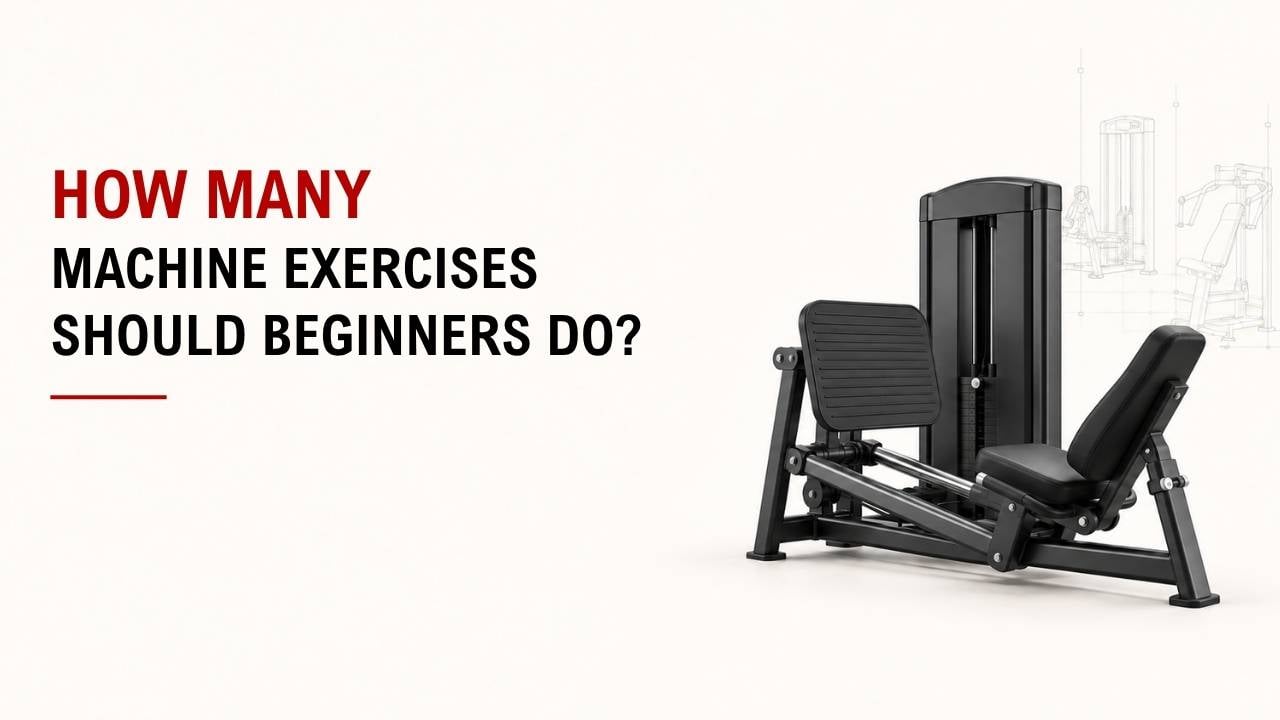

Not sure how many machines you should use in one workout as a beginner? You do not need to train on every machine in the gym.
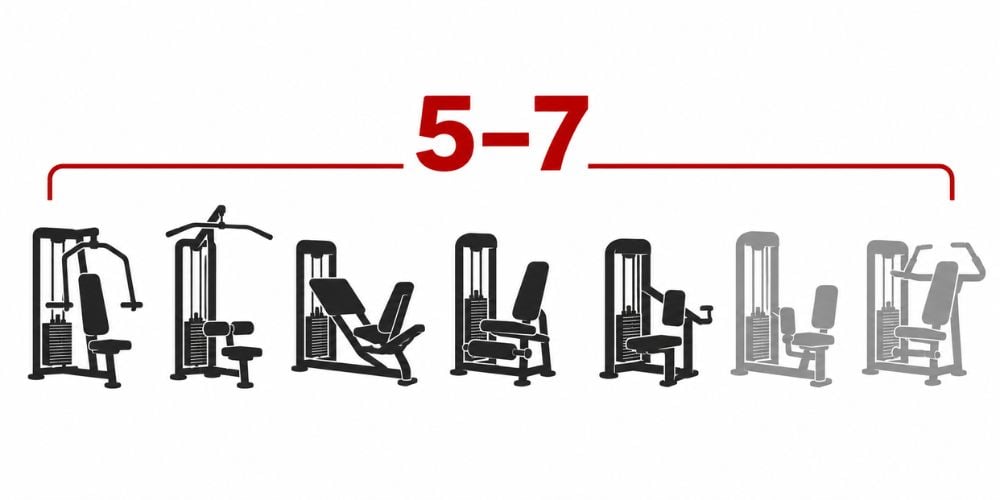
The quick answer is 5–7 machine exercises per workout. That is usually enough to cover your major muscle groups without making the workout complicated.
As an Exercise Physiology & Biomechanics Expert at YR Fitness, I study how exercise selection, resistance, and movement affect training. I often see beginners progress faster when they learn a few basic exercises well instead of constantly adding more.
Below, I’ll show you which machines to choose, how many sets and reps to do, and how often to train. Keep scrolling, and you can put together a simple beginner routine in minutes.
1. Beginners Should Start With 5–7 Machines
For most beginners, 5–7 machine exercises in one workout is enough.
You do not need 10, 12, or 15 different exercises. More exercises can simply make your workout longer without making it more useful.
Here is an easy way to decide:
Number of Machines | Best For | What It Means |
5 | Short workouts | Basic full-body coverage |
6 | Most beginners | Balanced full-body session |
7 | Extra training | Adds more work for one area |
8+ | More experienced routines | Usually unnecessary for a new beginner |
Your first goal should be to learn each exercise, control the weight, and train consistently.
This simple approach also matches the broader message in the ACSM’s current resistance-training guidance: consistency matters more than building an unnecessarily complicated program.
More machines = better results? Not necessarily.
If five or six exercises already train your whole body, adding more just to make the list longer does not automatically improve the workout.
2. What Machines Should Beginners Choose?
Do not choose machines randomly. Pick exercises that cover your main muscle groups.
A simple beginner setup looks like this:
Machine Exercise | Main Muscles | Movement |
Leg Press | Quads, glutes, hamstrings | Lower-body push |
Leg Curl | Hamstrings | Knee flexion |
Chest Press | Chest, shoulders, triceps | Upper-body push |
Lat Pulldown | Back, biceps | Vertical pull |
Seated Row | Back, biceps | Horizontal pull |
Shoulder Press | Shoulders, triceps | Overhead push |
Ab Machine | Core | Trunk training |
Do you need all seven every workout? No.
A five-machine session could include the leg press, leg curl, chest press, lat pulldown, and shoulder press. That already gives you lower-body work plus upper-body pushing and pulling.
The important part is coverage. The CDC’s muscle-strengthening guidance recommends working the major muscle groups, including the legs, hips, back, abdomen, chest, shoulders, and arms.
So instead of asking, “How many machines can I fit into my workout?” ask, “Am I covering the main areas of my body?”
That is a much better way to build your routine.
If you want to compare how common strength machines are designed for different movement patterns, explore the YR Fitness strength equipment range. We design our commercial strength equipment around practical movement paths, stable construction, and straightforward adjustment, so you can easily see how different machines fit into a complete strength-training setup.
3. How Many Sets and Reps?
Once you have your exercises, keep the sets and reps simple.
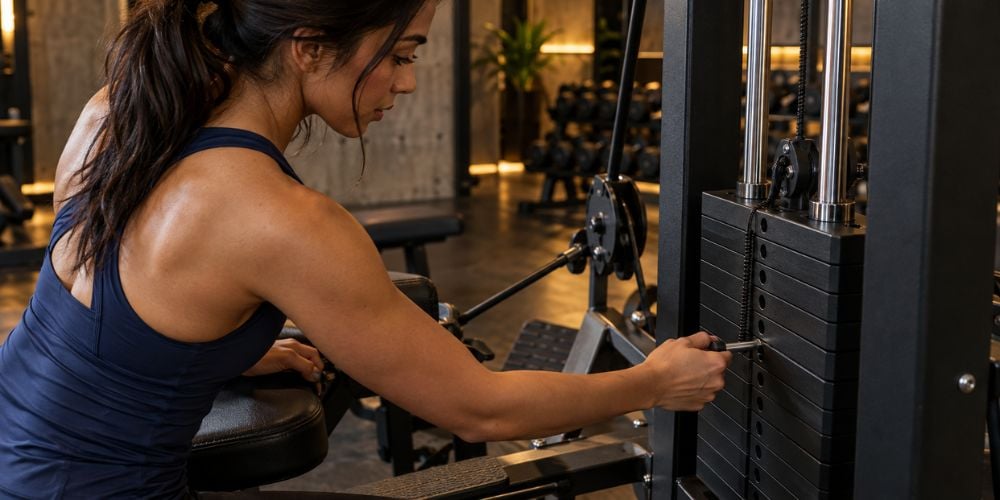
A practical beginner starting point is:
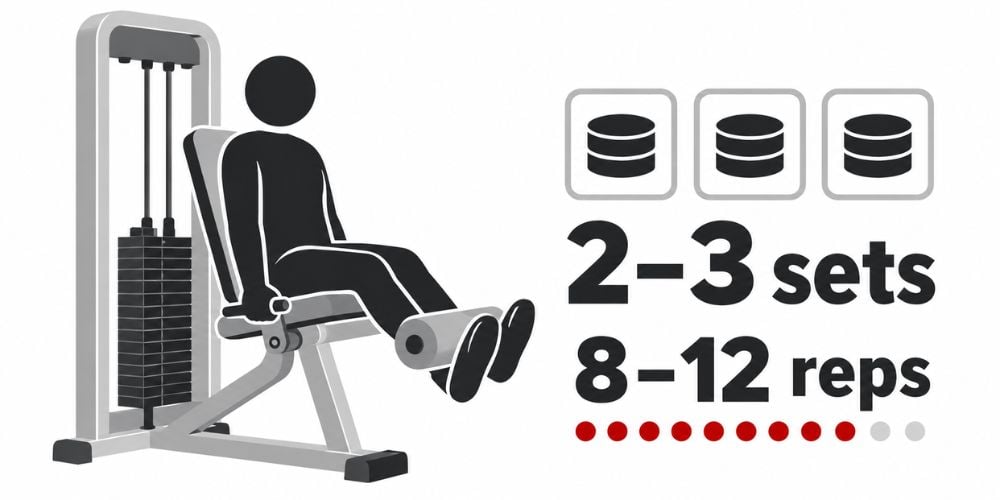
- 2–3 sets per exercise
- 8–12 reps per set
- 60–90 seconds of rest when needed
- Use a weight you can control through the whole movement
If you choose five exercises, that gives you around 10–15 working sets in one workout.
The 8–12 rep range and 2–3 sets also line up with practical recommendations in the CDC guidance on strength-training repetitions and sets.
I often see beginners increase their weight too quickly because heavier feels like faster progress. In reality, controlling the movement first gives you a much better foundation.
Can you complete 12 reps easily with clean form? You may be ready for a small weight increase.
Can you barely reach six or seven clean reps? The weight is probably too heavy for your planned 8–12 rep range.
Keep it simple and let your technique guide you.
4. How Long Should a Beginner Machine Workout Take?
You do not need a two-hour workout.
A beginner machine session can usually fit into around 30–60 minutes, depending on how many exercises you choose and how long you rest.
Five exercises naturally make a shorter session. Six or seven give you room for a little more training without turning the workout into a marathon.
A focused 40-minute workout can be more useful than spending 90 minutes moving between machines without a clear plan.
Here is why this matters: beginners still have to learn seat positions, starting positions, weight selection, and movement control. Leaving yourself time to perform each exercise properly is more useful than rushing to the next machine.
5. Should Beginners Train Every Machine in the Gym?
No.
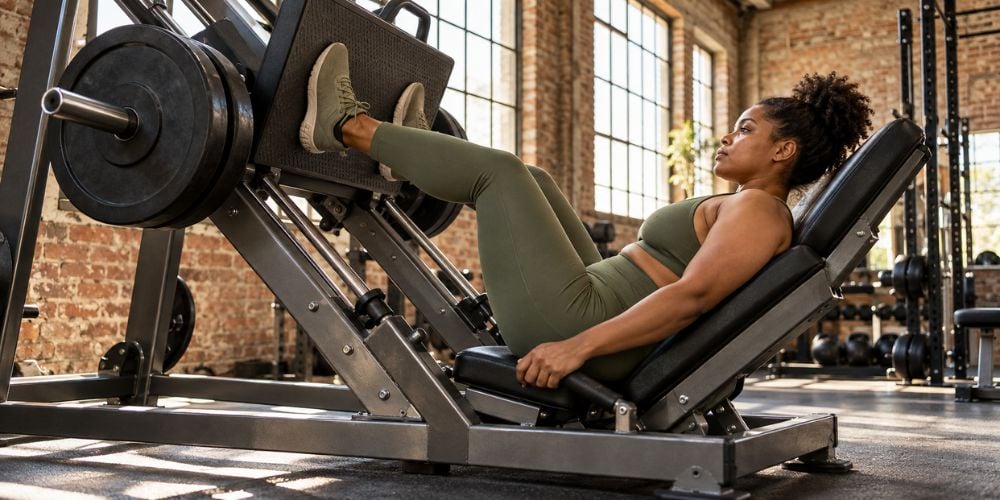
Your gym may have dozens of strength machines, but you only need a few that cover the basic movement patterns.
I often see beginners jump between machines because they think variety automatically means better training. The problem is that constantly changing exercises makes it harder to learn good technique and see whether you are actually getting stronger.
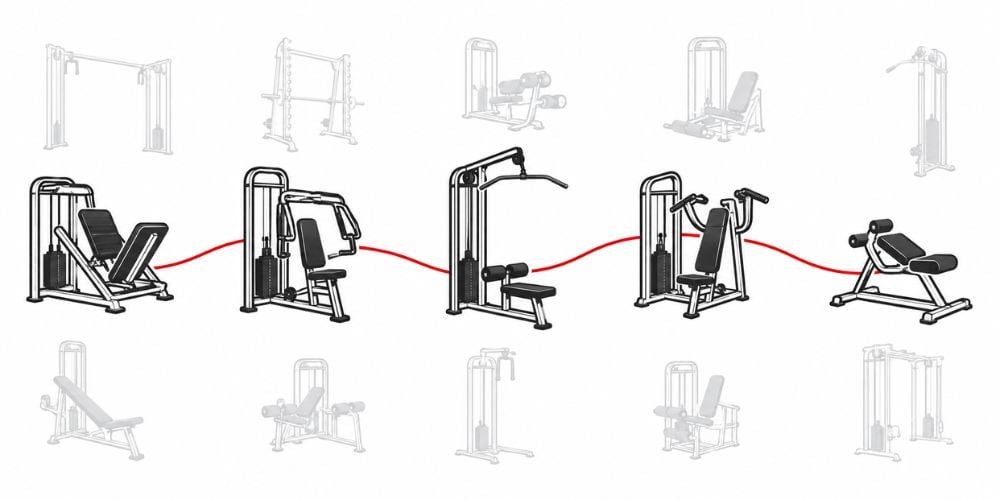
Instead, build around:
- One or two leg exercises
- One upper-body push
- One upper-body pull
- One shoulder exercise
- Optional extra leg, back, or core exercise
That quickly puts you around the 5–7 exercise range.
Stick with the same core exercises for several weeks. Once they feel familiar, you can add or replace an exercise based on what your routine is missing.
6. How Often Should Beginners Do Machine Workouts?
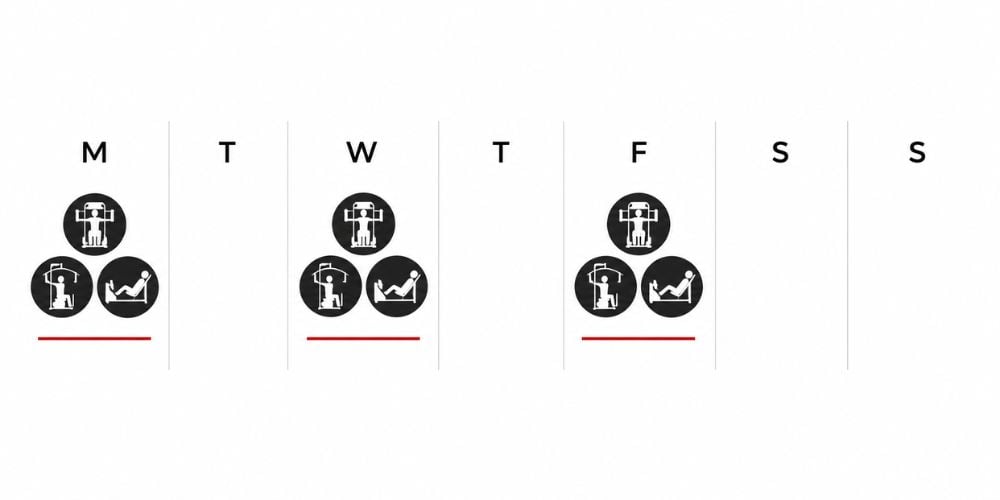
For most beginners, 2–3 full-body machine workouts per week is a practical starting point.
For example:
Monday – Wednesday – Friday
Or:
Tuesday – Saturday
The exact days matter less than staying consistent and allowing some recovery between harder sessions.
Both WHO physical activity recommendations and U.S. public-health guidance recommend muscle-strengthening work for all major muscle groups on at least two days per week.
Does that mean you must train three times? No.
Two full-body sessions can still give a beginner a solid starting routine. If your schedule allows three and you recover well, three can also work.
You also do not need seven exercises every time. If you are short on time or still learning the movements, five well-performed exercises can be enough.
From my experience, consistency matters much more than trying to use every machine available. A simple routine that you can repeat is much easier to improve.
Conclusion
So, how many machine exercises should beginners do? Start with 5–7 exercises per workout and perform around 2–3 sets of 8–12 reps for each one.
Choose exercises for your legs, chest, back, shoulders, and other major muscle groups. Learn those basic movements well before making your routine bigger.
If you want to see how those basic exercise categories translate into actual strength machines, explore YR Fitness and compare the available equipment. Start simple, train consistently, and only add more exercises when your routine genuinely needs them.
Related articles: