








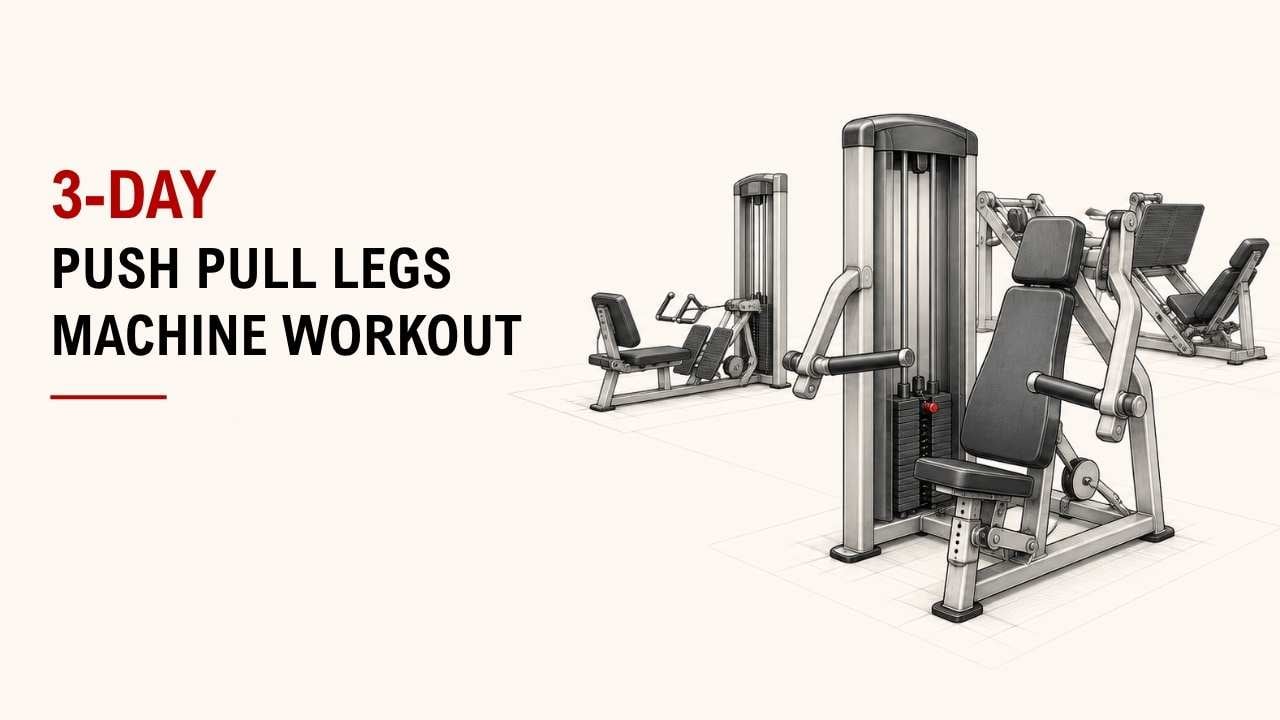

Want a simple machine workout you can follow three days a week without wondering what to train next? A push-pull-legs split gives each workout a clear purpose.
The short answer is: chest, shoulders, and triceps on Day 1, back and biceps on Day 2, and legs on Day 3. Start with 3 sets of 8–12 reps for most exercises, then progress as the weights become easier.
As an Exercise Physiology & Biomechanics Expert at YR Fitness, I study how resistance, exercise selection, and movement paths affect training. I often see fitness lovers make better progress when they stop overcomplicating their routine and focus on consistent, controlled training.
Below is the full workout, plus simple rest and progression guidelines. Follow it one day at a time and adjust the resistance to your current strength.
3-Day Workout at a Glance
Want to see the whole plan first? Here it is.
Day | Training Focus | Main Muscles | Exercises |
Day 1 | Push | Chest, shoulders, triceps | Chest press, incline press, shoulder press, lateral raise, triceps extension |
Day 2 | Pull | Back, rear shoulders, biceps | Lat pulldown, seated row, high row, reverse fly, biceps curl |
Day 3 | Legs | Quads, hamstrings, glutes, hips, calves | Leg press, leg extension, leg curl, hip abductor, calf raise |
The CDC’s guidance on resistance exercise suggests 8–12 repetitions per activity and notes that two or three sets can provide additional benefits.
1. Day 1: Push Machine Workout
Push day trains your chest, shoulders, and triceps. These muscles work together during pressing movements.
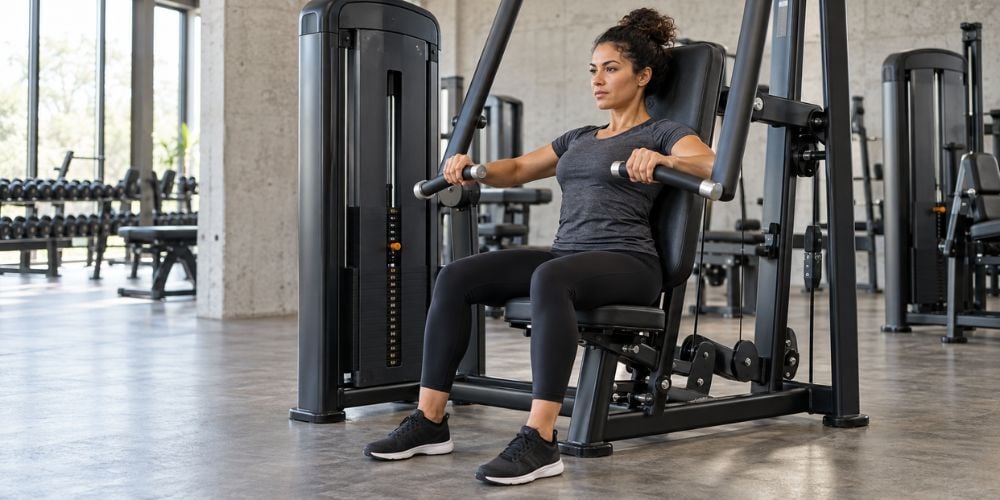
Machine Chest Press
3 sets × 8–12 reps
Set the seat so the handles are around mid-chest level. Press forward, then return slowly without letting the weight pull you back.
Incline Chest Press
3 sets × 8–12 reps
Use a comfortable incline and keep your shoulders down. The angle places more emphasis on your upper chest and front shoulders.
Machine Shoulder Press
3 sets × 8–12 reps
Set the handles around shoulder height. Press upward smoothly while keeping your back against the pad.
I often see people load this machine too heavily. If your back starts lifting or you have to throw the weight upward, reduce the resistance.
Lateral Raise Machine
3 sets × 10–15 reps
Raise your arms to about shoulder height. Keep your neck relaxed and avoid shrugging.
Triceps Extension Machine
3 sets × 10–12 reps
Keep your upper arms stable as you extend your elbows. Control the weight as you return.
Quick question: Should every set feel easy?
No. The final few reps should feel challenging, but you should still be able to keep good form.
2. Day 2: Pull Machine Workout
Pull day focuses on your back, rear shoulders, and biceps.
Lat Pulldown Machine
3 sets × 8–12 reps
Secure your thighs under the pads and pull the bar toward your upper chest. Avoid leaning far backward just to gain more weight.
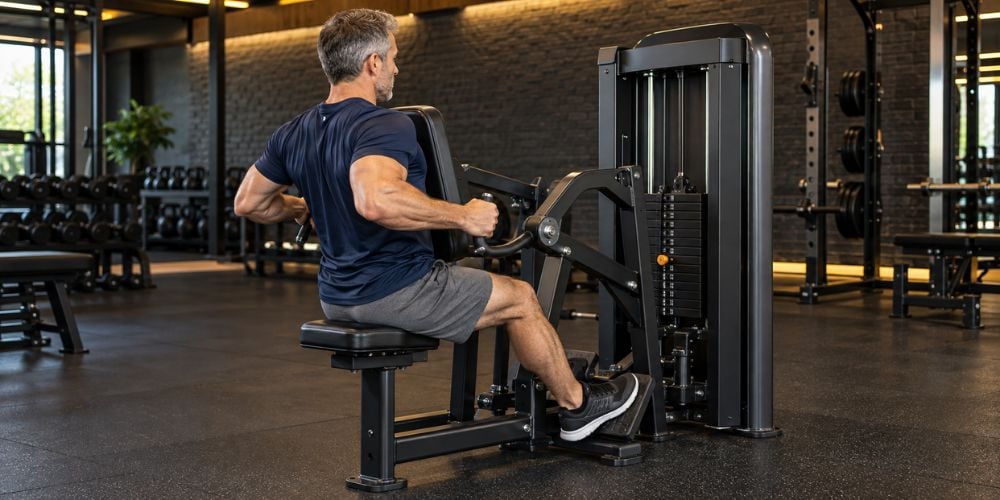
Seated Row Machine
3 sets × 8–12 reps
Pull the handles toward your lower ribs. Squeeze your shoulder blades together, then return slowly.
High Row Machine
3 sets × 8–12 reps
Pull the handles down and back toward your upper chest or ribs. Keep your torso stable throughout the movement.
Reverse Fly Machine
3 sets × 10–15 reps
Keep a slight bend in your elbows and open your arms backward. Use a lighter resistance so you can control full movement.
Biceps Curl Machine
3 sets × 10–12 reps
Keep your upper arms supported as you curl the handles toward you. Lower the weight slowly instead of letting it drop.
Mostly feeling your arms during rows?
Try lowering the resistance. Think about moving your elbows backward rather than simply pulling with your hands.
This simple approach also matches the broader message in the American College of Sports Medicine’s 2026 resistance training guidance: consistency matters more than making a program unnecessarily complicated. ACSM resistance training guidance
If machine workouts are a big part of how you like to train, movement paths and adjustability are worth paying attention to. At YR Fitness, we design commercial strength equipment around practical movement angles and controlled resistance, so you can browse our strength machine range and compare the types of equipment used in routines like this one.
3. Day 3: Leg Machine Workout
Now it is time for your lower body.
Leg day covers your quads, hamstrings, glutes, hips, and calves.
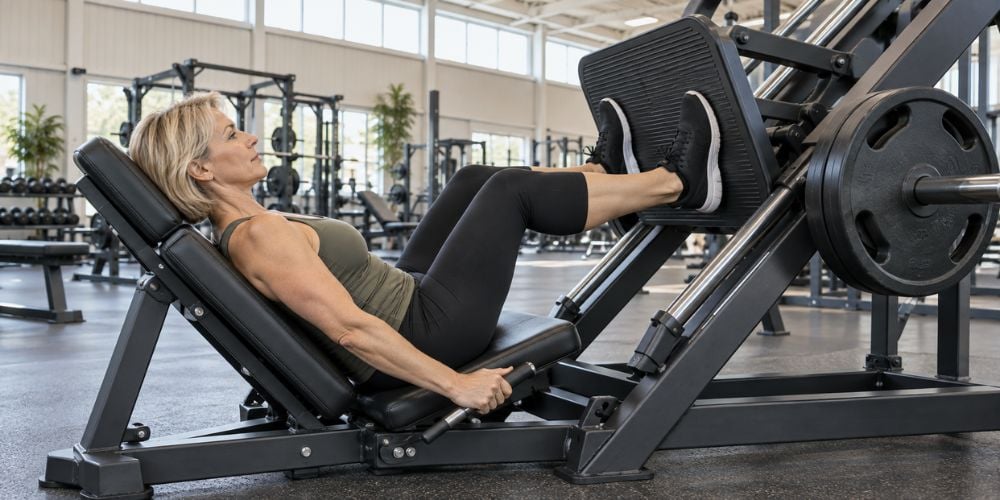
Leg Press
3 sets × 8–12 reps
Place your feet around shoulder width apart. Lower the platform to a comfortable depth, then press upward without aggressively locking your knees.
Leg Extension
3 sets × 10–15 reps
Adjust the machine so your knees line up with its pivot point. Extend smoothly, pause briefly, and lower the weight under control.
Seated or Lying Leg Curl
3 sets × 10–15 reps
Keep your hips stable while bending your knees. Avoid lifting your body away from the pad just to finish the rep.
Hip Abductor Machine
3 sets × 12–15 reps
Push your knees outward slowly. Return under control rather than letting the weight pull your legs inward.
Calf Raise Machine
3 sets × 12–20 reps
Lower your heels until you feel a comfortable stretch. Then push through the balls of your feet and rise as high as you comfortably can.
I prefer controlled calf reps over fast bouncing reps. Slowing down makes it easier to actually use the available range of motion.
4. How Much Rest Should You Take?
You do not need a stopwatch running every second. Use these numbers as a simple starting point.
Situation | Suggested Rest |
Most normal sets | 60–90 seconds |
Hard chest press, rows, or leg press sets | 90–120 seconds |
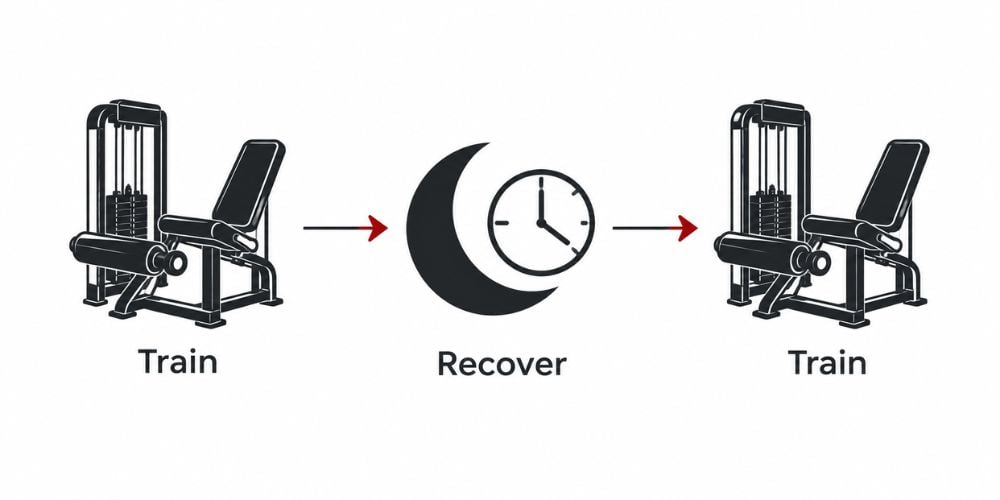
Between training days | About 1 day when possible |
A basic week could look like this:
- Monday: Push
- Tuesday: Rest
- Wednesday: Pull
- Thursday: Rest
- Friday: Legs
- Weekend: Rest or light activity
Do you have to use these exact days?
No. Move the workouts around your schedule.
If you are still unusually sore or tired, taking another recovery day is fine. The goal is to arrive at your next workout ready to train well.
5. How to Progress Each Week
Here is where people often make training harder than necessary.
You do not need new exercises every week. Keep the routine consistent and slowly improve your reps, resistance, or control.
For example:
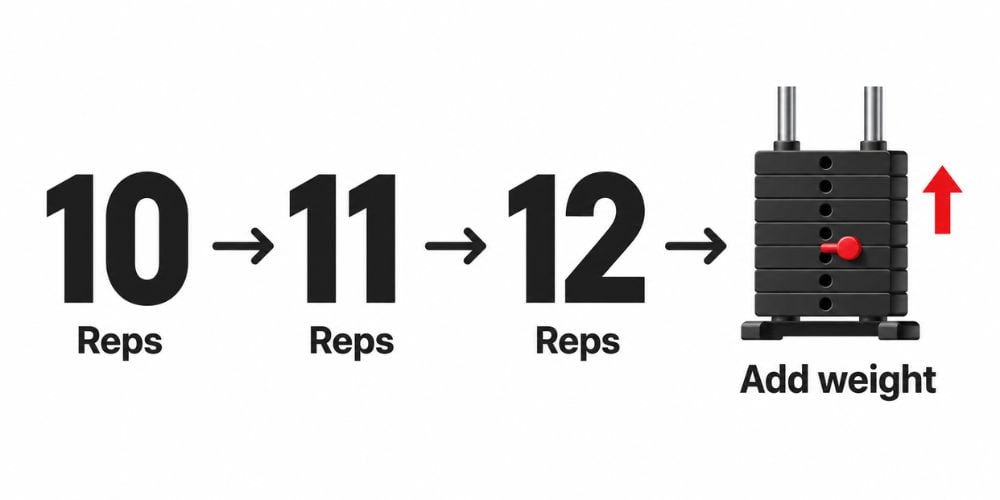
- Week 1: 10 reps
- Week 2: 11 reps
- Week 3: 12 reps
- Next workout: increase the weight slightly and return to around 8–10 reps
Then build back toward 12 reps.
This is a simple way to apply progressive overload. Resistance gradually increases as your body adapts.
ACSM’s current resistance training guidance also supports gradually progressing training rather than relying on complicated programming for the average healthy adult.
What if adding weight ruins your form?
Go back down. More weight only helps when you can still control it.
You can also progress by:
- Adding one rep
- Using slightly more resistance
- Improving your range of motion
- Slowing an uncontrolled rep
- Performing the same workout with better technique
Change one thing at a time. That makes it much easier to see whether you are actually getting stronger.
Conclusion
A 3-day push pull legs machine workout does not need dozens of exercises. Train your push muscles on Day 1, pull muscles on Day 2, and legs on Day 3, then repeat the routine consistently.
Control your reps, recover between workouts, and gradually increase the challenge as you get stronger.
To compare machines for chest, back, shoulders, arms, and legs, browse the YR Fitness strength equipment range and choose equipment that fits the movements you want to train.
Related articles:



