




Commercial Squat Rack Manufacturer in China
Built by athletes, for athletes.
Built tough to handle every strength training.
Built with precise movement angles since 1997.
Products We Have for You
Showing all 2 results


Certified by Global Standards
Backed by CE, TÜV, and ISO certifications so you can buy with full confidence in safety and performance.

DESIGNED By ATHLETES,
FOR ATHLETES
At YR Fitness, Design Transcends Aesthetics.
It’s About Functionality.
Simple, But Significant.


Only True Feedback Counts
Quality Standard of YR Fitness
That’s why we are confident to compete with big brand quality, but at 1/5 price.
Built with Strength: 3.0mm Solid Steel Pipes
We use thick 3.0mm+ Q235 steel pipes for every part of the machine — whether it’s the frame or the training area, no matter the size. With added reinforcement bends, our machines stay strong and steady. No shaking, just solid power.

This is How We Make Your Gym Equipment
Over 20 years, YR Fitness has put $8M into tech—just to bring you better machines.
100% Original Design Since 1997
Because Great Design Makes Great Machines.
Pulley Output Ratio
Leveraging the power of physics, we’ve tailored our pulley output ratio for optimal training. Take our butterfly machines: a 2:1 ratio means a 70kg weight selection delivers a 35kg training load. This higher ratio enhances your workout and saves on weight plate costs.

Compare Our Key Series
73 Series
Heavy-Duty Frame
Pro-Level Movement
High-End Line
61A Series
Durable
Affordable
Best-Selling
C4 Series
Modern Look
Upgraded Fusion
More Features
Quick Comparison At A Glance
Feature | 73 Tough Series | 61A Racing Series | C4 Revival Series |
|---|---|---|---|
Launch Year | 2008 | 2016 | 2025 |
Design Focus | High-end performance and biomechanics | Space-saving, budget-friendly, market-driven | Combines 61A’s simplicity with 73’s advanced features |
Frame Tubing | 75×130×3.0 mm (main) + 58×101×3.0 mm (functional) | 75×118×3.0 mm (main) + 50×120 / 40×80 / 50×100 mm | 150×50×3.0 mm (main) + 50×120 / 40×80 / 50×100 mm |
Aesthetic Design | Parabolic, bold, aluminum accents | Compact and practical | Stylish, modern, fits younger gym aesthetics |
Durability Level | Heavy-duty, custom-engineered components | Very durable, many still running after 20+ years | Same durability level with upgraded styling and adjustability |
Movement Types | Independent converging/diverging paths | Standard movement paths | Includes both standard and independent paths (split models) |
Adjustability | Basic adjustability | Standard user adjustability | Advanced: rotating handles, adjustable pads, backrests, etc. |
Innovation Level | First of its kind globally in 2008 | Refined through years of customer feedback | Integrated innovation from both series + unique new machines |
Series Size | 62 models | 62 models | 74 models (still expanding) |
Target Buyer | High-end gyms, serious training centers | Budget-conscious gyms, franchise chains | Gyms that want both performance and style |
Pricing | Premium | Most affordable | Mid-range, with excellent feature-to-price ratio |
Production Method | Partially handmade due to complex design | Fully industrialized | Industrial production with some specialty detailing |
After-Sales Service | Lifetime support | Lifetime support | Lifetime support |
Let’s Talk

Blake Fisher
Gym Owner from Malaysia
Our members love using this. Super strong with top engineering. Great quality at an affordable price. Smooth to operate, can handle big weights and hits the target muscle. We are very satisfied for these gym machines! We plan on opening another gym once the virus is over.

Jay Dang
Gym Owner from Australia
Commercial quality. Well made. I feel it is just as good as the other top brand benches we have at our club eg Technogym, Matrix etc, but is so much more affordable. All of my order arrived on time and the sales manager was awesome to communicate with. Highly recommend!!!

Steve
Gym Owner from USA
The Quality is very nice, I really like them. All my clients are happy with my new equipment. I will work hard to promote them in Poland.

Allan
Distributor from Poland
Commercial Squat Rack – Definitive FAQ Guide
1. What is the difference between squat rack and smith machine?
A squat rack uses a free barbell that you must balance, while a smith machine has the bar fixed on rails that guide the movement.
In a squat rack, the bar moves freely. The lifter controls the path, balance, and depth. This trains more stabilizer muscles and feels closer to real-life strength work. It also lets advanced lifters use many barbell styles, like low-bar and high-bar squats.
In a smith machine, the bar runs on a fixed track. The machine can feel more stable, but it changes the squat path and can limit natural movement. At YR Fitness, we focus on commercial free-weight equipment that gives a natural movement angle and suits both beginners and advanced lifters in real gym settings.
3. Are commercial squat racks suitable for beginners and advanced lifters?
Yes, a good commercial squat rack is suitable for both beginners and advanced lifters when it is used with the right setup and guidance.
Beginners can start with light weight and simple bar positions. The rack lets them practice proper depth, stance, and bar placement. With clear gym rules and coaching, new members can learn to rack and unrack the bar safely. This helps them build confidence step by step.
Advanced lifters need strong racks that can handle heavy loads and high traffic. Commercial racks are built for this kind of use and are designed for a wide range of users, from new members to serious athletes. At YR Fitness, we manufacture only commercial-use equipment, so our racks are made for long-term abusive use in busy gyms and fitness centers.
5. How much space is needed for a commercial squat rack?
In most commercial gyms, you should plan about a 3 m x 3 m training area for each squat rack, including the working space around it.
The rack itself takes only part of this area. Lifters still need room to load plates, step back, and move safely. You also need space for people to walk past without hitting the bar. Ceiling height matters too, especially for overhead presses and pull-ups.
We at YR Fitness focus on layouts for commercial gyms, not just single products. When you share your room size and expected member flow, we can suggest how many racks will fit while keeping safe walkways and clear lifting zones. Our goal is to help gym owners balance space, safety, and cost-effective commercial quality equipment.
7. What material is used to manufacture commercial squat racks?
Most commercial squat racks are made from heavy-duty steel with a strong frame and a durable powder-coated finish.
A good rack starts with thick steel posts and a solid base. These parts are usually welded and bolted together for strength. The steel is then covered with powder coating to protect it from rust and wear. Many racks also use strong hardware and plastic inserts to reduce noise and protect the bar.
Common materials used include:
- Heavy-duty steel uprights and base frame
- Steel crossbeams and braces for extra stability
- Powder-coated finish for corrosion and scratch resistance
- High-strength bolts, nuts, and washers
- Plastic or nylon inserts on J-hooks and safeties to protect the bar
We at YR Fitness focus on commercial-use equipment, so we choose materials that can handle long-term heavy use in busy gyms. Our racks are built with solid steel frames and durable finishes to reduce maintenance for gym owners. If you are planning or upgrading a strength area, our team can help you match the right rack materials and specs to your budget and training needs.
9. How do I know if a squat rack is stable enough for heavy lifters?
A stable squat rack has a heavy frame, a wide base, secure joints, and little to no wobble when you shake it or re-rack a loaded bar.
You can check stability by looking at the rack weight, base design, and steel thickness. A wider, longer base and cross-bracing usually mean better stability. Racks that allow floor anchoring or have large non-slip feet will also move less. In a commercial gym, you should test how the rack behaves when a strong lifter racks the bar with some speed.
At YR Fitness, we self-design our equipment to follow sound mechanical principles and professional movement angles, which includes stability under load. Our commercial racks are meant for busy gyms and advanced users, so we focus on strong frames and durable joints that can stand years of heavy lifting and high traffic.
11. Is a spotter still needed when using a commercial squat rack?
A spotter is still recommended for heavy or risky lifts, even with a commercial squat rack, but good safety arms can reduce the need in many cases.
For moderate loads and experienced lifters, properly set safety arms or bars can act as a backup if the lifter cannot stand up with the weight. This works best when the safeties are set just below the bottom of the squat. For beginners, very heavy attempts, or max tests, a trained spotter or coach is still a smart practice. Gym rules and staff guidance are also important for safe use.
At YR Fitness, we build racks for commercial use where many members train alone during the day. That is why we focus on strong frames and smart design that work well with safety arms and other accessories, so gym owners can create safer lifting stations and support members at all levels.
13. Does a commercial squat rack support resistance bands?
Yes, many commercial squat racks can support resistance bands, especially models with band pegs or stable anchor points.
Bands can be attached to pegs at the bottom of the rack and looped over the bar to add variable resistance. They are often used for squats, bench press, and deadlift variations. Even without pegs, some racks allow safe band setups using the base or heavy anchors, as long as you follow safe practices. This adds more training options without buying new machines.
At YR Fitness, we keep band use in mind when we design our strength frames. Many of our racks and platforms are suitable for band training in commercial gyms. We can guide you on which models work best with bands and how to combine racks, bars, and flooring for this type of work. This helps you offer more advanced training tools for athletes and serious lifters.
15. Can one commercial squat rack handle multiple users in peak hours?
Yes, one commercial squat rack can handle multiple users in peak hours if you plan the training flow and program well.
Often 2 or 3 members can rotate on the same rack, taking turns between sets. This works well if they follow similar programs and use close weight ranges. Clear gym rules and time limits per station also help. Good layout around the rack keeps people from crowding the area.
At YR Fitness, we design our commercial racks for high-traffic gyms where many users share the same station. Strong frames, easy adjustments, and clear markings make it simpler for people to switch heights and exercises quickly. When you plan your gym, we can help estimate how many racks you need for your member count and training style, so your peak hours stay manageable.
17. How often should a commercial squat rack be inspected and maintained?
A commercial squat rack should be visually checked often, and fully inspected and maintained on a regular schedule, such as monthly and yearly.
Daily or weekly, staff should look for loose bolts, damaged J-hooks, bent safeties, or chipped areas that expose bare metal. Wiping down chalk, sweat, and dust keeps the rack cleaner and slows wear. Monthly, it is good to check all bolts, test the stability, and look for any movement in joints. Any damaged parts should be replaced quickly to avoid risk.
We at YR Fitness recommend that gym owners treat strength equipment like a core asset and give it a simple maintenance plan. Our commercial racks are designed for low maintenance, but regular checks help them stay safe and attractive for members over many years. When you purchase from YR Fitness, our team can share basic care guidelines so your racks keep working well through heavy daily use.
19. How to choose the best squat rack for gym?
To choose the best squat rack for your gym, match the rack type, strength, and size to your space, member level, and budget.
First, decide if you need open squat racks, half racks, or full power racks. Think about your ceiling height, floor space, and how many members will train with barbells. Check the frame material, welding, and max load to be sure it is true commercial quality. Also look at safety options, attachments, and see if the rack can grow with your needs.
We at YR Fitness focus only on commercial-use equipment, so our racks are made to handle heavy traffic and long-term abusive use. Our team often helps gym owners and distributors balance price, quality, and brand so they can stay competitive on member pricing without using low-quality products.
If you share your gym size, target users, and budget, we can suggest specific rack styles and matching equipment to build a well-rounded strength area.
21. What are the advantages of buying squat racks in wholesale?
Buying squat racks in wholesale can lower your cost per unit, keep your brand look consistent, and simplify shipping and after-sales service.
When you order several racks at once, you often get better pricing from the manufacturer. This helps you equip more stations within the same budget. You also receive racks with the same design, color, and hole spacing, which makes your gym look more professional and easier to maintain. Bulk ordering can also reduce shipping cost per piece and simplify customs and logistics.
We at YR Fitness mainly serve gym owners, dealers, and distributors who buy multiple commercial products for their business, not single home users. Our goal is to help partners build profitable projects by offering commercial-quality equipment that can replace big brands at a better price point.
When you choose wholesale orders with us, you also benefit from experienced logistics support, reliable delivery times, and assured after-sales service for your bulk projects.
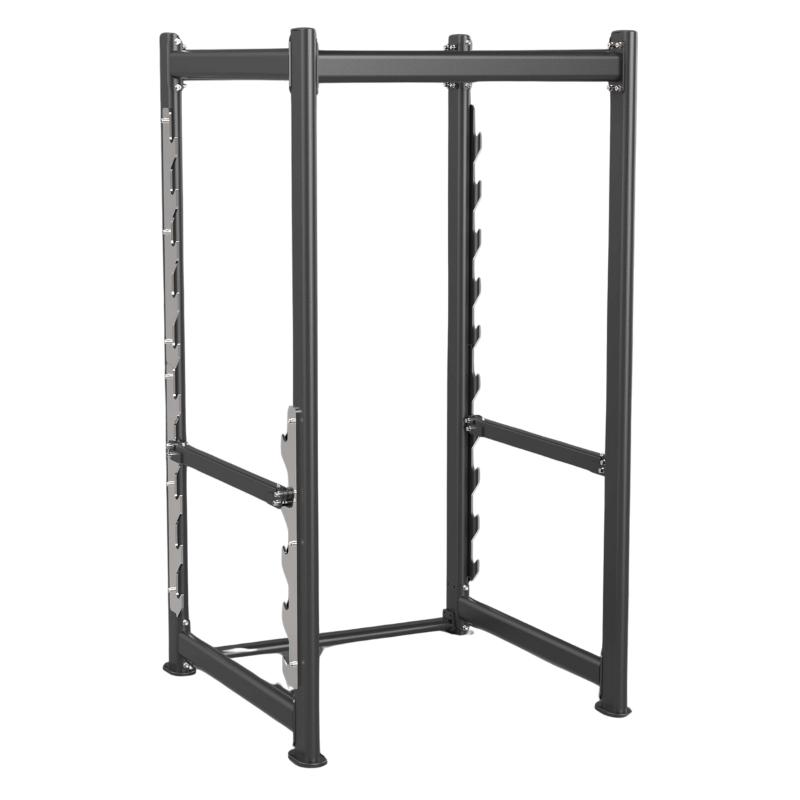
2. What is the difference between squat rack and power rack?
A squat rack is a more open frame mainly for barbell work, while a power rack is a full cage with four posts that offers more built-in safety and more exercise options.
A basic squat rack usually has two uprights or a half frame. It works well for squats, presses, and other barbell lifts, and it uses less space. But it often relies on spotter arms or a human spotter for safety. It suits gyms that want open access and flexible layouts.
A power rack is a full cage with four posts and safety bars or straps inside. Lifters can fail a heavy rep and rest the bar on the safeties, which is helpful in busy gyms. At YR Fitness, we design both open racks and full cages in commercial grade steel, so you can choose the setup that matches your space, safety needs, and member level.
4. What are the dimensions of a commercial squat rack?
Most commercial squat racks are roughly around 220–240 cm high, 120–130 cm wide, and 140–180 cm deep, but exact size depends on the design.
Compact half racks are usually a bit shallower and sometimes shorter, which helps in tight spaces. Full racks or racks with plate storage and pull-up bars may be deeper and taller. Always check the full footprint, including any weight storage and bar overhang. This helps you plan the training lane and walkways around the rack.
At YR Fitness, we design our commercial equipment for real gym floors, not home garages. Our team can share exact dimensions for each squat rack model and help you see how many units you can safely place in your space. We aim to give you a balance of stability, training comfort, and efficient use of your floor area.
6. What is the recommended floor type under a commercial squat rack?
The best floor under a commercial squat rack is thick rubber gym flooring or a lifting platform that can absorb impact and protect the subfloor.
Rubber tiles or rolls help reduce noise, protect the concrete, and keep plates from chipping. They also give lifters better grip for their feet and for the rack’s feet. In most gyms, 10–15 mm rubber is the basic level, and thicker flooring or a platform is used in heavy lifting zones. Good flooring also helps your rack stay more stable over time.
At YR Fitness, we design our commercial racks to work well with standard rubber gym flooring in busy facilities. We suggest that gym owners use heavy-duty rubber in any area where our racks, benches, and platforms are installed. This protects your building, your equipment, and your members, and supports long-term use of our commercial-strength frames.
8. How much weight can a commercial squat rack hold?
A good commercial squat rack usually handles at least 300 kg of load, and many heavy-duty models are rated for 400–500 kg or more.
The real capacity depends on the steel thickness, frame design, and quality of the welds and hardware. In commercial gyms, most members will never reach the top rating, but it is important for safety and for peace of mind. A higher capacity often means less flex and wobble when strong lifters squat or rack the bar quickly. You should always follow the maker’s stated max load.
At YR Fitness, we design our commercial equipment to bear long-term heavy use in real gyms, not just light home training. That means our squat racks and related strength pieces are built with enough capacity and durability to serve both everyday members and serious lifters, while helping gym owners keep member prices competitive compared with big-brand setups.
10. What safety features should a commercial squat rack have for members?
Key safety features for a commercial squat rack include strong J-hooks, adjustable safety arms or bars, clear height markings, and a stable frame.
J-hooks should be shaped to hold the bar securely but still allow a smooth unrack and rerack. Safety arms or safety bars should be easy to adjust and strong enough to catch the bar if a lifter fails a rep. Numbered uprights make it easier for members to set the same height every time. The rack should also have a clear max load rating and a design that keeps the bar path away from sharp edges.
We at YR Fitness design commercial equipment to be safe and effective for a wide range of users, from beginners to advanced athletes. Our products meet international standards like ISO20957 and are widely used in commercial gyms, which helps gym owners offer safe training stations without paying big-brand prices.
12. Can a commercial squat rack be used for other exercises besides squats?
Yes, a commercial squat rack can be used for many barbell and bodyweight exercises, not only squats.
You can use a bench with the rack for flat or incline bench press. Many gym owners also program overhead press, rack pulls, lunges, and good mornings inside or in front of the rack. If the rack has a pull-up bar, members can do pull-ups and hanging core work. This makes each rack a full strength station, not just a squat station.
At YR Fitness, we design our commercial racks to support multi-use training zones. When paired with a quality bench and bar, one rack can cover a large part of your free weight program. This helps you save space and budget while still giving members a full strength experience. Our team can suggest rack setups that match the key exercises you want to offer.
14. What attachments are compatible with a commercial squat rack?
Most commercial squat racks can be paired with attachments like safety arms, pull-up bars, dip handles, band pegs, and plate storage.
The exact list depends on the rack design and upright size. Common add-ons include J-hooks, spotter arms, landmine attachments, bar holders, and weight plate horns. Some racks also support step-up platforms or pulley add-ons. These extras can turn one rack into a full training station.
We at YR Fitness design many of our commercial racks to work with a family of matching attachments. This lets gym owners start with a basic setup and add more pieces later as budget and member needs grow. Our team can help you choose the attachment set that fits your training plan and floor space, so you get more value from each rack.
16. How long does a commercial squat rack last in a busy gym?
A well-built commercial squat rack can last many years in a busy gym, often 8–10 years or more with proper care.
The real lifespan depends on steel quality, welds, coating, and how members treat the equipment. In heavy-use gyms, racks may see hundreds of racking actions every day. If the frame is strong and the coating is durable, wear is usually cosmetic for a long time. Regular checks and simple maintenance also add years of safe use.
At YR Fitness, we build our racks for long-term abusive use in commercial settings, not light home training. Our focus is on solid material, sound structure, and commercial-grade finishes. This helps gym owners reduce replacement rates and keep their free-weight area looking professional. If you share your usage level and budget, we can suggest rack lines that match your expected lifespan.
18. What certifications or standards should a commercial squat rack meet?
A commercial squat rack should follow international fitness equipment standards, such as ISO certifications for safety and quality.
For a busy gym, you want racks that meet recognized standards for strength, safety, and durability. These standards help ensure the design, materials, and load capacity are tested, not random. When you buy from brands that follow strict standards, you reduce risk for members and protect your investment. It also makes it easier to work with insurance and professional clients.
We at YR Fitness build our commercial equipment to meet ISO20957 standards and hold many utility and design patents. This means our strength machines and racks are designed and tested for real gym use, from beginners to advanced athletes.
For gym owners and distributors, this gives confidence that our products follow strict global rules for safety and quality, while still being more cost-effective than many big brands.
20. How much does a commercial squat rack cost?
Commercial squat rack prices vary widely, but they usually cost more than home racks because they use heavier materials and stronger designs.
The price depends on the rack type (simple squat stand, half rack, or full power rack), steel thickness, attachments, and finish. Extra features like pull-up bars, plate storage, and dip handles also affect cost. While a cheaper rack may look similar, it often will not hold up under daily heavy use. For a gym owner, paying a bit more for real commercial quality usually saves money over time.
At YR Fitness, we position ourselves as a professional commercial gym equipment manufacturer that offers high quality at competitive prices, not the cheapest on the market. Our commercial equipment can compete with big international brands in quality, but at a more reasonable price level, which helps gym owners and distributors stay profitable.
22. Can I get customized squat racks?
Yes, many manufacturers, including YR Fitness, can offer customized options for commercial squat racks in bulk orders.
Common custom options include frame color, logo placement, and sometimes small design changes or attachment choices. Customization helps your gym or distribution brand stand out and match your overall design theme. For larger projects, it can also help you serve special training concepts or branding requirements. Custom work usually needs a minimum order and extra lead time.
We at YR Fitness are used to working with distributors and gym owners who need customized commercial equipment for their markets. Our factory can discuss options like color schemes, branding marks, and matched sets of strength equipment, so your squat racks and other machines follow one clean brand image.