




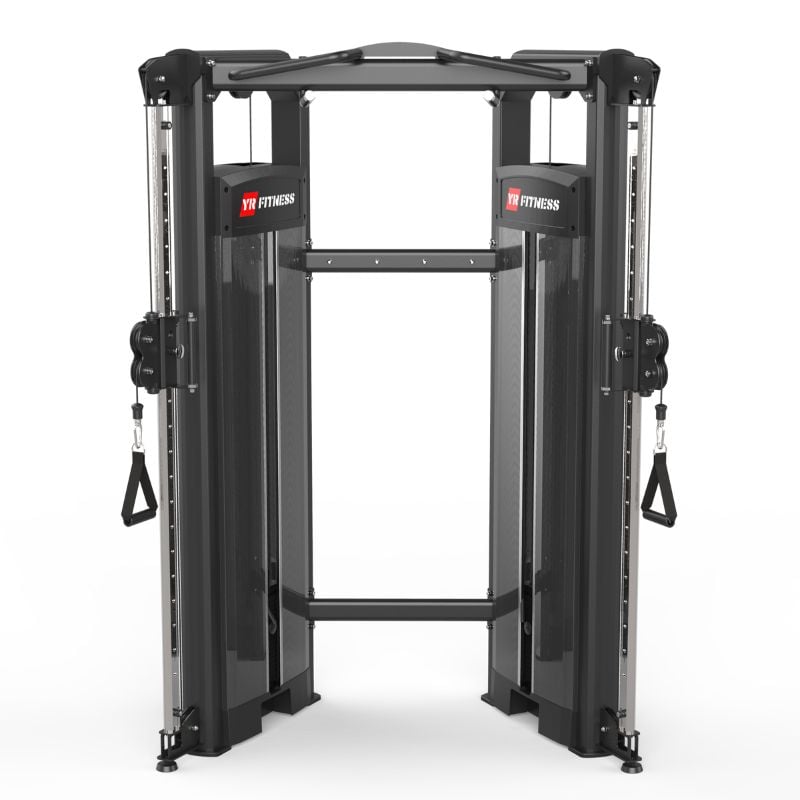
Commercial Functional Trainer Manufacturer in China
Built by athletes, for athletes.
Built tough to handle every strength training.
Built with precise movement angles since 1997.
Products We Have for You
Showing all 7 results
-

Single Functional Trainer
$5.00YR Fitness C4F32D Single Functional Trainer offers a compact design with extended height for greater movement range
-

Functional Trainer
$5.00YR Fitness C432B Functional Trainer offers 60+ exercises in one machine with smooth adjustments and a wide range of
-

Functional Trainer
$5.00YR Fitness 61A32B Functional Trainer delivers smooth, customizable resistance with over 60 exercise options. Its el
-

Smith & Functional Trainer and Power Rack Combo
$5.00YR Fitness Smith & Functional Trainer and Power Rack Combo 8509 is a heavy-duty all-in-one machine for serious
-

Functional Trainer
$5.00YR Fitness 7332A Functional Trainer delivers smooth cable movement and over 60 exercises for a full-body workout. I
-

Smith & Functional Trainer Combo
$4.00YR Fitness Smith & Functional Trainer Combo 8504 is a space-saving machine that combines a smooth Smith system
-

Smith & Functional Trainer Combo
$4.00YR Fitness Smith & Functional Trainer Combo 8502 combines two powerful training systems in one space-saving des
Certified by Global Standards
Backed by CE, TÜV, and ISO certifications so you can buy with full confidence in safety and performance.

DESIGNED By ATHLETES,
FOR ATHLETES
At YR Fitness, Design Transcends Aesthetics.
It’s About Functionality.
Simple, But Significant.


Only True Feedback Counts
Quality Standard of YR Fitness
That’s why we are confident to compete with big brand quality, but at 1/5 price.
Built with Strength: 3.0mm Solid Steel Pipes
We use thick 3.0mm+ Q235 steel pipes for every part of the machine — whether it’s the frame or the training area, no matter the size. With added reinforcement bends, our machines stay strong and steady. No shaking, just solid power.

This is How We Make Your Gym Equipment
Over 20 years, YR Fitness has put $8M into tech—just to bring you better machines.
100% Original Design Since 1997
Because Great Design Makes Great Machines.
Pulley Output Ratio
Leveraging the power of physics, we’ve tailored our pulley output ratio for optimal training. Take our butterfly machines: a 2:1 ratio means a 70kg weight selection delivers a 35kg training load. This higher ratio enhances your workout and saves on weight plate costs.

Compare Our Key Series
73 Series
Heavy-Duty Frame
Pro-Level Movement
High-End Line
61A Series
Durable
Affordable
Best-Selling
C4 Series
Modern Look
Upgraded Fusion
More Features
Quick Comparison At A Glance
Feature | 73 Tough Series | 61A Racing Series | C4 Revival Series |
|---|---|---|---|
Launch Year | 2008 | 2016 | 2025 |
Design Focus | High-end performance and biomechanics | Space-saving, budget-friendly, market-driven | Combines 61A’s simplicity with 73’s advanced features |
Frame Tubing | 75×130×3.0 mm (main) + 58×101×3.0 mm (functional) | 75×118×3.0 mm (main) + 50×120 / 40×80 / 50×100 mm | 150×50×3.0 mm (main) + 50×120 / 40×80 / 50×100 mm |
Aesthetic Design | Parabolic, bold, aluminum accents | Compact and practical | Stylish, modern, fits younger gym aesthetics |
Durability Level | Heavy-duty, custom-engineered components | Very durable, many still running after 20+ years | Same durability level with upgraded styling and adjustability |
Movement Types | Independent converging/diverging paths | Standard movement paths | Includes both standard and independent paths (split models) |
Adjustability | Basic adjustability | Standard user adjustability | Advanced: rotating handles, adjustable pads, backrests, etc. |
Innovation Level | First of its kind globally in 2008 | Refined through years of customer feedback | Integrated innovation from both series + unique new machines |
Series Size | 62 models | 62 models | 74 models (still expanding) |
Target Buyer | High-end gyms, serious training centers | Budget-conscious gyms, franchise chains | Gyms that want both performance and style |
Pricing | Premium | Most affordable | Mid-range, with excellent feature-to-price ratio |
Production Method | Partially handmade due to complex design | Fully industrialized | Industrial production with some specialty detailing |
After-Sales Service | Lifetime support | Lifetime support | Lifetime support |
Let’s Talk

Blake Fisher
Gym Owner from Malaysia
Our members love using this. Super strong with top engineering. Great quality at an affordable price. Smooth to operate, can handle big weights and hits the target muscle. We are very satisfied for these gym machines! We plan on opening another gym once the virus is over.

Jay Dang
Gym Owner from Australia
Commercial quality. Well made. I feel it is just as good as the other top brand benches we have at our club eg Technogym, Matrix etc, but is so much more affordable. All of my order arrived on time and the sales manager was awesome to communicate with. Highly recommend!!!

Steve
Gym Owner from USA
The Quality is very nice, I really like them. All my clients are happy with my new equipment. I will work hard to promote them in Poland.

Allan
Distributor from Poland
Commercial Functional Trainer – Definitive FAQ Guide
1. What is a commercial functional trainer?
A commercial functional trainer is a versatile cable-based strength machine used in professional gyms for full-body workouts. It allows users to perform a wide range of exercises that mimic real-life movements.
This equipment typically consists of adjustable pulleys, weight stacks, and various attachments that make it suitable for all fitness levels. Its adaptability makes it one of the most useful machines for both strength and rehabilitation training. Commercial versions are built with high-grade steel frames and premium components for durability under continuous use.
In professional gyms, trainers use them to enhance movement coordination and strength across multiple planes. Many athletes also rely on this machine to improve performance in functional sports. At YR Fitness, we design our commercial functional trainers to meet these professional demands, combining reliability, ergonomics, and smooth motion performance.
3. What are the parts of a commercial functional trainer?
A commercial functional trainer typically includes a frame, weight stacks, cables, pulleys, and adjustable arms. These components work together to provide smooth and adjustable resistance for different exercises.
Here are the main parts:
- Frame: The backbone, made from reinforced steel for stability.
- Weight stacks: Usually dual stacks, allowing independent or combined use.
- Pulleys and cables: Ensure fluid movement and resistance adjustment.
- Adjustable arms or columns: Let users change pulley height for various exercises.
- Attachments: Handles, ropes, and bars for targeting different muscle groups.
High-end models like those made by YR Fitness include heavy-duty pulleys, precision bearings, and commercial-grade cables rated for thousands of cycles. This ensures consistent performance even in high-traffic gym environments.
5. What is the construction of a commercial functional trainer?
A commercial functional trainer is built with a heavy-duty steel frame, precision pulleys, and coated cables designed for continuous gym use. Its structure prioritizes strength, durability, and smooth motion.
Most models use 11- or 12-gauge steel tubing with a powder-coated finish to resist rust and wear. The pulley system typically includes sealed bearings for consistent performance. Cables are aircraft-grade, coated in nylon to prevent fraying and reduce friction. The weight stacks are precision-machined for smooth and even lifting. High-end designs also integrate counterbalanced arms and laser-cut adjustment holes for accuracy.
The construction ensures both user safety and ease of maintenance. YR Fitness engineers each trainer with premium-grade materials and precision welding techniques, ensuring it performs reliably even under heavy daily use.
7. What is the advantage of the pulley system of a commercial functional trainer?
The pulley system allows for smooth, continuous resistance and adjustable angles for multi-directional training. It provides a natural, fluid motion that reduces joint stress.
Pulley systems enable users to perform functional movements from virtually any position—standing, seated, or kneeling. They help train muscles through full ranges of motion, improving coordination and strength balance. The mechanical advantage of pulleys also allows progressive loading, ideal for rehabilitation or sports training.
In commercial-grade models, the pulley ratio can be adjusted (commonly 2:1 or 4:1) to fine-tune resistance and motion feel. This feature enhances control and versatility. YR Fitness designs pulleys with sealed bearings and precision machining to ensure consistent tension and whisper-quiet operation, giving gyms long-lasting, maintenance-free performance.
9. What is the purpose of commercial functional trainer attachments?
Attachments enhance exercise variety and allow users to target specific muscle groups effectively. They turn one machine into a full-body training system.
By swapping attachments, users can quickly switch between upper-body, core, and lower-body exercises. This flexibility improves workout efficiency and keeps routines engaging. Attachments also help achieve different training goals—from strength and toning to rehabilitation.
They make functional trainers suitable for all fitness levels and training styles. Commercial gyms value this adaptability because it maximizes space utilization. YR Fitness designs attachments that integrate seamlessly with our machines, ensuring secure fitment, comfort, and professional-grade performance.
11. What is the difference between traditional vs functional strength trainers?
Traditional strength trainers isolate specific muscles, while functional trainers work multiple muscles together in dynamic movements. Functional trainers are more versatile and mimic real-life motion.
Traditional machines often use fixed paths and seats, great for focused muscle building but limited in movement variety. Functional trainers, on the other hand, use cables and pulleys to allow freedom of movement across multiple planes. This helps build balance, coordination, and stability while strengthening supporting muscles.
They’re especially effective for athletes and rehab clients who need realistic movement patterns. Many gyms combine both types to cater to different training needs. YR Fitness manufactures both traditional and functional training systems, helping gym owners design balanced facilities that serve beginners and pros alike.
13. How to assemble a commercial functional trainer?
To assemble a commercial functional trainer, follow the manufacturer’s manual carefully, ensuring all frame parts, pulleys, and cables are correctly aligned and secured. Assembly usually requires at least two people.
Start by laying out all components and hardware. Attach the main frame sections, then mount the pulleys and route the cables through them following the diagram. Secure the weight stacks and ensure each cable runs smoothly without kinks. Tighten all bolts evenly and check stability before use.
Always perform a few test repetitions to confirm motion is smooth and balanced. Professional installation is recommended for safety and warranty compliance. YR Fitness provides detailed assembly guides and optional on-site support for all our commercial gym clients to make setup hassle-free.
15. What is the typical weight stack range in a commercial functional trainer?
Most commercial functional trainers feature dual weight stacks ranging from 150 to 220 lbs each. Some premium models offer heavier stacks for advanced users.
The total resistance often doubles depending on pulley ratios—commonly 2:1 or 4:1—meaning smoother motion and fine-tuned control. Lighter stacks are suitable for beginners or rehab exercises, while heavier ones cater to strength-focused athletes. Some models allow optional upgrades to 300 lbs per side.
Gym owners usually select the range based on their clientele. At YR Fitness, our standard trainers feature precision-calibrated stacks from 160 to 220 lbs, with upgrade options for custom builds to meet diverse gym needs.
17. Can a commercial functional trainer be customized for specific gym branding?
Yes, many commercial functional trainers can be customized with your gym’s logo, colors, and specific design details. This adds a professional, branded look to your facility.
Customization options often include powder-coat frame colors, laser-engraved logos, upholstery stitching, and attachment finishes. Branded machines create a cohesive visual identity that strengthens your gym’s image. It’s also a marketing advantage, especially for boutique or franchise gyms.
Customization may slightly affect lead time but enhances perceived value significantly. At YR Fitness, we specialize in OEM and ODM services, allowing clients to personalize their trainers to match their gym’s aesthetic and brand identity without compromising performance.
19. How much space is required to install a commercial functional trainer?
A typical commercial functional trainer requires about 8 to 10 feet of width, 6 feet of depth, and 7 to 8 feet of ceiling height. Additional space is recommended for safe exercise movement.
Compact or wall-mounted models can fit into smaller studios, while dual-stack systems need more clearance for full arm and cable extension. Always account for extra room on both sides for user freedom and attachment changes. Ceiling height is especially important for pull-down and overhead exercises.
Floor surface should be level and non-slip to maintain balance. YR Fitness provides dimension details for every model and offers layout consultation to help gyms optimize space planning and installation safely.
2. What is functional training?
Functional training is a style of exercise that improves strength, balance, and coordination by mimicking everyday movements. It focuses on building functional strength that translates to real-life activities.
The goal is to train multiple muscle groups together rather than isolating them, helping the body work as one coordinated system. For instance, exercises like squats, pulls, and rotations simulate actions like lifting, pushing, or twisting. This approach reduces injury risk and enhances mobility.
Many fitness centers integrate functional training into their routines because it boosts performance efficiency. Athletes and rehabilitation specialists often prefer this style for its practicality and effectiveness. At YR Fitness, our equipment lineup supports this kind of movement-based training, ensuring fluid resistance and biomechanical accuracy.
4. What are the advantages of a commercial functional trainer?
A commercial functional trainer provides versatility, safety, and a full-body workout in a compact space. It supports hundreds of exercise variations for users of all levels.
These machines replace the need for multiple single-function units, saving floor space and cost. They allow bilateral and unilateral movements, perfect for correcting muscle imbalances. The smooth cable resistance ensures constant tension throughout the range of motion. This flexibility makes it ideal for both beginners and advanced athletes.
The dual weight stacks also enable simultaneous use by two people, improving gym efficiency. Furthermore, it enhances coordination and balance while strengthening stabilizer muscles. At YR Fitness, our functional trainers are designed to deliver all these benefits with durable engineering and ergonomic adjustability for long-term reliability.
6. What is a carabiner in a commercial functional trainer?
A carabiner is a metal clip used to attach different handles or accessories to the cable system of a functional trainer. It allows quick changes between attachments during workouts.
Carabiners are typically made from steel or aluminum and designed to handle heavy loads safely. They are spring-loaded, making them easy to open and close with one hand. In commercial gym settings, carabiners make training more efficient since users can switch between ropes, bars, or single handles in seconds.
They’re also key for maintaining secure connections during high-resistance exercises. Regular inspection ensures safety and prevents wear-related accidents. YR Fitness uses industrial-grade, anti-corrosion carabiners in all its commercial models to guarantee long-term reliability and smooth operation.
8. What are the cable attachments for a commercial functional trainer?
Cable attachments are interchangeable accessories used with the trainer’s pulley system to target different muscle groups. Common types include handles, ropes, and bars.
Here are some popular attachments:
- Single handles for isolated arm and shoulder work.
- Tricep ropes for extensions and pull-downs.
- Lat bars for wide-grip back exercises.
- Ankle straps for glute and leg workouts.
- Straight bars for chest, biceps, and rowing movements.
These attachments expand the versatility of the machine, allowing hundreds of exercise variations. YR Fitness provides a wide range of high-quality cable attachments compatible with our trainers, designed with ergonomic grips and heavy-duty construction for comfort and durability.
10. What is a wall mounted commercial functional trainer?
A wall-mounted commercial functional trainer is a space-saving version of the traditional model that attaches directly to a wall. It provides similar functionality in a compact footprint.
These units typically include adjustable pulleys, a single or dual weight stack, and minimal framing. They are perfect for smaller studios, personal training spaces, or hotel gyms where space efficiency is critical. Despite the smaller size, they offer the same range of motion and versatility as full-sized models.
Installation requires a solid wall or reinforced backing to support the machine’s load safely. Wall-mounted trainers often have sleek designs and adjustable pulley heights for versatility. YR Fitness produces wall-mounted trainers with heavy-duty anchor systems and industrial-grade components, offering the same durability and smooth resistance as our freestanding units.
12. What are the qualities to look for in a commercial functional trainer?
A good commercial functional trainer should be durable, smooth, adjustable, and easy to use. Look for models with sturdy construction and reliable pulley systems.
Key qualities include:
- Heavy-duty steel frame for long-term stability.
- Smooth pulley and cable system for consistent tension.
- Multiple height adjustments for versatility.
- Dual independent weight stacks for simultaneous use.
- High-quality attachments for varied exercises.
- Ergonomic handles and grips for user comfort.
Durability and usability are top priorities for commercial environments. At YR Fitness, we ensure every functional trainer undergoes precision testing for load capacity, alignment, and cable performance before shipment—so gym owners can trust their investment for years.
14. What exercises can you do with a commercial functional trainer?
You can perform hundreds of exercises with a commercial functional trainer, targeting every major muscle group. It’s ideal for strength, balance, and flexibility training.
Here are some common examples:
- Upper Body: chest flys, cable rows, tricep pushdowns, bicep curls.
- Lower Body: cable kickbacks, lunges, and hip abductions.
- Core: woodchoppers, twists, and cable crunches.
- Full Body: squats with rows, single-arm presses, and rotations.
Because of its adjustable pulleys, it adapts to any height or angle, making it a go-to for personal trainers and rehabilitation programs. YR Fitness designs functional trainers with dual pulleys and ergonomic handles to make transitions between these exercises fast, fluid, and safe.
16. How do you maintain and lubricate the cables and pulleys?
Regular maintenance involves cleaning, inspecting, and applying silicone-based lubricant to the cables and pulleys. This keeps the motion smooth and prevents wear.
Follow these steps:
- Wipe down cables weekly with a dry cloth to remove dust or sweat.
- Check for fraying, cracks, or rust on cables and replace if needed.
- Inspect pulley wheels and bearings for smooth rotation.
- Apply a light silicone spray every few months to reduce friction.
- Tighten any loose bolts or hardware regularly.
Consistent upkeep extends the lifespan of your equipment and ensures user safety. YR Fitness supplies maintenance kits and replacement parts for our functional trainers, helping gyms minimize downtime and keep machines operating like new.
18. What safety features are built into a commercial functional trainer?
Commercial functional trainers include several safety features such as cable guards, sturdy frames, and smooth pulley motion to prevent accidents. The design prioritizes controlled movement.
Other safety features include:
- Heavy-duty construction to prevent tipping or instability.
- Protective covers over weight stacks and cables.
- Locking pins for height and handle adjustments.
- Rubber foot pads for floor grip and shock absorption.
- Even weight distribution to reduce sudden jerks or imbalance.
These ensure users can train confidently across all motion ranges. YR Fitness integrates all these safety measures into our commercial line and tests every unit for stability, tension consistency, and compliance with international safety standards.
20. What certifications or quality standards should a commercial functional trainer meet?
A high-quality commercial functional trainer should comply with international standards like ISO, EN957, and CE certifications. These ensure safety, durability, and performance.
Certifications verify that the machine’s materials, load capacity, and construction meet rigorous testing protocols. Some brands also adhere to ASTM or TUV standards, which further guarantee reliability. For commercial gyms, certified equipment reduces liability risks and ensures longevity under constant use. Always check that the supplier provides proper documentation and testing reports.
YR Fitness manufactures all our functional trainers under ISO-certified processes and CE-compliant designs, ensuring each unit meets global commercial gym standards for safety and performance.