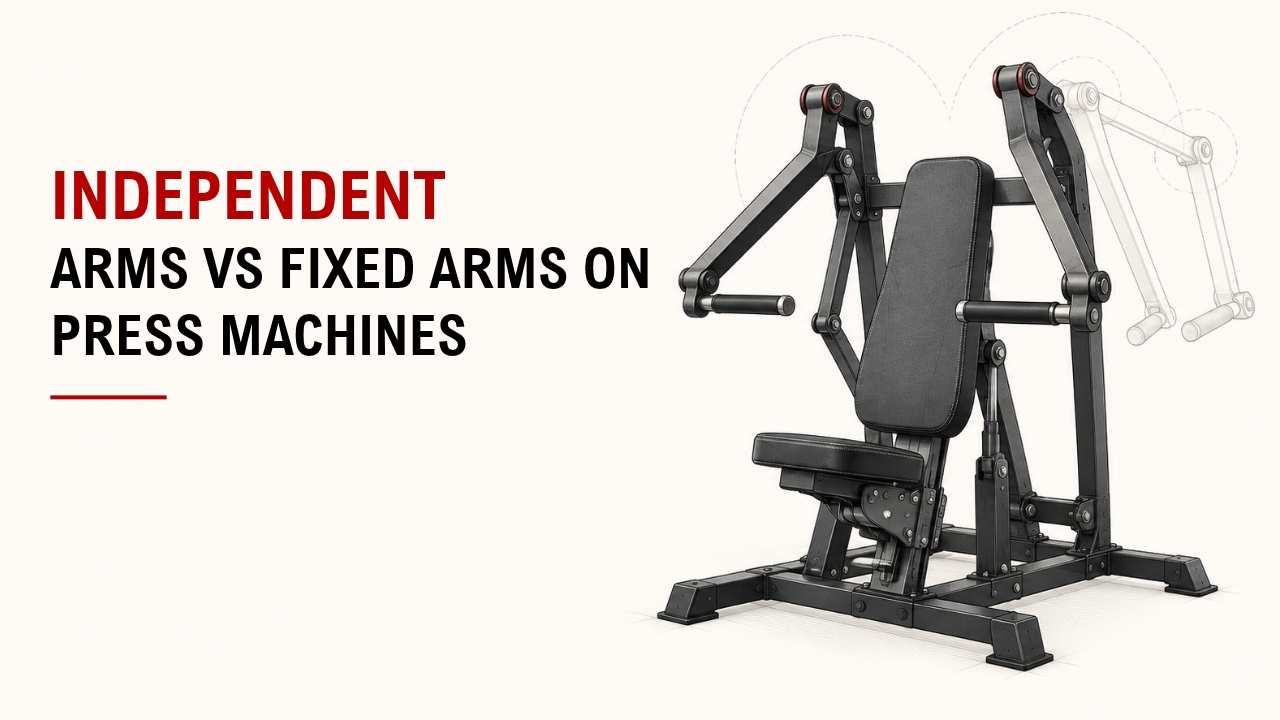

Have you noticed that some press machines move each arm separately, while others move both together? The difference changes how stable and controlled the press feels.
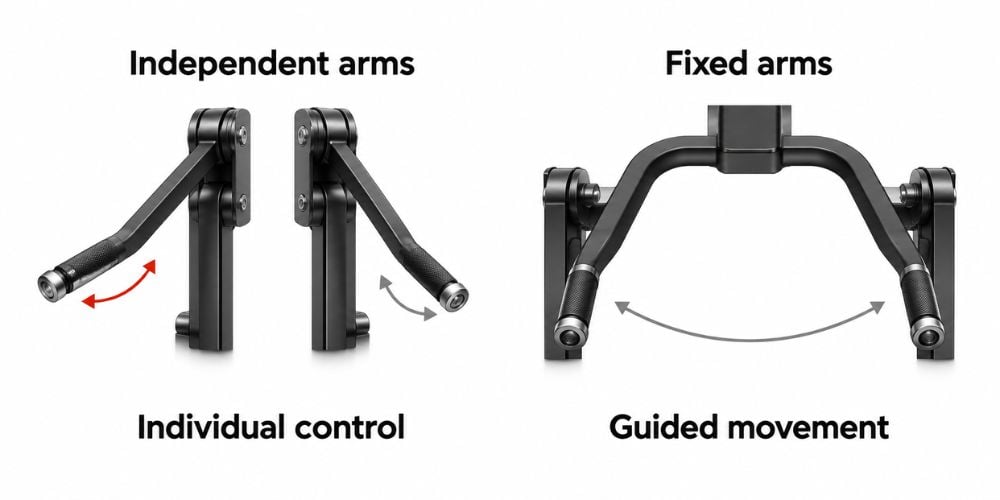
The short answer is simple: independent arms give each side more freedom, while fixed arms move together on one path. One gives you more individual control, while the other feels more guided.
As the founder and chief designer of YR Fitness, I have spent decades working with press-machine movement and design. In my experience, both styles work well when they match how you prefer to train.
Below, I will compare how they feel, muscle balance, stability, and which one may suit you better. Keep scrolling to see the difference.
Independent Arms vs Fixed Arms at a Glance
Want the difference first? Here it is.
Feature | Independent Arms | Fixed Arms |
Arm movement | Each side moves separately | Both sides move together |
Left-right control | Higher | Lower |
Stability | Slightly more control required | More guided |
Weak-side awareness | Easier to notice | Less obvious |
Coordination | Slightly higher | Lower |
Training feel | More individual freedom | More connected and predictable |
Best for | Side-to-side control | Simple, stable pressing |
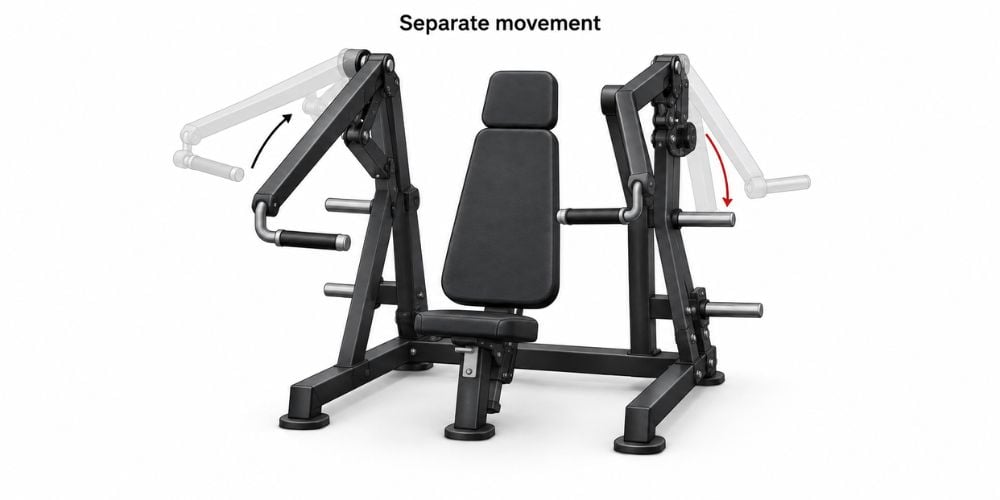
One detail is worth clearing up: independent arms do not mean you have to train one arm at a time. You can still press both arms together; the two levers simply are not mechanically tied to each other.
1. How Independent Arms Feel
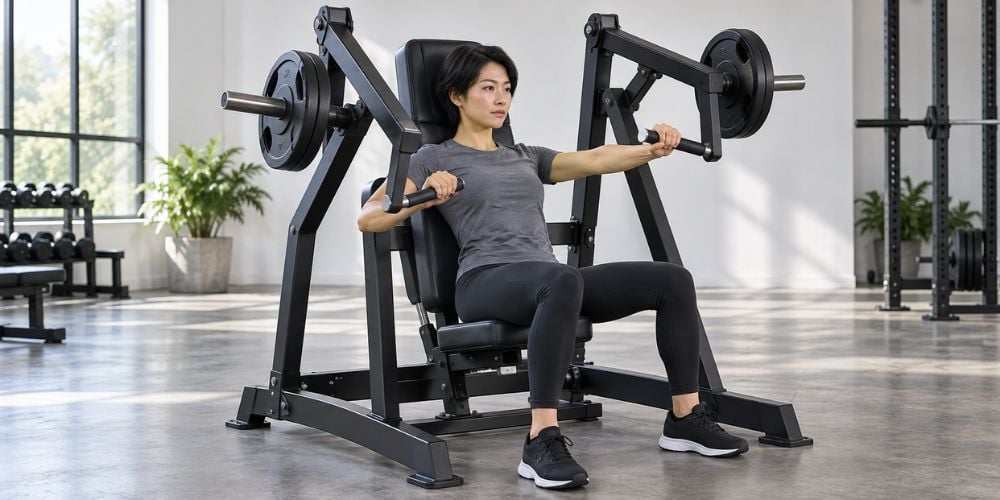
On an independent-arm press machine, each handle moves on its own lever.
Your right and left arms do not have to move at exactly the same speed. If one side starts slowing down, you will usually notice it quickly.
You may also find that:
- Each arm has to contribute to the press.
- Your weaker side is easier to identify.
- You get more left-to-right control.
- The movement may feel closer to pressing dumbbells.
- You can train one side at a time if the machine allows it.
Imagine your right arm is slightly stronger. It might finish the rep while your left side is still fighting through the last part of the movement.
An independent-arm machine makes that difference harder to hide.
Quick takeaway: Choose independent arms if you like controlling each side separately.
2. How Fixed Arms Feel
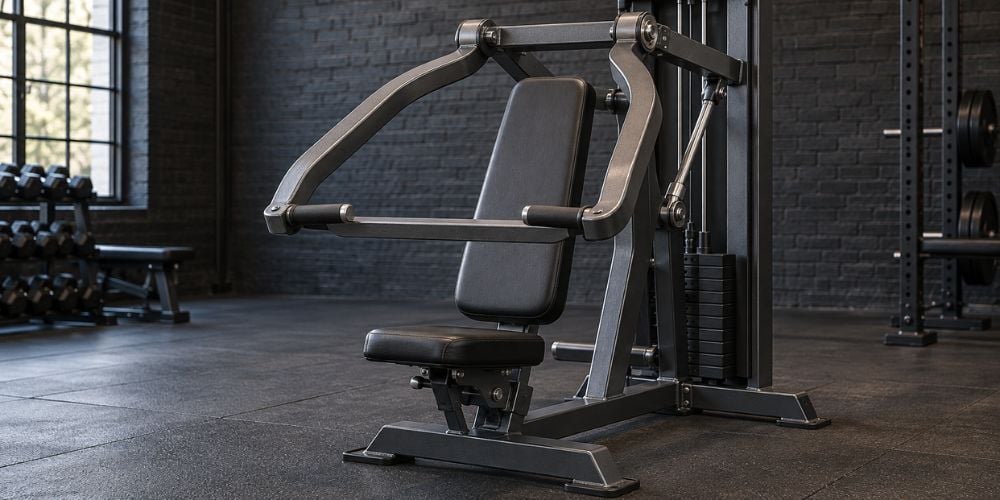
Fixed arms work differently. Both handles are connected to the same movement system, so they travel together.
That normally creates a more stable and predictable press.
You have less to manage from side to side, which can make it easier to:
- Focus on pushing the weight.
- Follow a consistent movement path.
- Use less coordination.
- Learn the basic pressing motion.
- Concentrate on your chest, shoulders, and triceps.
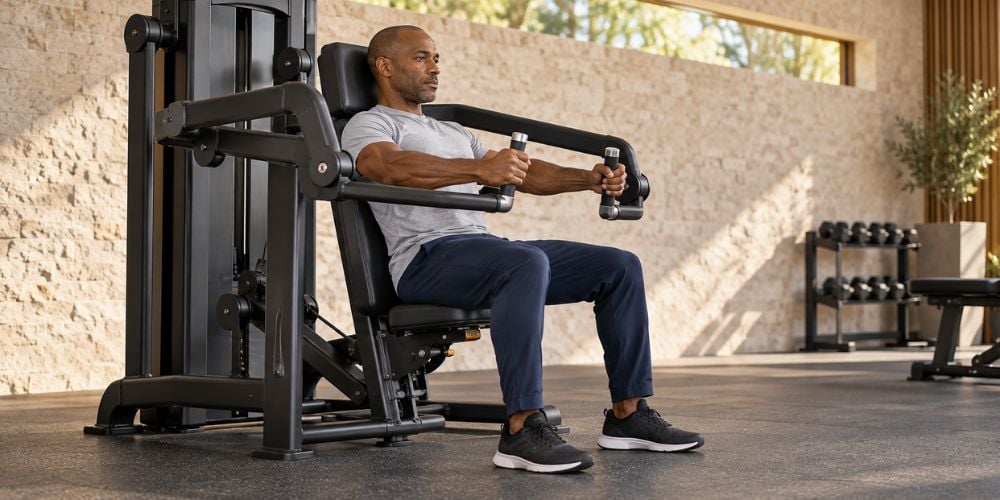
This is one reason beginners often feel comfortable on a fixed-arm press. You adjust your position, grip the handles, and follow the machine.
Setup still matters, though.
The ACE seated chest press guide recommends adjusting the seat so the handles sit around mid-chest level, keeping your back supported, wrists neutral, and feet stable.
Those basics apply no matter which arm design you use.
Quick takeaway: Choose fixed arms if you want a straightforward and stable press.
3. Which Is Better for Muscle Balance?
If you want to pay closer attention to differences between your left and right sides, independent arms have the advantage.
Why?
Each arm controls its own lever. If your left side starts slowing down before your right, you can see and feel it.
That does not mean fixed-arm machines cause muscle imbalances. Both designs can train your chest, shoulders, and triceps effectively.
Research also gives us some useful context here.
A 2025 systematic review and meta-analysis comparing unilateral and bilateral resistance training found no significant difference in muscle hypertrophy between the two approaches. Strength improvements were more specific: unilateral training favored unilateral strength, while bilateral training favored bilateral strength.
Keep in mind that independent-arm machines and unilateral training are not exactly the same thing. Still, the research supports a useful point: one style does not automatically build more muscle just because each side can move separately.
So what is the real benefit?
Independent arms simply make your left-to-right performance easier to monitor.
If you enjoy press machines that let each side move naturally while still giving you machine support, explore the strength equipment from YR Fitness. We design our pressing movements around handle position, movement angles, stability, and a smooth training feel—not just whether the arms are connected.
4. Which Is Better for Stability?
For stability, fixed arms usually have the edge.
Because both handles move together, there is less independent movement to control. You can spend more attention to pressing and less on keeping both sides synchronized.
Why does that matter?
It can be useful when you want to:
- Keep each rep consistent.
- Focus on the target muscles.
- Reduce coordination demands.
- Push through a predictable path.
- Learn the movement before adding more challenge.
Independent-arm machines are still very stable compared with free weights. They simply give each arm a little more freedom.
That extra freedom is not automatically better or worse.
Think of it this way:
More guidance: Fixed arms
More individual control: Independent arms
The machine’s overall design matters too. Seat position, handle angle, back support, pivot placement, and resistance curve can change the exercise just as much as the arm configuration.
5. Which Should You Choose?
Still not sure?
Start with what you want from the exercise.
If You Want… | Better Starting Choice |
Each arm to work separately | Independent arms |
Easier detection of a weaker side | Independent arms |
More left-to-right control | Independent arms |
Ability to press one side at a time | Independent arms |
A simple pressing movement | Fixed arms |
More guidance | Fixed arms |
Less coordination | Fixed arms |
A predictable movement path | Fixed arms |
If you already enjoy dumbbell pressing, independent arms may feel familiar because each side has more freedom.
On the other hand, if you like sitting down and concentrating on a smooth, stable press, fixed arms may suit you better.
What about muscle growth?
Do not choose based only on the assumption that one design builds more muscle.
The updated American College of Sports Medicine resistance-training position stand reviewed 137 systematic reviews involving more than 30,000 participants. It found that resistance training improves strength and muscle size, while equipment type itself did not consistently change training outcomes.
So focus on the basics:
- Does the machine fit your body?
- Can you use a comfortable range of motion?
- Does the movement feel smooth?
- Can you control the weight?
- Can you train consistently and gradually progress?
You can also use both designs.
A fixed-arm press can work well when you want simple, stable sets. An independent-arm press can be useful when you want more control over each side.
There is no need to turn it into an either-or decision.
Conclusion
Independent-arm and fixed-arm press machines can both train your chest, shoulders, and triceps effectively.
The difference is straightforward: independent arms give each side more freedom, while fixed arms provide a more connected and stable movement. Choose independent arms when left-right control matters to you, or fixed arms when you prefer a simpler guided press.
If you want to try press machines designed around comfortable movement angles, stable support, and smooth resistance, at YR Fitness we build strength equipment with the complete pressing movement in mind. Explore our equipment and see which pressing style feels right for the way you train.
Related articles: