





Adding small-group classes but not sure what equipment you really need? Start simple and focus on versatile tools.
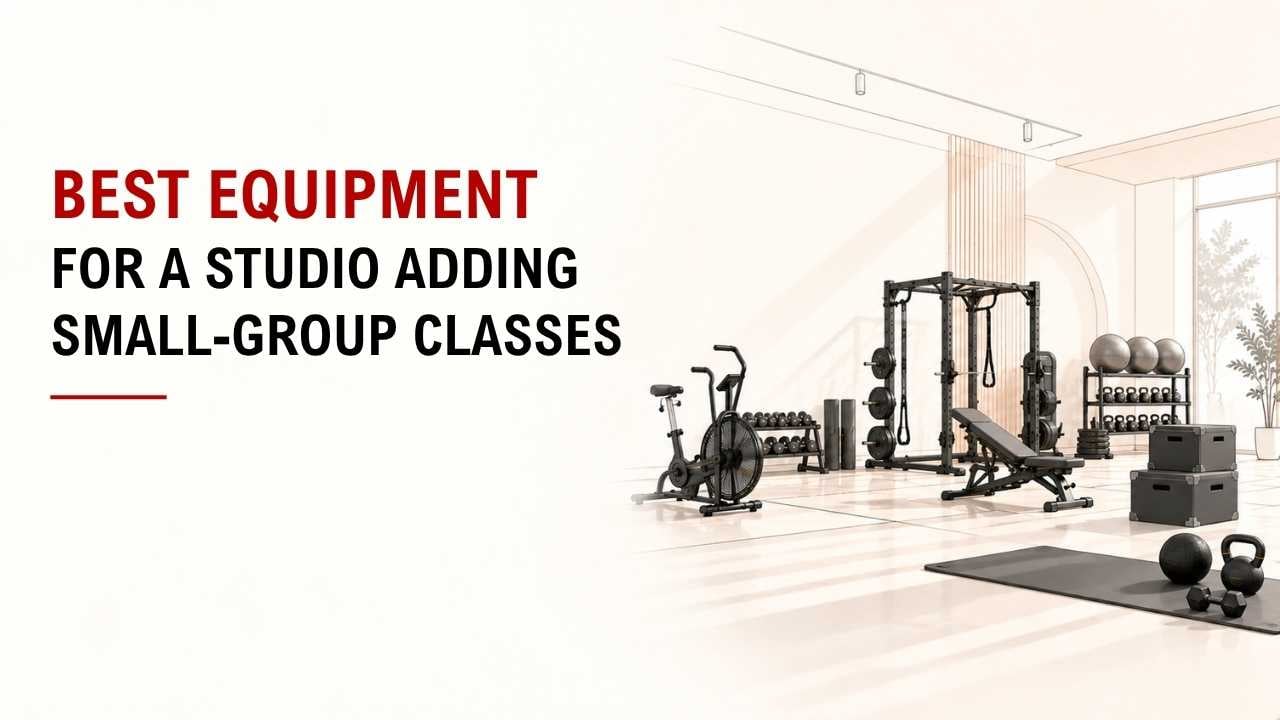
The best choices are dumbbells, kettlebells, adjustable benches, a functional trainer, a squat rack, and resistance bands. Together, they cover most strength and conditioning workouts.
As an Exercise Physiology & Biomechanics Expert at YR Fitness, I study how equipment affects movement, comfort, and training flow. I have seen that the best setups are usually the ones that keep exercises simple, safe, and easy to switch between.
Below are the six equipment choices I would prioritize first. Each one adds useful training options without making the space feel crowded.
a Glance
Want the quick version first?
Equipment | Best For | Space Needed | Exercise Variety |
Dumbbells | Full-body strength | Low | Very high |
Kettlebells | Strength and conditioning | Low | High |
Adjustable benches | Presses, rows, step-ups | Medium | High |
Functional trainer | Full-body cable exercises | Medium | Very high |
Squat/half rack | Barbell strength | Medium–high | High |
Resistance bands | Warm-ups and accessory work | Very low | High |
The main goal is not to own the most equipment. It is to have enough variety to keep people moving from one exercise to the next.
1. Dumbbells
If you only start with one type of equipment, dumbbells are one of the easiest choices.
You can use them for:
- Goblet squats
- Lunges
- Shoulder presses
- Chest presses
- Rows
- Romanian deadlifts
- Biceps curls
- Triceps exercises
Why do they work so well?
Several people can train at the same time, and changing exercises takes only a few seconds.
I usually recommend having several pairs of commonly used weights rather than one pair of every possible weight. It reduces waiting and makes circuit training much smoother.
Dumbbells also make it easy to adjust resistance for different fitness levels. The American College of Sports Medicine’s resistance-training guidance emphasizes matching resistance training to the person’s ability and training goal.
Best for: Strength circuits, full-body workouts, and beginner classes.
2. Kettlebells
Kettlebells are compact, easy to move, and useful for both strength and conditioning.
Try them for:
- Kettlebell swings
- Goblet squats
- Deadlifts
- Carries
- Lunges
- Presses
- Rows
One kettlebell can cover a surprising number of movements.
For example, the ACE kettlebell exercise library includes exercises ranging from presses to full-body integrated movements.
I like kettlebells in group sessions because you can build a whole circuit without taking over the room. They also move easily between stations.
Keep several weights available so beginners and stronger users can perform the same workout at an appropriate level.
Best for: Functional training, strength work, and conditioning.
3. Adjustable Benches
A bench looks basic, but it gives you a lot more exercise options.
You can use it for:
- Flat dumbbell presses
- Incline presses
- Seated shoulder presses
- One-arm rows
- Step-ups
- Bulgarian split squats
- Seated curls
Here is why adjustability matters.
A bench that moves between flat, incline, and upright positions can support far more exercises than a fixed bench.
I also prefer benches that adjust quickly. In a small-group workout, nobody wants to spend time struggling with a seat or backrest mechanism.
Best for: Dumbbell strength training and variety of exercise.
Need benches, cable stations, or strength equipment that can handle regular group use? At YR Fitness, we build commercial equipment for frequent daily training, so you can compare versatile options before deciding what fits your space.
4. Functional Trainer or Cable Machine
Want one machine that can handle a long list of exercises?
A functional trainer is one of the most versatile options.
You can perform:
- Cable rows
- Chest presses
- Lat pulldowns
- Triceps pushdowns
- Biceps curls
The adjustable pulleys let you change the height and direction of resistance.
That matters because a row, lateral raise, pushdown, and rotation all need different cable positions.
I often see cable machines work especially well in circuits. One person can use the cable station while others work with dumbbells, kettlebells, benches, or bands.
Best for: Full-body strength training and compact studio layouts.
5. Squat Rack or Half Rack
If your workouts include heavier strength training, a squat rack or half rack becomes much more useful.
You can use it for:
- Barbell squats
- Overhead presses
- Rack pulls
- Bench presses
- Pull-ups
- Some resistance-band exercises
For smaller rooms, a half rack can make more sense because it generally takes up less floor area than a full power rack.
What should you check?
Look for:
- Strong uprights
- Stable construction
- Adjustable J-hooks
- Safety arms or spotters
Safety should come before extra features.
I would not add several racks unless barbell training is a major part of the workout. In many setups, one or two stations can complement dumbbells, cables, and other equipment without taking over the room.
Best for: Strength-focused classes and barbell training.
6. Resistance Bands
Resistance bands may be simple, but they are extremely useful when several people are training together.
They are:
- Cheap
- Light
- Easy to store
- Easy to carry
- Suitable for different fitness levels
Use them for:
- Warm-ups
- Glute exercises
- Rows
- Shoulder exercises
- Mobility work
The biggest advantage?
Everyone can have their own band.
The ACE Exercise Library includes dozens of movements using resistance bands and cables, which shows how much exercise variety you can get from a very simple training tool.
Keep several resistance levels available, so beginners and more experienced users can perform the same exercise at different difficulty levels.
Best for: warm-ups, accessory exercises, mobility, and circuit stations.
Which Equipment Should You Buy First?
Still not sure where to begin?
Start with equipment that gives you the most exercises with the least setup.
Priority | Equipment | Why Start Here? |
1 | Dumbbells | Huge exercise variety and easy to share |
2 | Kettlebells | Compact and good for strength or conditioning |
3 | Adjustable benches | Makes dumbbell training much more versatile |
4 | Resistance bands | Cheap, compact, and easy to give to everyone |
5 | Functional trainer | Adds many cable exercises from one station |
6 | Squat or half rack | Best when heavier barbell work becomes important |
The first four options are easy to share, easy to move, and useful across many exercises.
The functional trainer and rack can then add more training options as your workouts become more strength-focused.
Do you need everything at once?
No.
A good small-group workout depends more on exercise variety, smooth transitions, and smart programming than on having a huge equipment collection. Start with the basics and add equipment when you can clearly see a reason for it.
Conclusion
The best small-group equipment is equipment that can do more than one job.
Start with dumbbells, kettlebells, adjustable benches, resistance bands, a functional trainer, and a rack, then expand only when you actually need more options.
If you are ready to compare commercial benches, racks, cable machines, and strength equipment, explore YR Fitness. Our equipment is designed for regular, heavy use, giving you a practical place to start when building a more complete training setup.
Related articles: